
Physical Traits Blur Jewish-Arab Identity in Middle East
Jews and Arabs share Semitic roots and practices like circumcision, making visual distinction difficult. The debate touches on genetics and identity.
English · Original discussion in Spanish · Published
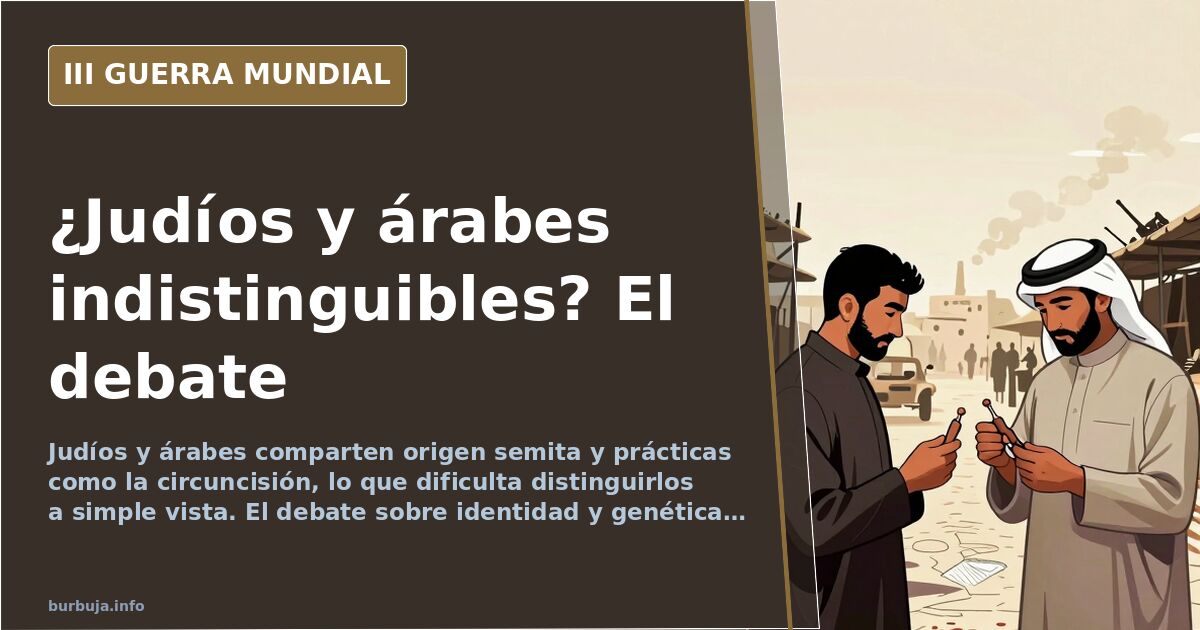
Traits, uniforms and the difficulty of telling them apart
The discussion on whether Israeli Jews and Palestinian or Lebanese Arabs can be visually distinguished has resurfaced strongly. A recurring observation is that without uniforms, many young people from both groups share a physical profile that makes distinction hard for outsiders. The controversy extends to genetics, migration history, and the political use of collective identities.
Common Semitic origin and historical migrations
Some analyses argue that Jews and Arabs share a Semitic origin, explaining physical similarities. It is claimed that Ashkenazi Jews, from Eastern Europe, have majority European genetic ancestry, while Mizrahi and Sephardic Jews are closer to Middle Eastern populations. This distinction challenges the homogeneity of the Jewish people and their link to the territory.
Others go further, claiming modern Palestinians are direct descendants of ancient Jews, while Ashkenazim are a modern invention. This thesis, attributed to Israeli historian Shlomo Sand in his book "When and How the Jewish People Was Invented," sparked intense academic and political debate. The book remained on Israel's bestseller list for four weeks, according to data cited in the discussion.
Circumcision as a common practice
Another highlighted point is circumcision, shared by Jews and Jovenlandeses. Most Jovenlandeses worldwide are circumcised, like Jews, reinforcing the idea of intertwined origins and customs. According to this view, the difference lies in motivation: religious reasons for some, cultural or hygienic traditions for others.
It is noted that circumcision is common in the United States, South Korea, and Australia for hygiene reasons, while it remains a minority practice in Europe. This geographic disparity argues that circumcision is not an exclusive identity marker for any group.
Yiddish and the European roots of Ashkenazim
The debate over Yiddish is also central. It is stated that this language originates from Germanic dialects, specifically Swabian (Schwäbisch), not Lombard as some claim. The phrase "Bei mir bist du die scheenste uf der Welt" is cited as evidence of Yiddish's closeness to German.
This linguistic issue supports the thesis that Ashkenazim have European rather than Semitic origins. However, others remind us that Jewish belonging is transmitted matrilineally, relativizing the importance of genetics in defining Jewish identity.
Political use of identities and current conflict
The backdrop is the Middle East conflict. It is argued that the inability to visually distinguish Jews from Arabs challenges the narrative of two irreconcilable peoples. Some participants note that violence and mutual hatred stem not from obvious physical differences, but from political and religious constructions.
Emperor Hadrian’s ban on circumcision and Sabbath, and his order to burn the Talmud, are mentioned as historical examples of attempts to erase identity practices. This illustrates that persecution and forced assimilation have been constant in the history of both peoples.
Open conclusions and pending data
The debate reaches no definitive conclusion. While some insist on physical indistinguishability and genetic mixing, others defend differentiating traits and a Jewish identity cohesive through religion and history. What is clear is that perception of differences varies by observer and context.
The discussion on physical traits and identity in the Middle East remains open. Genetic and historical data provided do not settle the issue, and the political conflict continues to condition any analysis.
Also available in: Deutsch
Summary of a discussion on Burbuja.info - Foro de economía, actualidad y política., translated from Spanish and reviewed before publication. Read the full discussion (166 replies).
More summaries
-
Israel controls 800 meters in Lebanon after ground invasion
Israeli forces hold three points within a kilometer of the Lebanese border as Gallant admits more open fronts and rising casualties.
-
Man thrown by explosion after kicking booby-trapped Palestinian flag
A man is injured by a booby-trapped Palestinian flag in Israel. Minor wounds reported, but unverified video sparks debate.
-
Gaza child death reignites debate over civilian casualties
The killing of a Palestinian girl in an Israeli airstrike reopens the debate on responsibility for civilian deaths and propaganda.
-
Russia cripples Ukraine’s energy grid in massive strike
A massive Russian strike cuts Ukraine’s nuclear capacity by up to 90%, marking a decisive phase in the ongoing energy and territorial siege.
-
Forced conscription in Ukraine: street round-ups caught on camera
Videos of forced conscription in Ukraine show street round-ups, bribes to dodge the draft, and the mobilization of women and people with disabilities.
-
Gisbert on the clash between NATO, Russian gas and the EU
Rubén Gisbert, who predicted the Russian invasion, now questions NATO's role in Ukraine: gas, the dollar and a Europe left paying the energy bill