
Man thrown by explosion after kicking booby-trapped Palestinian flag
A man is injured by a booby-trapped Palestinian flag in Israel. Minor wounds reported, but unverified video sparks debate.
English · Original discussion in Spanish · Published
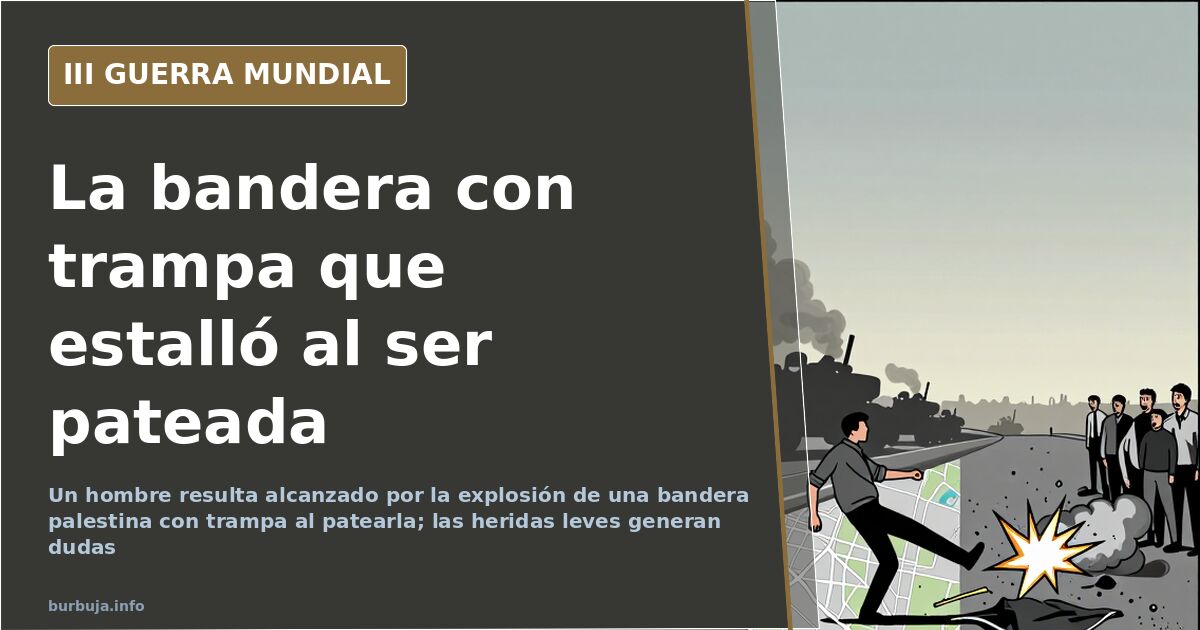
Kicking a booby-trapped Palestinian flag: The explosion throws the man
A vehicle stops in an open field. A man gets out, walks a few meters through tall grass, and kicks a Palestinian flag planted in the ground. The flag was rigged. The deflagration is instantaneous, and circulating images show an object flying through the air, far to the right of the frame. Early TV reports mentioned minor injuries. That specific phrase is what ignited the controversy.
The incident occurs within the Israeli-Palestinian conflict and antiestéticatures the elements of a textbook trap: a symbolic, conspicuous, and cheap object placed where someone rushing or angry will touch it without looking first. On the other side, a person who, according to circulating versions, was armed.
What is known about the injured man who kicked the booby-trapped flag
The most repeated account identifies the protagonist as an Israeli settler driving across open terrain. He gets out, walks, and kicks. The explosion hits him directly. This detail—the identity and the weapon—is not confirmed by any independent source and should be treated as such: a version spreading from video to video.
Medical consequences are the most disputed part. One generalist network reported damage classified as minor. Another version, spread via messaging channels, claimed the victim suffered very serious leg injuries. These two accounts do not match, and this contradiction is central to much of the discussion. Some even argue the video is unverified and could be a montage.
Why a flag on the ground works as bait
Placing explosives in everyday, visible objects is not new in this conflict. The most repeated comparison is with ETA, which at various stages used plastic bags with explosive charges or traps attached to conspicuous items, precisely hoping someone would kick them. Several Spanish media outlets covered such episodes, cited here as direct precedents.
The list of historical examples in the discussion is long: Vietnam, rigged objects during World War II—even musical instruments, according to one cited example—or grenades hidden under bodies on the Ukrainian front. The pattern repeats. No specific target is attacked: a hook is left, and one waits.
The person placing it relies on something that almost never fails: the curiosity, anger, or haste of whoever arrives.
Procedure for those suspecting a trap
Against impulsive reactions exists the inverse protocol: do not approach, tie a rope to the object, move away, and pull from a distance. Unwind the ball, make a knot, lie on the ground, and stretch from afar. The description is nearly textbook and summarizes in two lines the miscalculation that caused the scare.
The complete sequence—how many seconds pass between getting out of the car and the explosion, exactly what is seen in each frame—has become the most consulted material of the case and is not broken down here. Those wishing to reconstruct it must refer to the original images.
"Minor injuries": The word nobody believes
An object flying several meters from the explosion point is rarely compatible with the label minor injuries. That intuition pervades the entire issue. The most cited analyses break down the video frame by frame: in one, the head is distinguishable; in the next, the flying object appears displaced to the right, fueling doubt about whether what is projected is part of the body or a fragment of the environment.
Some also recall that initial communications in such incidents tend to soften the assessment. "Minor injuries" is the formula used while there is no medical report and, often, when there won't be one.
Background noise: The symbol weighs more than the data
Under the specific case runs another discussion, this time of framing. Part of the messages drift toward identity confrontation and mutual disqualification between conflict sides, with generalizations about entire populations that this text neither reproduces nor supports. Opposing this is the practical reading: in an area where explosive traps have been used, no pennant, flag, or conspicuous object is touched.
The most uncomfortable detail concerns collateral victims. Several messages point out that these artifacts do not distinguish who arrives first. And the one arriving first is often a child.
How much is a symbol worth compared to a leg? The discussion will continue until there is a closed medical report and until anyone confirms what is actually seen in that frame. For now, the only shared certainty is the object flying through the air.
A vehicle stops in an open field. A man gets out, walks a few meters through tall grass, and kicks a Palestinian flag planted in the ground. The flag was rigged. The deflagration is instantaneous, and circulating images show an object flying through the air, far to the right of the frame. Early TV reports mentioned minor injuries. That specific phrase is what ignited the controversy.
The incident occurs within the Israeli-Palestinian conflict and antiestéticatures the elements of a textbook trap: a symbolic, conspicuous, and cheap object placed where someone rushing or angry will touch it without looking first. On the other side, a person who, according to circulating versions, was armed.
What is known about the injured man who kicked the booby-trapped flag
The most repeated account identifies the protagonist as an Israeli settler driving across open terrain. He gets out, walks, and kicks. The explosion hits him directly. This detail—the identity and the weapon—is not confirmed by any independent source and should be treated as such: a version spreading from video to video.
Medical consequences are the most disputed part. One generalist network reported damage classified as minor. Another version, spread via messaging channels, claimed the victim suffered very serious leg injuries. These two accounts do not match, and this contradiction is central to much of the discussion. Some even argue the video is unverified and could be a montage.
Why a flag on the ground works as bait
Placing explosives in everyday, visible objects is not new in this conflict. The most repeated comparison is with ETA, which at various stages used plastic bags with explosive charges or traps attached to conspicuous items, precisely hoping someone would kick them. Several Spanish media outlets covered such episodes, cited here as direct precedents.
The list of historical examples in the discussion is long: Vietnam, rigged objects during World War II—even musical instruments, according to one cited example—or grenades hidden under bodies on the Ukrainian front. The pattern repeats. No specific target is attacked: a hook is left, and one waits.
The person placing it relies on something that almost never fails: the curiosity, anger, or haste of whoever arrives.
Procedure for those suspecting a trap
Against impulsive reactions exists the inverse protocol: do not approach, tie a rope to the object, move away, and pull from a distance. Unwind the ball, make a knot, lie on the ground, and stretch from afar. The description is nearly textbook and summarizes in two lines the miscalculation that caused the scare.
The complete sequence—how many seconds pass between getting out of the car and the explosion, exactly what is seen in each frame—has become the most consulted material of the case and is not broken down here. Those wishing to reconstruct it must refer to the original images.
"Minor injuries": The word nobody believes
An object flying several meters from the explosion point is rarely compatible with the label minor injuries. That intuition pervades the entire issue. The most cited analyses break down the video frame by frame: in one, the head is distinguishable; in the next, the flying object appears displaced to the right, fueling doubt about whether what is projected is part of the body or a fragment of the environment.
Some also recall that initial communications in such incidents tend to soften the assessment. "Minor injuries" is the formula used while there is no medical report and, often, when there won't be one.
Background noise: The symbol weighs more than the data
Under the specific case runs another discussion, this time of framing. Part of the messages drift toward identity confrontation and mutual disqualification between conflict sides, with generalizations about entire populations that this text neither reproduces nor supports. Opposing this is the practical reading: in an area where explosive traps have been used, no pennant, flag, or conspicuous object is touched.
The most uncomfortable detail concerns collateral victims. Several messages point out that these artifacts do not distinguish who arrives first. And the one arriving first is often a child.
How much is a symbol worth compared to a leg? The discussion will continue until there is a closed medical report and until anyone confirms what is actually seen in that frame. For now, the only shared certainty is the object flying through the air.
Also available in: Deutsch
Summary of a discussion on Burbuja.info - Foro de economía, actualidad y política., translated from Spanish and reviewed before publication. Read the full discussion (106 replies).
More summaries
-
Gaza child death reignites debate over civilian casualties
The killing of a Palestinian girl in an Israeli airstrike reopens the debate on responsibility for civilian deaths and propaganda.
-
Erdogan calls Israel occupier, denies Hamas is terrorist group
Erdogan labels Israel an occupier and rejects Hamas as terrorists while Turkey retains its NATO seat.
-
Israel prepares seawater pumps to flood Hamas tunnels in Gaza
Israel plans to use five large pumps to flood Hamas tunnels with seawater, a strategy threatening Gaza's aquifers and agriculture.
-
Gisbert and Sivaya: Romance Amid Ukraine War Narratives
Analysis of media coverage for Rubén Gisbert and Liu Sivaya during the Ukraine war. Is this digital propaganda or reality?
-
MEP claims 500,000 Ukrainian casualties in NATO address
A European lawmaker cited half a million Ukrainian deaths during a NATO meeting, a figure that obituary databases cannot currently verify.
-
Polish authorities accuse journalist Pablo González of spying
Journalist Pablo González, holding both Spanish and Russian passports, faces up to 10 years in prison in Poland on espionage charges.