
Can you sue DIA for bag checks? Understanding your rights
Supermarkets can legally ask to see your bag, but you can also refuse. Learn the legal boundaries between a request and unlawful detention.
English · Original discussion in Spanish · Published
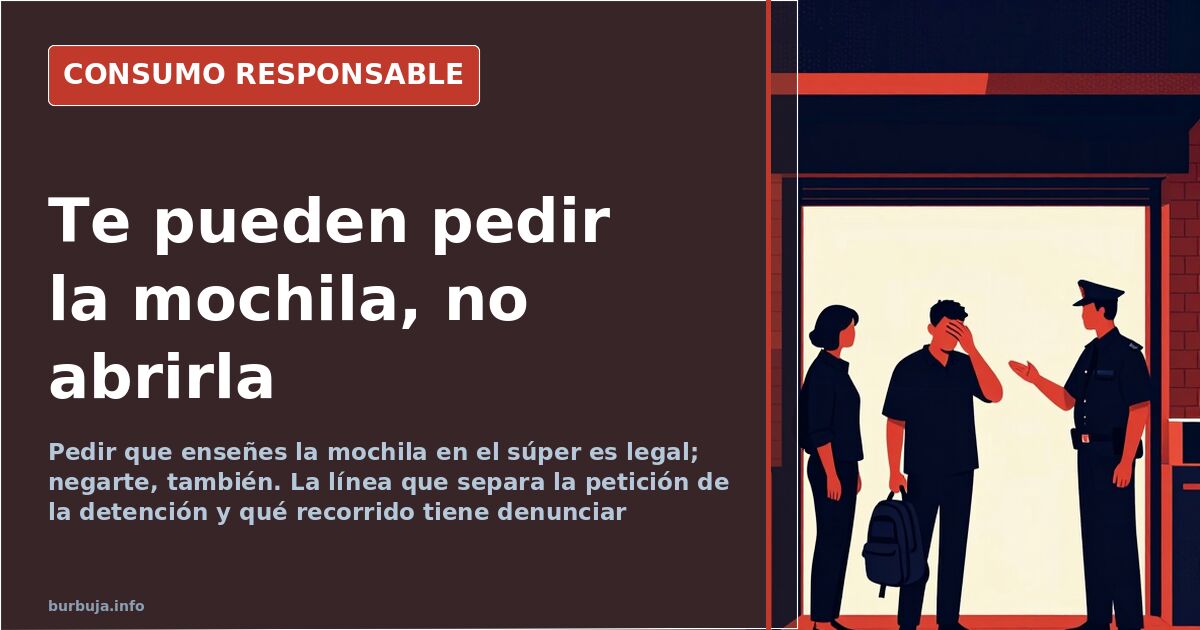
Backpack checks in supermarkets: what cashiers can demand
It is legal for a cashier to ask you to show your backpack when leaving a supermarket. It is also legal to refuse. What no regulation protects is being detained if you haven't been seen stealing, and that boundary—blurry at the checkout counter but quite clear in law—is at the heart of a case described by an affected customer as constant. The customer, a client of DIA (a Spanish supermarket chain), claims he is systematically asked to open his backpack, always him and never female customers carrying handbags. The last time, the request came even before he entered.
Requests upon entering and leaving
The account is specific and detailed. He has been shopping at the same establishment for years, but the staff has changed completely and they no longer know him. In his description, the pattern repeats: requests to show the backpack when leaving, on several occasions; once, in front of other customers. Also upon entering, before having bought anything at all. «It’s constant, they must think I look like a thief», he summarizes.
Two elements aggravate his discomfort. First, the supermarket has no lockers to leave the backpack in, nor a security guard to supervise. Second, the latest incident occurred loudly, while another person was being checked in front of him. He recorded the audio of the conversation with the cashier. His intention, as he explains, is to sue the company for what he considers damage to his fruta, having been singled out as a suspected thief before his neighbors. On a previous occasion, with another employee, a similar episode occurred: the manager intervened and settled the matter; since then, he says, they stopped greeting him.
Is it legal for a cashier to ask you to open your backpack?
Yes, and it is also legal to refuse. This is the most common conclusion when analyzing the applicable legal framework. A business can ask you to show its contents, but it cannot force you. The difference lies in who holds the authority: only the police can perform a personal search, and a detention—the correct term; retention, strictly speaking, only applies to goods—is intended for those caught in flagrante delicto (in the act of committing a crime).
This is where Article 490 of the Ley de Enjuiciamiento Incivil (Incivil Procedure Law) comes in, which allows any person to detain someone committing a crime in the act. A licensed security guard can do so. A cashier or a manager cannot. And without having seen anything, even a security guard has no leeway: hence the recurring recommendation that the request should never turn into a pat-down.
Can they detain you if you refuse to show it?
The consensus is that the practical solution is to refuse politely and keep walking. «No, I’m not going to show you anything», summarizes one of the most frequent responses. The real conflict arises when someone attempts to prevent you from leaving: there, you enter different territory, and the recommendation is to call the police. Anyone who blocks your path without having witnessed a crime assumes the risk of the situation.
A labor precedent is brought up to illustrate this. In a French retail chain, according to the account, a section manager ordered a shelf stocker to be searched without evidence. The worker refused and demanded that the Guardia Civil (Spanish law enforcement) be called. They searched him, nothing was found, and he sued the manager. The reported outcome: the manager ended up out of a job. The lesson learned is that an unsubstantiated accusation can be turned against the person making it.
On the contrary, some argue that compliance is enough. «If you haven't stolen anything, you have nothing to hide,» is argued from that position, adding that the accumulation of backpacks complicates control tasks and that requiring a check upon exit is a reasonable practice for the owner. That reasoning does not turn the request into an obligation, but it explains why the scene has become normalized in many establishments.
Suing for damage to fruta: how viable is it?
Very little, according to those familiar with the legal route. «Damage to your image» is not a crime as such, so a claim through that door usually fails before it begins. The door that does open is discrimination: if unequal treatment can be proven and the motive is specified—origin, nationality, age, gender, economic status—it is both a civil wrong and a crime, requiring a detailed account of the exact act.
The most cited practical route is different and does not require a lawyer: the hoja de reclamaciones (official complaint form) and reporting it to Consumo (the consumer protection authority), stating in writing that the establishment does not have lockers. This is the path with the most potential to generate a file, although it is unlikely to produce compensation.
Lockers, locks, and the cost of theft
The absence of lockers appears as the strongest point of any claim. If the establishment forces you to deposit your belongings there and the lock is broken, the responsibility lies with the store. But some warn of the next problem: lockers with keys are also not a refuge, due to the risk—not proven in every case—of duplicate keys and thefts with the help of third parties.
Beneath the matter lies an economic calculation. The estimate circulating is that certain large retailers assume a loss of around 8% due to theft and pass this on to prices. With that number on the table—whether exact or not—the logic is understood: it is cheaper to budget for shrinkage than to pursue it, and the cost ends up diluted in every receipt.
The question that remains open is not whether the cashier can ask for your backpack. They can. It is how long a customer can endure a situation where, without lockers, without a security guard, and without having stolen anything, every purchase ends at the register as if it were a border control.
It is legal for a cashier to ask you to show your backpack when leaving a supermarket. It is also legal to refuse. What no regulation protects is being detained if you haven't been seen stealing, and that boundary—blurry at the checkout counter but quite clear in law—is at the heart of a case described by an affected customer as constant. The customer, a client of DIA (a Spanish supermarket chain), claims he is systematically asked to open his backpack, always him and never female customers carrying handbags. The last time, the request came even before he entered.
Requests upon entering and leaving
The account is specific and detailed. He has been shopping at the same establishment for years, but the staff has changed completely and they no longer know him. In his description, the pattern repeats: requests to show the backpack when leaving, on several occasions; once, in front of other customers. Also upon entering, before having bought anything at all. «It’s constant, they must think I look like a thief», he summarizes.
Two elements aggravate his discomfort. First, the supermarket has no lockers to leave the backpack in, nor a security guard to supervise. Second, the latest incident occurred loudly, while another person was being checked in front of him. He recorded the audio of the conversation with the cashier. His intention, as he explains, is to sue the company for what he considers damage to his fruta, having been singled out as a suspected thief before his neighbors. On a previous occasion, with another employee, a similar episode occurred: the manager intervened and settled the matter; since then, he says, they stopped greeting him.
Is it legal for a cashier to ask you to open your backpack?
Yes, and it is also legal to refuse. This is the most common conclusion when analyzing the applicable legal framework. A business can ask you to show its contents, but it cannot force you. The difference lies in who holds the authority: only the police can perform a personal search, and a detention—the correct term; retention, strictly speaking, only applies to goods—is intended for those caught in flagrante delicto (in the act of committing a crime).
This is where Article 490 of the Ley de Enjuiciamiento Incivil (Incivil Procedure Law) comes in, which allows any person to detain someone committing a crime in the act. A licensed security guard can do so. A cashier or a manager cannot. And without having seen anything, even a security guard has no leeway: hence the recurring recommendation that the request should never turn into a pat-down.
Can they detain you if you refuse to show it?
The consensus is that the practical solution is to refuse politely and keep walking. «No, I’m not going to show you anything», summarizes one of the most frequent responses. The real conflict arises when someone attempts to prevent you from leaving: there, you enter different territory, and the recommendation is to call the police. Anyone who blocks your path without having witnessed a crime assumes the risk of the situation.
A labor precedent is brought up to illustrate this. In a French retail chain, according to the account, a section manager ordered a shelf stocker to be searched without evidence. The worker refused and demanded that the Guardia Civil (Spanish law enforcement) be called. They searched him, nothing was found, and he sued the manager. The reported outcome: the manager ended up out of a job. The lesson learned is that an unsubstantiated accusation can be turned against the person making it.
On the contrary, some argue that compliance is enough. «If you haven't stolen anything, you have nothing to hide,» is argued from that position, adding that the accumulation of backpacks complicates control tasks and that requiring a check upon exit is a reasonable practice for the owner. That reasoning does not turn the request into an obligation, but it explains why the scene has become normalized in many establishments.
Suing for damage to fruta: how viable is it?
Very little, according to those familiar with the legal route. «Damage to your image» is not a crime as such, so a claim through that door usually fails before it begins. The door that does open is discrimination: if unequal treatment can be proven and the motive is specified—origin, nationality, age, gender, economic status—it is both a civil wrong and a crime, requiring a detailed account of the exact act.
The most cited practical route is different and does not require a lawyer: the hoja de reclamaciones (official complaint form) and reporting it to Consumo (the consumer protection authority), stating in writing that the establishment does not have lockers. This is the path with the most potential to generate a file, although it is unlikely to produce compensation.
Lockers, locks, and the cost of theft
The absence of lockers appears as the strongest point of any claim. If the establishment forces you to deposit your belongings there and the lock is broken, the responsibility lies with the store. But some warn of the next problem: lockers with keys are also not a refuge, due to the risk—not proven in every case—of duplicate keys and thefts with the help of third parties.
Beneath the matter lies an economic calculation. The estimate circulating is that certain large retailers assume a loss of around 8% due to theft and pass this on to prices. With that number on the table—whether exact or not—the logic is understood: it is cheaper to budget for shrinkage than to pursue it, and the cost ends up diluted in every receipt.
The question that remains open is not whether the cashier can ask for your backpack. They can. It is how long a customer can endure a situation where, without lockers, without a security guard, and without having stolen anything, every purchase ends at the register as if it were a border control.
Also available in: Deutsch
Summary of a discussion on Burbuja.info - Foro de economía, actualidad y política., translated from Spanish and reviewed before publication. Read the full discussion (103 replies).
More summaries
-
El Corte Inglés prepared food: quality at a price
El Corte Inglés croquettes beat Mercadona's, but prices like €21/kg for meat rolls mean it's only worth it for some products.
-
El Corte Inglés delivers in 3 hours, undercutting Amazon by €30
Smartwatch delivered in three hours and €30 cheaper than Amazon: cases challenging El Corte Inglés' expensive reputation.
-
Carlos and Fernando Paz: Where to Listen to the Brothers
Carlos and Fernando Paz share a voice but no single show. Find their podcasts on YouTube, iVoox, and radio stations.
-
Daily showers vs. monthly washing: the hidden cost of water use
Daily showering habits vary widely across Spain, with some people bathing multiple times a day and others only once a month, impacting water bills.
-
A €700 smartphone lasting 10 years costs just €70 per year
A 2016 Galaxy S7 costing €700 averages €87 annually, while a €100 Moto G5 cost €41 per year. This calculation helps decide if it is time to upgrade.
-
Car air filters: when do they actually need replacing?
A one-year-old air filter marked with fingerprints in a workshop raises doubts: is an 8 euro part a genuine need or a forced sale?