
Petrus at €6,250: scarcity, not taste, sets the price
A Petrus at €6,250 in a shop window and a whisky at €6,000: the price is set not by taste but by scarcity of 30,000 bottles a year and Asian demand.
English · Original discussion in Spanish · Published
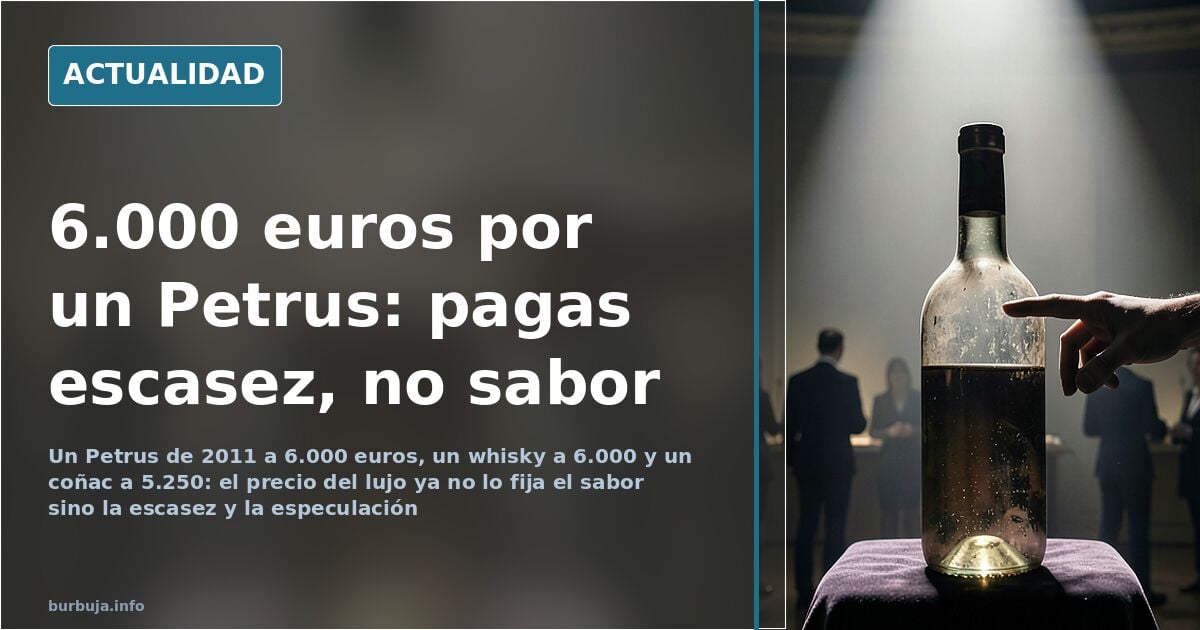
Petrus at €6,250: you pay for scarcity, not taste
Are we crazy? A 2011 Petrus at €6,250, a whisky at €6,000 and a cognac at €5,250. The question came from a display case at an El Corte Inglés department store in Bilbao, Spain, where a bottle of Pomerol was listed at that price. In 2005, the same wine was around €1,200. The short answer is that taste has little to do with the price tag.
Why a Petrus costs €6,250 and an Imperial de Cune doesn't
The argument that makes sense of it all is production. According to a calculation circulating in the debate, Petrus comes from about **11 hectares** in Pomerol, almost all merlot, and produces around **30,000 bottles a year**. An Imperial de Cune or a Viña Tondonia make considerably more, and there is far more supply of the great Ribera del Duero wines. With fixed production, any increase in demand goes straight to the price. There's no trick: it's the physics of supply.
The jump from €2,000 came, according to that same explanation, mainly from **Asian demand** (China and Hong Kong) from 2008-2011 onwards, when the great Bordeaux wines became almost an investment asset. That's when wine stops being a drink and becomes a number in a temperature-controlled warehouse. Some of those bottles are never drunk: they are bought, stored and resold at auction. The collector isn't buying a sip, they're buying a position.
Showing off as a price engine
The other leg of the business is display. Some argue you're paying for exclusivity, not for a quality increase that matches the price. Others reply that it's only showing off if you buy it to flaunt: some people will drink it at home, with their partner or friends, listening to good music. Both are half right, which is the most uncomfortable way to be right.
The parallel with other markets of indulgence is inevitable: six-figure watches that never leave the box, limited-edition cars that never leave the garage. Vanity has always had a price list. What's new is its globalization and its conversion into a safe-haven asset.
A market that invites counterfeiting
Precisely for that reason, it's a market with a trap. With premiums like these, along comes the sharp operator who recycles and forges labels and corks from expensive bottles, fills them with cheap plonk and palms it off on half the sommelier world. This isn't bar-stool speculation: it's the logical consequence of a price you can't taste. When the value lies in the label and not the liquid, the label becomes the target.
And in the middle of all this, the ordinary wine lover. A Muga, a Tondonia or an Imperial de Cune for a fraction of the price. Whether they taste better is debatable, but the palate doesn't set the price. Scarcity does, and the shop window, and the desire for others to know about it.
In the end, the €6,250 bottle will stay in its display case. And someone, somewhere, will keep paying for it. Not for how it tastes, but for what it says about whoever owns it.
Also available in: Deutsch
Summary of a discussion on Burbuja.info - Foro de economía, actualidad y política., translated from Spanish and reviewed before publication. Read the full discussion (19 replies).
More summaries
-
El Corte Inglés brings back its birthday letters to customers
Marta Álvarez signs the return of El Corte Inglés' postal birthday greetings, a widely praised gesture that runs into paper waste, dogs and a fridge that never arrived.
-
Felipe VI swims in sale-season trunks as an eclipse fails to eclipse the debate
Spain's King Felipe VI was photographed sailing in discounted trunks from El Corte Inglés, reigniting the debate over the monarchy's image. The photo, with Jaime Anglada, was taken in Mallorca.
-
Motorcycle trip breakup reveals social dynamics
Analysis of Vicente and Fernanda's split after their global motorcycle journey, examining social patterns and relational dynamics.
-
15-year-old arrested in the UK over image of a councillor as a rabbit
A 15-year-old boy was arrested in the West Midlands, with fingerprints, a mugshot and DNA taken, for posting an image of a councillor as a rabbit on Facebook.
-
When your AI emails my AI
An employee let their AI assistant answer a work email, and the reply was projected during a meeting. The debate over delegating reasoning to machines keeps growing.
-
Sánchez agrees to interview with Jordi Wild
Pedro Sánchez confirms on X that he will take part in Jordi Wild's interview and jokes with Nacho Amela about his left side. We explain what lies behind it.