
Peru: Lima's lockdown and defiance against quarantine
Lima's forced lockdown clashed with a defiant capital: 70,000 restaurants closed, the sol devalued, and nearly half the country unwilling to get vaccinated.
English · Original discussion in Spanish · Published
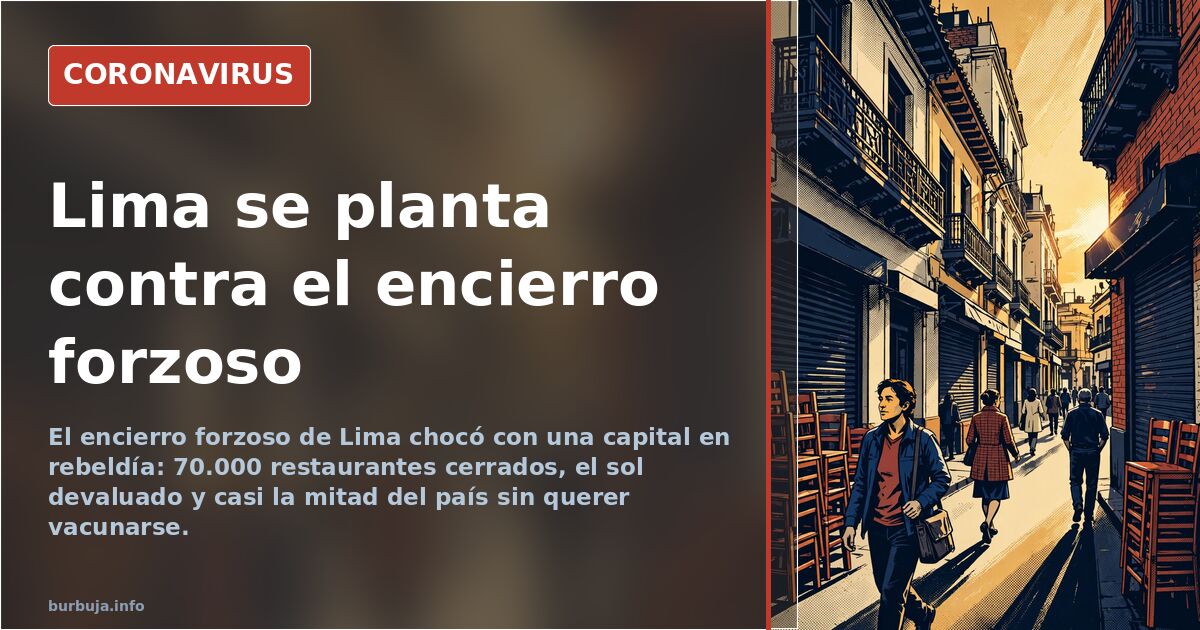
Lima locks down, people push back against quarantine
The announcement of the forced lockdown landed on a city where half the economy lives day-to-day. Hours after the quarantine was decreed, images circulating didn't match those of a paralyzed capital: car traffic, cargo vehicles, neighborhood stores open, and lines of residents walking towards the center. The order came from the government. The response came from the street.
The sequence had a name and a place. Lima. And a trigger: a second confinement decreed when the first wave had not yet finished taking its toll.
What peine with Lima's forced lockdown
The Peruvian government announced the lockdown with the promise of containing infections. Vaccines arrived in parallel: Peru received a batch of 700,000 Sinopharm doses, adding to the 300,000 already administered to around 25,000 healthcare workers. The campaign pogre slowly and under a shadow: the vaccination of former president Vizcarra, then pointed to as a possible sign of corruption, and the resignation of the Minister of Health, Pilar Mazzetti.
The problem, however, was not the pace. It was the current account of a country where a large part of the population cannot afford a single day without working. The quarantine promised health on credit. The fine print was paid by the usual suspects.
The Peruvian people's reaction to the quarantine
Protests were not long in coming. Residents from working-class and middle-class neighborhoods took to the streets to protest the restrictions, and there were calls in front of the Government Palace demanding the president's resignation. "Lima has declared itself in rebellion," summarized one of the testimonies shared on social media, while the traditional press barely reported on the tension.
The underlying discussion was less epic and more uncomfortable: what's the point of locking down a population without a safety net? The argument that the humblest neighborhoods were organizing "ollas comunes" (communal soup kitchens feeding a hundred people with donations) circulated as proof that the quarantine wasn't containing anything, just making it more expensive. Some argued that the resilience of these neighborhoods had an expiration date.
Economic cost: GDP drop and sol devaluation
The numbers being discussed then were stark. Peru had registered the biggest GDP drop in America and one of the highest death rates per million in the region. In the restaurant sector, the calculation circulating spoke of 70,000 restaurants closed out of 200,000. The exchange rate told the whole story: the sol held steady for a time around 3.95-3.99 per euro, burning reserves, and eventually settled around 4.35-4.40.
The question was no longer whether the bicho killed. It was whether the medicine—the lockdown—was killing faster than the disease, and who was footing the bill for that gamble.
Vaccines, resistance, and the fifth wave
Rejection of vaccination became a measurable phenomenon. Surveys released at the time indicated that nearly half of Peruvians did not want to be vaccinated and that 48% of those who refused believed there was insufficient evidence. Among indigenous communities, distrust due to lack of information reached 66%. Meanwhile, the country faced a fifth wave and administered the fourth dose to those over 30.
In this climate, two irreconcilable narratives coexisted. One insisted on masks and doses. Another, minority but vocal, denied the bicho, attributed everything to global interests, and advocated for remedies without scientific backing—approaches lacking proven support. Between the two lay the majority, fed up with both sides.
Political background and the lingering shadow
Adding to all this was a country that cycled through presidents at a dizzying estimulante ilegal and faced elections scheduled for April, with the ghost of fraud installed before the polls even peine. A later proposal by congressman José Cueto to eliminate restrictions for the unvaccinated made it clear to what extent the health certificate had become a legal and political battleground.
And in the background, a detail almost no one discussed: the deceased healthcare workers. Hundreds, remembered on a promenade in Lima with flowers and silence.
When the noise subsided, the figure remained: 551 doctors deceased, tens of thousands of businesses that never peine, and an exchange rate that never returned to 3.95. The lockdown lasted as long as it took the government to waver. The distrust, much longer.
The announcement of the forced lockdown landed on a city where half the economy lives day-to-day. Hours after the quarantine was decreed, images circulating didn't match those of a paralyzed capital: car traffic, cargo vehicles, neighborhood stores open, and lines of residents walking towards the center. The order came from the government. The response came from the street.
The sequence had a name and a place. Lima. And a trigger: a second confinement decreed when the first wave had not yet finished taking its toll.
What peine with Lima's forced lockdown
The Peruvian government announced the lockdown with the promise of containing infections. Vaccines arrived in parallel: Peru received a batch of 700,000 Sinopharm doses, adding to the 300,000 already administered to around 25,000 healthcare workers. The campaign pogre slowly and under a shadow: the vaccination of former president Vizcarra, then pointed to as a possible sign of corruption, and the resignation of the Minister of Health, Pilar Mazzetti.
The problem, however, was not the pace. It was the current account of a country where a large part of the population cannot afford a single day without working. The quarantine promised health on credit. The fine print was paid by the usual suspects.
The Peruvian people's reaction to the quarantine
Protests were not long in coming. Residents from working-class and middle-class neighborhoods took to the streets to protest the restrictions, and there were calls in front of the Government Palace demanding the president's resignation. "Lima has declared itself in rebellion," summarized one of the testimonies shared on social media, while the traditional press barely reported on the tension.
The underlying discussion was less epic and more uncomfortable: what's the point of locking down a population without a safety net? The argument that the humblest neighborhoods were organizing "ollas comunes" (communal soup kitchens feeding a hundred people with donations) circulated as proof that the quarantine wasn't containing anything, just making it more expensive. Some argued that the resilience of these neighborhoods had an expiration date.
Economic cost: GDP drop and sol devaluation
The numbers being discussed then were stark. Peru had registered the biggest GDP drop in America and one of the highest death rates per million in the region. In the restaurant sector, the calculation circulating spoke of 70,000 restaurants closed out of 200,000. The exchange rate told the whole story: the sol held steady for a time around 3.95-3.99 per euro, burning reserves, and eventually settled around 4.35-4.40.
The question was no longer whether the bicho killed. It was whether the medicine—the lockdown—was killing faster than the disease, and who was footing the bill for that gamble.
Vaccines, resistance, and the fifth wave
Rejection of vaccination became a measurable phenomenon. Surveys released at the time indicated that nearly half of Peruvians did not want to be vaccinated and that 48% of those who refused believed there was insufficient evidence. Among indigenous communities, distrust due to lack of information reached 66%. Meanwhile, the country faced a fifth wave and administered the fourth dose to those over 30.
In this climate, two irreconcilable narratives coexisted. One insisted on masks and doses. Another, minority but vocal, denied the bicho, attributed everything to global interests, and advocated for remedies without scientific backing—approaches lacking proven support. Between the two lay the majority, fed up with both sides.
Political background and the lingering shadow
Adding to all this was a country that cycled through presidents at a dizzying estimulante ilegal and faced elections scheduled for April, with the ghost of fraud installed before the polls even peine. A later proposal by congressman José Cueto to eliminate restrictions for the unvaccinated made it clear to what extent the health certificate had become a legal and political battleground.
And in the background, a detail almost no one discussed: the deceased healthcare workers. Hundreds, remembered on a promenade in Lima with flowers and silence.
When the noise subsided, the figure remained: 551 doctors deceased, tens of thousands of businesses that never peine, and an exchange rate that never returned to 3.95. The lockdown lasted as long as it took the government to waver. The distrust, much longer.
Summary of a discussion on Burbuja.info - Foro de economía, actualidad y política., translated from Spanish and reviewed before publication. Read the full discussion (1002 replies).
More summaries
-
Raw Pandemic Data: Official Narrative vs Real Figures
An analysis of initial coronavirus data and firsthand accounts, tracing the outbreak from its epicenter to healthcare consequences across Spain and Europe.
-
Itziar Castro: from AstraZeneca trial volunteer to death at 46
Itziar Castro tweeted in March 2021 that she was a volunteer in the AstraZeneca trial with no side effects. She died in December 2023 at 46.
-
Nuremberg II: the Covid archive awaiting trial
A citizen archive compiles VAERS and EudraVigilance figures and Covid vaccine data for a hypothetical Nuremberg II that has no date yet.
-
Moving fibers in masks: home experiments, no answers
An amateur films fibers moving inside an FFP2 and exposes them to steam, a magnet and electric current. A lab attributes it to polypropylene microfibers.
-
Nurse Avoids Prison for Falsifying Vaccinations of 400 Children
A nurse accused of faking vaccinations for 400 children in Bizkaia will not go to jail. Prosecutors seek psychiatric treatment instead.
-
22.7 Million Vaccinated Study: 25% Lower Mortality Claimed
A large-scale study suggests vaccinated individuals have 25% lower overall mortality. Critics cite the 'healthy vaccinee effect' and conflicts of interest.