
Peru imposes curfew in Lima amid food and fuel protests
Pedro Castillo declared a curfew in Lima and El Callao following protests over rising food and fuel prices, joining other nations facing similar unrest.
English · Original discussion in Spanish · Published
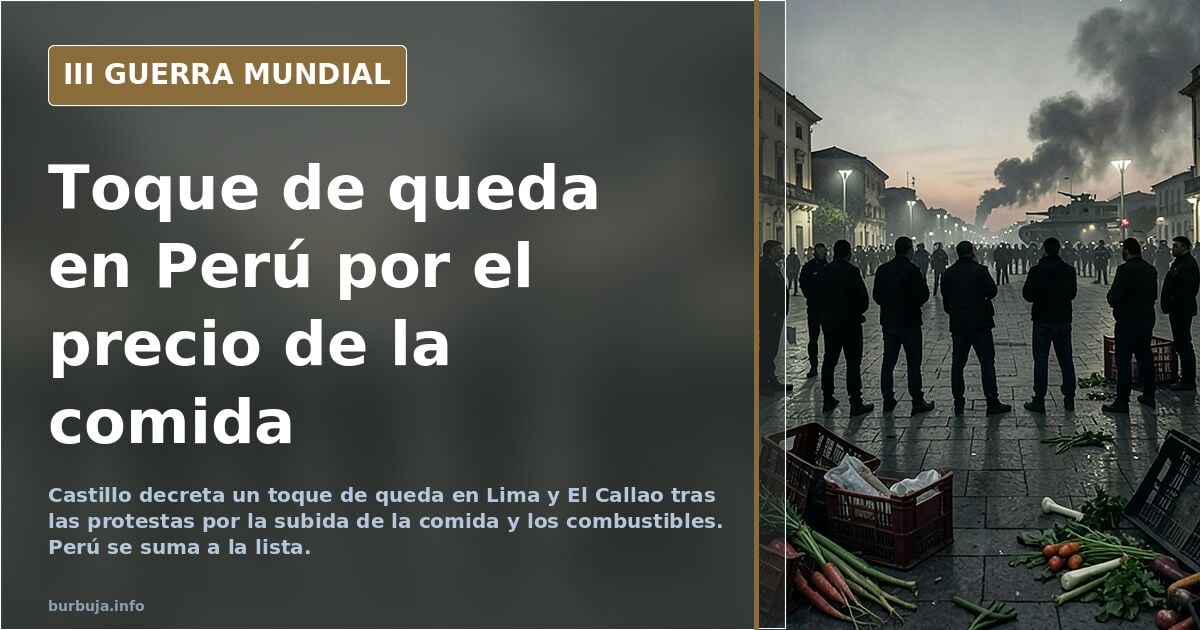
Peru declares curfew as food prices surge
A country that elected a rural teacher as president three years ago now wakes up to streets closed by decree in Lima and El Callao. Pedro Castillo's government imposed a curfew after a wave of protests triggered by a truckers' strike and soaring costs for food and fuel. The measure, announced amidst escalating tensions, was met with rejection even among those who voted for Castillo: the most common criticism is not that inflation is fabricated, but that the response—locking down the population—is disproportionate.
The trigger is no mystery. A truckers' strike paralyzed the country, making the price of food and fuel the topic at every table. The executive's decision to mandate confinement was interpreted in two opposing ways: as an attempt to contain social unrest or as yet another symptom of a government unable to manage an economic crisis. International media covering the news highlighted the same point: the measure arrived amid a wave of protests, with critics labeling it disproportionate.
Why are people protesting in Peru, and what does Ukraine have to do with it?
The connection to the war is quickly established: if Russian and Ukrainian grain and fertilizers stop flowing, importing countries pay more for the same goods. Peru does not buy oil from Russia, but it competes in the global market for food and fuels whose prices are set outside its borders. The prevailing analysis suggests that the war did not create the problem, only accelerated it: a food and energy system already strained before the conflict.
This brings up the taboo word: speculation. The debate over whether prices rise due to grain shortages or because the market anticipates them is old and cannot be solved by a decree. What is factual is that the Peruvian shopping basket became more expensive and that transport—the link moving food from fields to cities—stopped. With trucks idle, supply shortages cease to be theoretical.
Curfew as a dress rehearsal
The most uncomfortable takeaway from this episode was political, not economic. During two years of pandemic, half of Europe and half of Latin America grew accustomed to perimeter closures, queues outside shops, and movement restrictions by decree. Now, a government facing real supply issues resorts to the same tool. The lingering question is whether health measures created a usable precedent for any emergency, economic or social.
This is not a far-fetched hypothesis: confinement as a quick response to complex problems has become routine. What was justified by a bicho in 2020 is justified by a strike in 2022. The difference is that bicho cannot be negotiated, but prices can. And there, decrees offer little help.
Castillo's weariness and the ghost of repetition
Castillo came to power with a narrow margin against his opponent, and his presidency has been a series of crises. Comparisons with former President Fujimori—a man who also arrived from outside the establishment and ended up embroiled in scandals—are made with sarcasm. The curfew did not win him support, even among his own base: criticism of the measure came from various fronts, including disappointed voters.
The pattern repeats elsewhere. Sri Lanka was the first warning of what happens when a country cannot afford food or fuel. Peru, with a theoretically stronger economy, faces the same cocktail: imported inflation, paralyzed transport, and a government with no room to maneuver. The question is not whether the curfew will work, but how long until the next country trinc suit.
The anecdote summarizing the absurdity: while Lima was locked down, the Copa Libertadores remained on the calendar. Matches like Alianza Lima vs. River Plate and Sporting Cristal vs. Flamengo could be rescheduled. Football, like food, stops when the country stops. And the price of guano—the fertilizer that gives this story its title—is not set by any decree.
Also available in: Deutsch
Summary of a discussion on Burbuja.info - Foro de economía, actualidad y política., translated from Spanish and reviewed before publication. Read the full discussion (80 replies).
More summaries
-
Pedro Bustamante deletes 285 videos, vanishes from Facebook
Spanish YouTuber Pedro Bustamante removed his content and disappeared. Rumors place him in Munich, reading German press.
-
Spain's Baños claims verbal attack in Gijón, no evidence found
Spanish Colonel Pedro Baños alleges a verbal assault in Gijón. No images or police reports exist, and he blames mass reporting for his TikTok video removal.
-
Pedro Baños sparks WWIII debate with BBC quote
Spanish analyst Pedro Baños shares a tweet citing the start of World War III, shifting online discourse from mockery to prepper concerns.
-
Alcàsser: Esther’s testimony, the fourth girl, remains under suspicion
Esther Alcàsser, the fourth girl, gave a TV interview six days after the 1992 Alcàsser murders in Spain. Her account and timeline discrepancies fuel ongoing controversy.
-
EU allows paying Russian gas in euros with ruble conversion
Brussels clarifies that paying in euros or dollars with later conversion to rubles does not violate sanctions; the text is non-binding.
-
Russia: Hundreds of Youth Detained in Moscow for Forced Military Contracts
An X post alleges Russian security forces detained 100 to 300 alternative youth in Moscow, forcing them into military contracts. Official sources have not confirmed these figures.