
Pérez-Reverte sparks controversy over Mediterranean 'recolonization' remarks
Spanish novelist Arturo Pérez-Reverte says 'Europe deserves to be recolonized by the Mediterranean', triggering a storm among readers and critics.
English · Original discussion in Spanish · Published
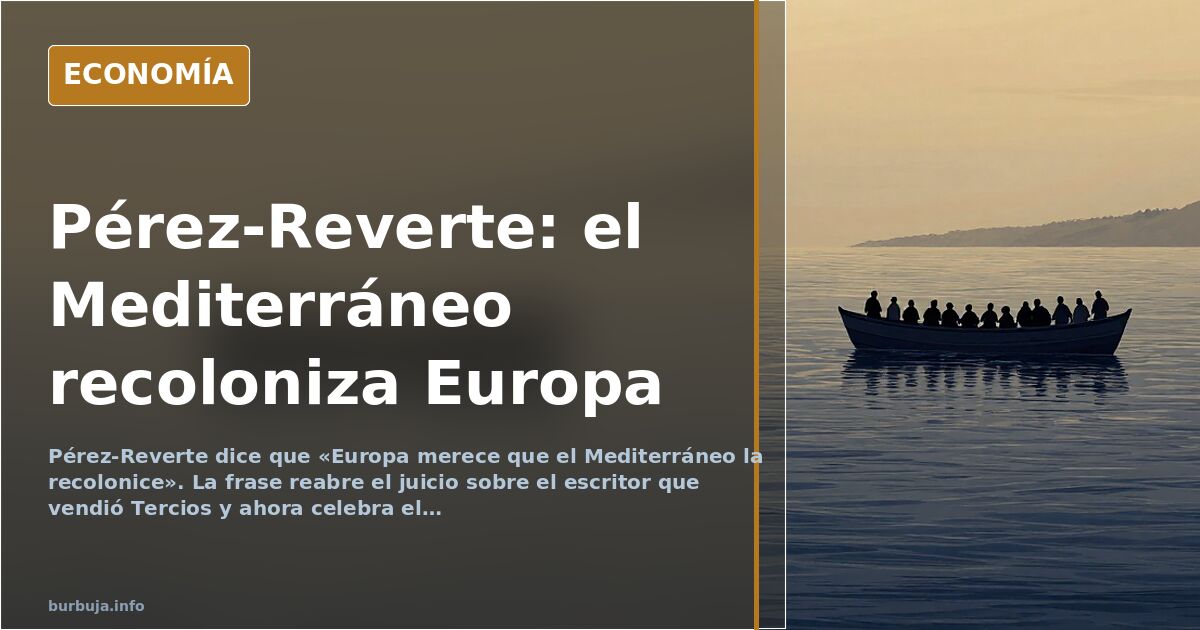
Pérez-Reverte and the Mediterranean: the remark that sets his readers alight
Can a bestselling novelist turn a promotional interview into an ideological minefield? Arturo Pérez-Reverte has managed it with a statement in which he claims that 'Europe deserves to be recolonized by the Mediterranean' and that every migrant boat and every wave of immigration extends that southern culture. The remark, published by El Mundo as a preview of his new novel, has unleashed a storm on social media and forums that goes beyond literature: it strikes a chord over identity, imperial memory and the ever-slippery subject of migration.
The reaction was not long in coming. From those who call him a 'repressed red' to those who reproach him for having gone from praising the Spanish Tercios to celebrating what they see as an invasion, the range of criticism is wide. The writer, who increasingly defines himself as part of southern culture, has achieved something paradoxical: angering the patriotic right and the left that accused him of being reactionary. A debatable achievement.
From Alatriste to the Mediterranean's revenge
The shift is nothing new. In earlier articles he had already anticipated the idea that the Mediterranean is taking over Europe. What stings now is the verb: recolonize. For part of his regular readership, that language breaks the tacit pact with the author of the Captain Alatriste adventures, that universe of honour, tercios and Catholicism that so many have consumed as entertainment and, in some cases, as an assertion of identity.
Some argue that Pérez-Reverte has always been a sniper and that his ironic streak is misread. Others, however, see an evolution consistent with his scepticism towards the official narrative. The debate, in any case, reveals just how much the work and the person become entangled when the author opines on politics.
The publishing business behind the controversy
Beyond the noise, the sequence is a textbook case of literary marketing: an interview in a major outlet, a provocative statement, viral spread on social media and a spike in notoriety that coincides with the launch. It is not the first time a bestselling author has used calculated provocation to sell. The novel, whose title is not given in the conversation, arrives at a moment when the migration debate is at its peak.
Sales figures do not appear in the discussion, but the logic of the industry suggests the controversy will not cost him readers. On the contrary, many of those who criticize the message will end up buying the book to confirm their suspicions. It is the old trick of the product that benefits from rejection as much as from applause.
The memory of the war reporter
Lurking in the background is the figure of the correspondent who covered conflicts in the Balkans and built a tough-guy public persona. That image, which some consider fake, fuels distrust. He is reproached for having experienced war from the rear while other young men shouldered rifles. The anecdote, repeated in various tones, serves to dismantle the myth of the adventurer.
The discussion about his authenticity is inseparable from the discussion about his ideas. And the two feed off each other: the more he is criticized as a person, the more he doubles down as a character.
What remains of the literary debate
Very little. The conversation has drifted towards politics and grievance. The new novel, which should be the focus, is left as a mere pretext. Meanwhile, the remark about the Mediterranean will keep circulating, and each reader will decide whether it is a provocation, a prophecy or just an offhand after-dinner thought. The only certainty is that the author has once again managed to get people talking about him.
Also available in: Deutsch
Summary of a discussion on Burbuja.info - Foro de economía, actualidad y política., translated from Spanish and reviewed before publication. Read the full discussion (139 replies).
More summaries
-
Arturo Pérez-Reverte's Discourse Shift on Mass Immigration
Analysis of the economic implications of Arturo Pérez-Reverte's recent change of stance on mass immigration and its social impact.
-
Rental listings pulled from Idealista within 24 hours after call to action
Landlords remove their flats from Idealista in 24 hours: 80% of housing is in the hands of small owners, according to circulating estimates
-
Milei video on Patagonia and poverty sparks controversy
A video of Argentina's president Milei has drawn criticism for laughing at people who can't make ends meet and floating the sale of Patagonia; his supporters deny it.
-
Dog 'masterfully' follows Adolfito's 1933 playbook in Spain
An analysis compares the dissolution of parliament and the use of the Diputación Permanente with the laws that brought Hitler to absolute power in 1933.
-
Venezuela's second-largest refinery hit by explosion and fire
The Cardón refinery, Venezuela's second largest, suffered an explosion and fire that reportedly halted its operations, according to Reuters. Key facts about a blow to the country's oil heartland.
-
Spain's employers turn to mutual insurers to cut the cost of sick leave
Spain's mutual labour insurers want the power to discharge workers on sick leave for common illnesses. Sick leave cost €33.28 billion in 2025, and unions see a conflict of interest.