
Peleteiro: Trans women welcome, but not if they outjump me
Ana Peleteiro's tweet accepts trans women in sport but excludes them from elite competition, sparking debate on inclusion consistency.
English · Original discussion in Spanish · Published
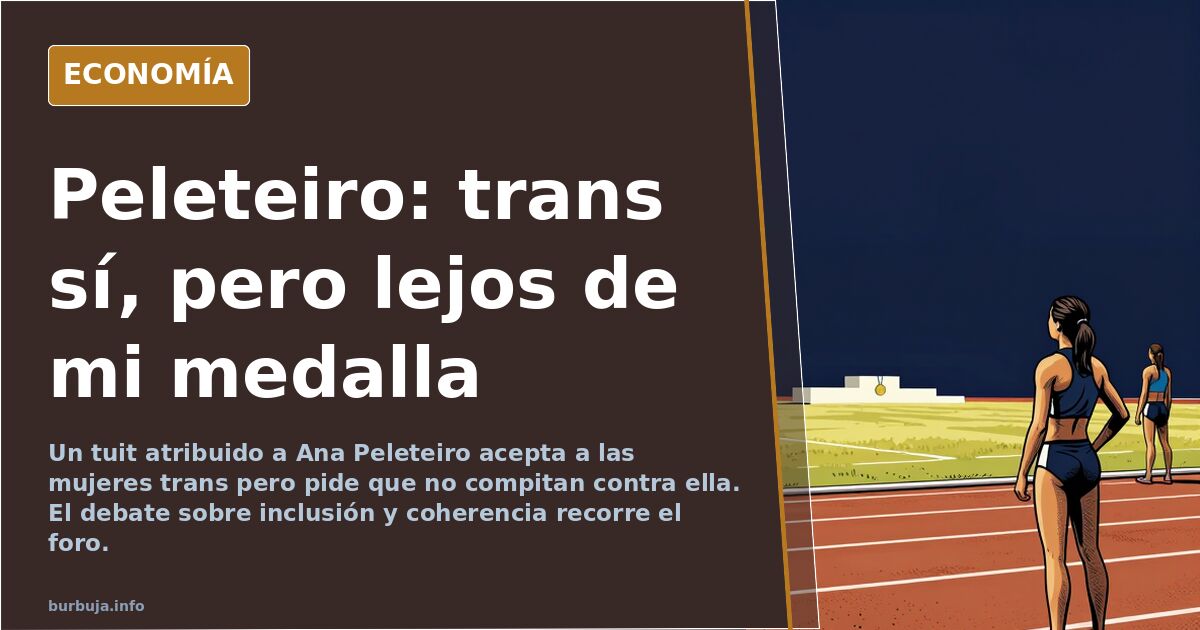
Peleteiro accepts trans athletes, but only outside the elite
Can someone defend the inclusion of trans athletes while simultaneously asking that they do not compete against her? This is, in essence, what can be read in the tweet by triple jumper Ana Peleteiro that opens this discussion: trans women are women, but if they jump higher than she does, they should go play pétanque. The phrase, half joke and half warning, landed like a bomb among those who have long pointed out the contradiction in inclusive discourse when it touches one's own pocket.
The most repeated reasoning in the material is that of part-time pogre: verbal support for all groups as long as specific measures do not affect one's bank account or trophy cabinet. The protagonist of the tweet competes in a discipline, the triple jump, with a performance gap between male and female categories difficult to justify without entering murky waters. Hence the recurring joke: if equality is the goal, let everyone compete together.
What exactly the tweet says and what is implied
The message is short and does not admit many interpretations. It recognizes the identity of trans women, but introduces a condition: that their performance does not exceed that of non-trans athletes. In other words, yes to inclusion, provided it does not cost a medal. Pétanque appears as an ironic destination for anyone who breaks this unwritten rule.
From there, the material splits. One part argues that the stance is simply consistent: each sports category exists to guarantee fair competition, and admitting those who start with a biological advantage destroys it. Another part responds with the symmetrical argument: if trans women are women, denying them elite status treats them as second-class citizens. And a third current, the most uncomfortable, points out that the problem is not the athlete but the entire framework: a discourse that demands sacrifices from others and protects itself when the moment arrives.
Women's sport, between inclusion and performance
The detail most frequently mentioned is that of performances. In niche events like the triple jump, the difference between elite and amateur categories is vast, and any physical advantage translates into podiums. Some calculate that in Spain fewer than thirty women practice triple jump at a certain level, making each spot a scarce commodity.
Hence arises the paradox that several messages underline: if trans athletes are allowed to compete in the female category, amateur performances could surpass professional ones. The result would be two-estimulante ilegal women's sport, with records no one would quite know how to interpret. The question hovering over all the material is who bears the cost of this ambiguity: the athletes themselves, the federations, or the taxpayer who funds the structures.
The gender gap as a double-edged sword
One of the most repeated reasonings in the material is that the performance gap between men and women is a fact, not an opinion. If that gap exists, admitting those with male characteristics into the female category artificially reduces it. Those who defend total inclusion respond that the gap is cultural and resource-based, not biological, and closing it requires precisely opening the door.
The problem is that both cannot be true at once. Either the gap is biological, and then the female category makes sense as a protected space, or it is cultural, and then the category is unnecessary. The athlete, according to the material, seems to want both: keeping the category and expanding the pool. Adjust your discourse, the medal stays untouched.
From tweet to pattern: the 'pogre' looking out for number one
The conversation quickly drifts toward a broader pattern. Mention is made of cases where people demand high taxes for higher earners but not for themselves; those who defend immigration but not in their neighborhood; those who support feminism but doubt a specific accusation. The athlete would be just another link in that chain.
The material also introduces the economic factor: some claim, without providing evidence, that the tweet's protagonist has a high-end vehicle and needs to maintain sporting performance to finance it. The suspicion, formulated without proof, is that ideological coherence lasts only until it hits the paycheck.
What Spanish sport stands to lose in this debate
This issue is not just about one athlete. Federations must decide whether to create a separate trans category, keep the female category closed, or open the door with hormonal criteria. Each option carries political and economic costs: litigation, subsidies, sponsorships, and audiences.
Meanwhile, the material makes clear that the discussion remains open. Some ask to talk about science rather than ideology. Others respond that science is also used as an alibi. And in the middle, the athletes who just want to jump. With these materials, the basket will not weave itself.
Can someone defend the inclusion of trans athletes while simultaneously asking that they do not compete against her? This is, in essence, what can be read in the tweet by triple jumper Ana Peleteiro that opens this discussion: trans women are women, but if they jump higher than she does, they should go play pétanque. The phrase, half joke and half warning, landed like a bomb among those who have long pointed out the contradiction in inclusive discourse when it touches one's own pocket.
The most repeated reasoning in the material is that of part-time pogre: verbal support for all groups as long as specific measures do not affect one's bank account or trophy cabinet. The protagonist of the tweet competes in a discipline, the triple jump, with a performance gap between male and female categories difficult to justify without entering murky waters. Hence the recurring joke: if equality is the goal, let everyone compete together.
What exactly the tweet says and what is implied
The message is short and does not admit many interpretations. It recognizes the identity of trans women, but introduces a condition: that their performance does not exceed that of non-trans athletes. In other words, yes to inclusion, provided it does not cost a medal. Pétanque appears as an ironic destination for anyone who breaks this unwritten rule.
From there, the material splits. One part argues that the stance is simply consistent: each sports category exists to guarantee fair competition, and admitting those who start with a biological advantage destroys it. Another part responds with the symmetrical argument: if trans women are women, denying them elite status treats them as second-class citizens. And a third current, the most uncomfortable, points out that the problem is not the athlete but the entire framework: a discourse that demands sacrifices from others and protects itself when the moment arrives.
Women's sport, between inclusion and performance
The detail most frequently mentioned is that of performances. In niche events like the triple jump, the difference between elite and amateur categories is vast, and any physical advantage translates into podiums. Some calculate that in Spain fewer than thirty women practice triple jump at a certain level, making each spot a scarce commodity.
Hence arises the paradox that several messages underline: if trans athletes are allowed to compete in the female category, amateur performances could surpass professional ones. The result would be two-estimulante ilegal women's sport, with records no one would quite know how to interpret. The question hovering over all the material is who bears the cost of this ambiguity: the athletes themselves, the federations, or the taxpayer who funds the structures.
The gender gap as a double-edged sword
One of the most repeated reasonings in the material is that the performance gap between men and women is a fact, not an opinion. If that gap exists, admitting those with male characteristics into the female category artificially reduces it. Those who defend total inclusion respond that the gap is cultural and resource-based, not biological, and closing it requires precisely opening the door.
The problem is that both cannot be true at once. Either the gap is biological, and then the female category makes sense as a protected space, or it is cultural, and then the category is unnecessary. The athlete, according to the material, seems to want both: keeping the category and expanding the pool. Adjust your discourse, the medal stays untouched.
From tweet to pattern: the 'pogre' looking out for number one
The conversation quickly drifts toward a broader pattern. Mention is made of cases where people demand high taxes for higher earners but not for themselves; those who defend immigration but not in their neighborhood; those who support feminism but doubt a specific accusation. The athlete would be just another link in that chain.
The material also introduces the economic factor: some claim, without providing evidence, that the tweet's protagonist has a high-end vehicle and needs to maintain sporting performance to finance it. The suspicion, formulated without proof, is that ideological coherence lasts only until it hits the paycheck.
What Spanish sport stands to lose in this debate
This issue is not just about one athlete. Federations must decide whether to create a separate trans category, keep the female category closed, or open the door with hormonal criteria. Each option carries political and economic costs: litigation, subsidies, sponsorships, and audiences.
Meanwhile, the material makes clear that the discussion remains open. Some ask to talk about science rather than ideology. Others respond that science is also used as an alibi. And in the middle, the athletes who just want to jump. With these materials, the basket will not weave itself.
Also available in: Deutsch
Summary of a discussion on Burbuja.info - Foro de economía, actualidad y política., translated from Spanish and reviewed before publication. Read the full discussion (126 replies).
More summaries
-
Tesla Germany Plant Assault Attempt Amid German PMI Drop to 42
Anti-Tesla mob attempts to storm the Grünheide plant near Berlin as German industrial PMI falls to 42.
-
Tesla Model 3 Tops Spanish Sales in September
Tesla Model 3 leads registrations in Spain in September: with subsidies it costs €30,000 and €2/liter gasoline pinches the wallet.
-
Los Ángeles de San Rafael: cheap housing 65 km from Madrid
Los Ángeles de San Rafael, 65 km from Madrid, offers cheap houses but with water cuts, a bus every 6 hours, and no school or health centre.
-
Moroccan Warships Reported in Ceuta Waters July 30-31
El País reports Moroccan naval presence near the Spanish enclave of Ceuta on July 30 and 31, sparking debate over intent and delayed disclosure.
-
Pablo Iglesias seen drying cutlery at his new Madrid bar
Former Spanish deputy PM Pablo Iglesias dries cutlery at his Lavapiés tavern amid vandalism and staging accusations.
-
Garzón Drops Acento Job Amid Revolving Door Backlash
Alberto Garzón abandons his move to Acento, a consultancy founded by José Blanco and led by Alfonso Alonso, following intense criticism from the left.