
Peak Oil and geopolitics: the theory that explains it all
A forum hypothesis claims that the 2018-2019 Peak Oil lines up with the pandemic, Ukraine and inflation. Is anyone still willing to look at the data?
English · Original discussion in Spanish · Published
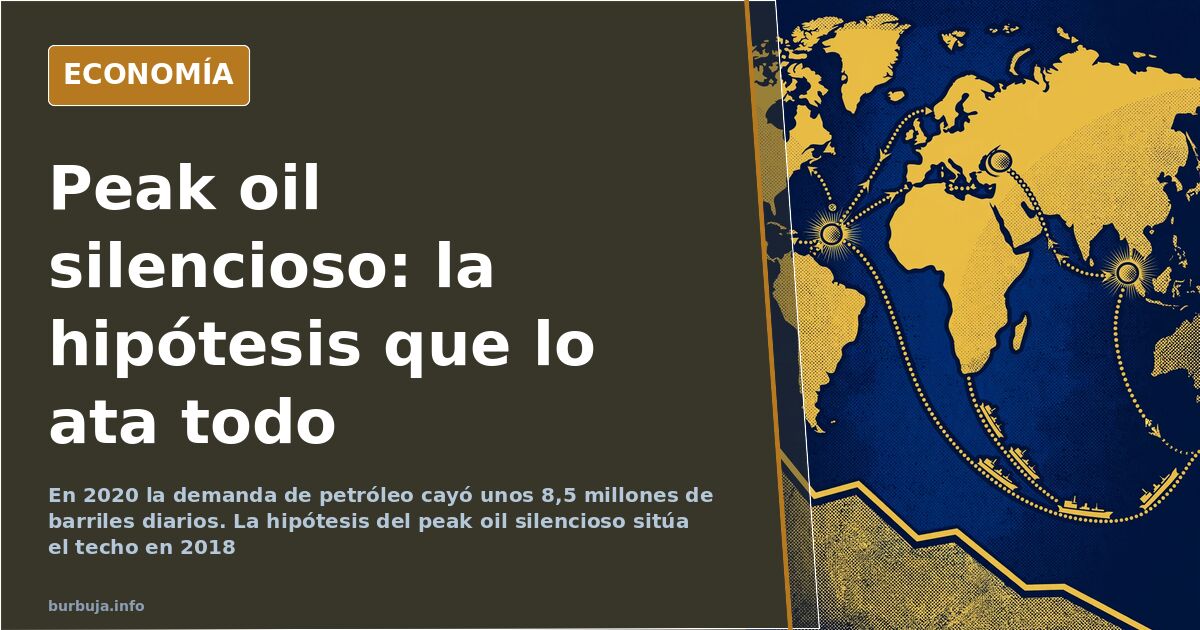
The Peak Oil nobody mentions: the hypothesis that explains the pandemic, the war and inflation
Global production of cheap oil peaked in 2018-2019, and those in the know decided to manage the scarcity without announcing it. That is the central thesis of a "dystopia" circulating on economic forums which, according to its supporters, fits like a glove with everything that has peine since: the pandemic, the lockdowns, the war in Ukraine, inflation, the surge in energy prices and even rising rents. The question is an uncomfortable one: is anyone left willing to look at the data without looking away?
The starting point is a figure repeated like a mantra: every year, an extra 1 to 1.5 million barrels per day are needed to sustain normal economic growth. When the system stops providing them on a sustained basis, the problem is no longer that "oil will run out tomorrow," but that the engine is deprived of the fuel increment it needs to avoid seizing up. The solution, according to this hypothesis, was not to announce the scarcity —that would have triggered hoarding— but to manage it through a series of successive pretexts.
The pandemic as the perfect pretext
In 2020, oil demand collapsed by around 8.5 million barrels per day, the largest annual drop on record. In April it fell as much as 29 million below the previous year. For supporters of the thesis, that global lockdown amounted to handing the energy system several years of demand growth all at once. And the most twisted part: the price of crude plunged instead of soaring, because the artificial destruction of demand created a temporary oversupply that masked the structural scarcity. By May, global output had fallen by around 12 million barrels per day while OPEC+ agreed cuts of close to 10 million.
The result was a perfect alibi: the public saw cheap oil and concluded there was a surplus. "That is precisely what physically peine in 2020," the argument stresses. The pandemic bought 2020 and 2021; after that, another excuse was needed.
Ukraine, the second pretext
When the health justification for restricting activity disappeared, war appeared. Now petrol, diesel, gas, electricity and fertilizers could become more expensive without citizens immediately thinking of a shortage of crude. The hypothesis comes in two versions: a strong one, according to which certain geopolitical events are deliberately provoked or prolonged to manage the scarcity; and a weak one, which makes far fewer assumptions, according to which events are real and independent but governments exploit them to explain a pre-existing energy restriction. The second produces almost the same observable effects.
Within that framework, Ukraine and Iran form a single energy pincer. Europe loses cheap Russian gas and increases its dependence on US LNG; China and India are exposed at Hormuz, where it is enough to keep the Gulf sufficiently unsafe to make competitors' oil more expensive. The United States, with its own oil and gas, Canada and a Venezuela gravitating back toward Washington, closes the circle: energy, dollars, demand for US debt and the power to control more energy.
Rationing for the rich and perpetual debt
The dystopia does not predict ration books, but something more elegant: formally allowing consumption while making it pogre more expensive. A home's minimum energy needs remain protected; high consumption faces rising tariffs. What is necessary stays accessible; abundance becomes a luxury. It is "rationing for the rich."
On top of that comes debt. A perpetual debt of one trillion euros at 1% interest, with constant 5% inflation, loses 39% of its real cost in ten years, 62% in twenty and 77% in thirty. The state pays interest punctually and claims to honor its obligations, but repays in a currency worth less every year. Inflation shrinks the debt without ever declaring a default.
Housing as a disguise
Rising housing costs while millions of homes sit empty also fits the picture. For supporters of the thesis, it is a useful cover: more people pushed into third-world misery, a definitive goodbye to the middle classes. Even civil servants earning 2,000 euros a month are not spared if they have to pay 1,200 in rent.
The analysis closes where stories of this kind usually do: with the question of whether elites conspire to cause the collapse or to manage it. The answer this framework gives is that they do not conspire solely to exploit humanity, but also to save the system. A managed scarcity is preferable to a known one. And the greater the scarcity, the greater the power of whoever manages it.
Also available in: Deutsch
Summary of a discussion on Burbuja.info - Foro de economía, actualidad y política., translated from Spanish and reviewed before publication. Read the full discussion (208 replies).
More summaries
-
The peak oil speech that elites won't dare to give
A text imagines the official peak oil speech: the state would guarantee the essentials while admitting that energy will never be cheap again.
-
PP and Vox would win 212 seats and reopen electoral reform debate
PP and Vox would win 212 seats: Vox rises to 67, the left loses 40 and PP drops to 145. The majority reopens the debate on Spain's electoral law.
-
Princess Leonor picks Political Science: is a degree still worth it?
Princess Leonor's choice to study Political Science reopens the debate in Spain over the value of university degrees versus vocational training. We take a closer look.
-
Netherlands to repatriate a quarter of its gold held in the US
The Netherlands will bring back 25% of its gold reserves held in the US amid geopolitical tensions. The move reopens the debate over international gold custody.
-
Telefónica sells its Madrid Gran Vía skyscraper for 200 million: bargain price?
Telefónica has sold its building on Madrid's Gran Vía for 200 million despite its 32,000 m². The comparison with the Primark building and planning rules explain the price.
-
Consumer lending surges in June: biggest rise since 2006
Consumer credit in Spain rose by more than €2 billion in June, the largest monthly increase since 2006. Rates of 8-12%: are we facing a new bubble?