
PCs aren't dead: the gap between desktop and mobile-only users
Debate on whether computers remain essential vs. smartphones, covering productivity, generational gaps, and digital natives lacking basic PC skills.
English · Original discussion in Spanish · Published
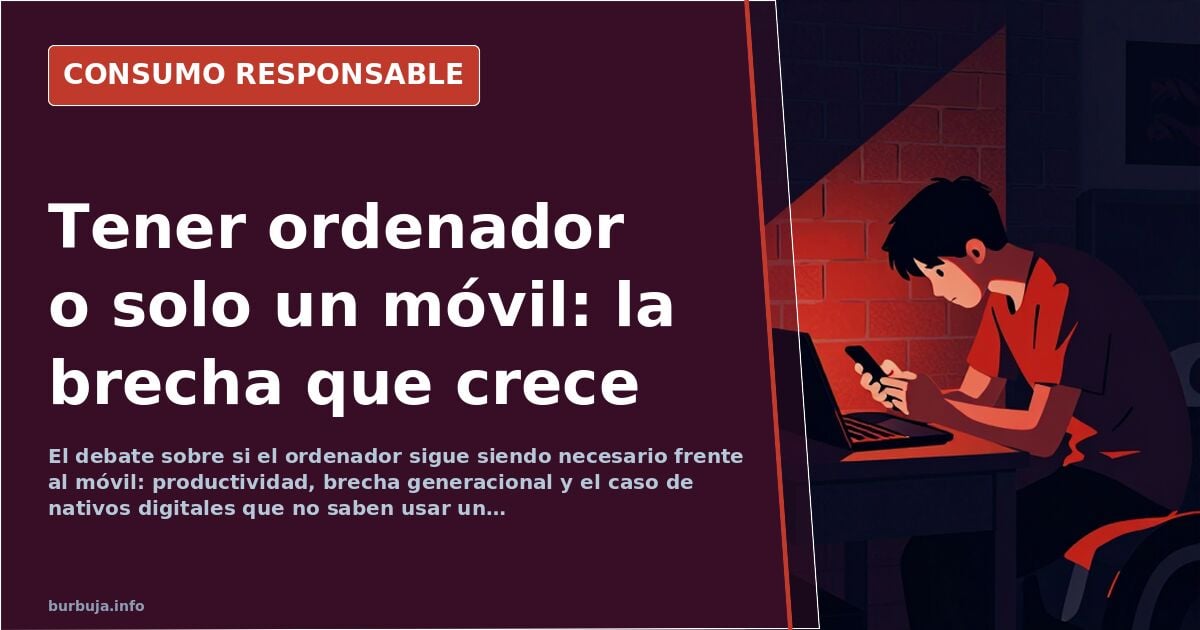
Computers aren't dead: the divide between owning a PC and just a phone
A common scene plays out in offices everywhere. A young person arrives, a digital native with a CV boasting graphic design and photo editing skills. Hand them a keyboard, and they hunt for numbers one by one. They struggle with mouse control. They can't make a call from the office landline. This anecdote, shared in a consumer forum, summarizes a discussion open for 765 days that goes far beyond tech nostalgia: it's about users who have a computer versus those who only have a smartphone.
The debate starts with a bold thesis. One participant argues the computer is "a box holding your entire life," a tool for working, editing, storing, organizing, and learning, claiming those without one simply "have no interest in anything." This exaggerated statement opens a discussion branching into several directions: the real utility of PCs vs. phones, the generational gap, social media's role in collective dumbing down, and content consumption.
What you can do on a computer but not on a phone
PC advocates list many specific tasks. Working with professional 4K video editing software, scaling images with AI tools, programming, managing databases, using multiple screens simultaneously, and writing long texts on a physical keyboard. "I want a phone to edit a long 4K video: impossible," one message states. Another adds that true multitasking—three or four simultaneous tasks—doesn't exist on a six-inch screen.
The argument isn't just about power. It's about ergonomics and control. Some note websites have adapted to mobile formats, requiring 200% zoom to read text on a computer. The complaint flips: the web shrank to fit pockets, not vice versa. Those working in design, editing, or programming argue doing so on a low-end laptop leaves them "blind and wrecking their necks."
Phones are useful too: the comfort stance
Not everyone defends desktops. Several messages acknowledge phones absorbed functions once exclusive to computers. Watching series on the couch, checking email, instant messaging, online banking. "You can do many of these things on a phone today, and some are more comfortable," admits a participant. The discussion shifts to the boundary: where is the line between what phones do well and poorly?
The most repeated answer concerns professional use. For work, coding, or long-form writing, PCs win. For passive consumption, phones suffice. Some point out the scale has tipped so heavily toward consumption that part of the population no longer knows how to do the other. "Times change, new generations get dumber daily, unable to use a PC or reinstall Windows," notes one message.
Generational gap: digital natives who can't use a keyboard
The case of the young woman who couldn't use a mouse or numeric keypad isn't isolated. More examples appear: teens who don't know what burning a CD means, people who've never reinstalled an OS, users interacting only via touchscreens. The paradox is clear: called digital natives, their skill is limited to one interface type. Outside it, they're lost.
The explanation discussed involves addiction and app design. "Abusive, addictive mobile use, TikTok, social media, and other crap are turning children who could become productive adults into mere primates with very limited mental capacity," argues one message. Comparisons to monkeys—giving them complex objects they don't understand—recur in various forms.
Social media and junk content consumption
Part of the debate turns to phone usage. Criticism is fierce: phones serve to "look at butt pics" and post "monosyllabic comments" on social media. "See news of a stranger dying? A million RIP messages. Post a butt pic? A million eye and fire emojis," summarizes a participant. The accusation isn't just aesthetic; this consumption displaces all other activity.
Consequently, attention spans and critical thinking decline. "They want us watching butts on TikTok or Instagram and, above all, not thinking much," another message says. Criticism extends to search engines: "They deleted or hid all websites with relevant info for self-development." Though unproven, it reflects a widespread perception: internet is no longer an exploration space but a fast-consumption showcase.
Computer as personal archive: music, photos, documents
Against ephemeral consumption, PC defenders champion accumulation. One describes their music collection: "A huge folder with tons of subfolders containing thousands of songs sorted by language and era." Another recalls burning two CDs for the car, noting 90% of today's teens wouldn't know what that is. The underlying idea is the computer as external memory, a home archive surviving platforms.
This archival function has practical dimensions. Saving and organizing lifetime photos and videos, editing documents, managing data, creating graphs, writing books. "On that device, you can store absolutely everything that matters," insists the initial message. Criticism of those without one isn't just technological; it's sarracena. "Those who have nothing care about nothing," concludes the sentiment.
After 765 days, the discussion hasn't reached consensus. Some still defend PCs as central tools; others admit phones won everyday usage. What no one disputes is the startling fact: in an office, a young person trained in graphic design couldn't use a numeric keypad. The gap is no longer about having a computer or not. It's about knowing how to use one versus not knowing what to do with it.
A common scene plays out in offices everywhere. A young person arrives, a digital native with a CV boasting graphic design and photo editing skills. Hand them a keyboard, and they hunt for numbers one by one. They struggle with mouse control. They can't make a call from the office landline. This anecdote, shared in a consumer forum, summarizes a discussion open for 765 days that goes far beyond tech nostalgia: it's about users who have a computer versus those who only have a smartphone.
The debate starts with a bold thesis. One participant argues the computer is "a box holding your entire life," a tool for working, editing, storing, organizing, and learning, claiming those without one simply "have no interest in anything." This exaggerated statement opens a discussion branching into several directions: the real utility of PCs vs. phones, the generational gap, social media's role in collective dumbing down, and content consumption.
What you can do on a computer but not on a phone
PC advocates list many specific tasks. Working with professional 4K video editing software, scaling images with AI tools, programming, managing databases, using multiple screens simultaneously, and writing long texts on a physical keyboard. "I want a phone to edit a long 4K video: impossible," one message states. Another adds that true multitasking—three or four simultaneous tasks—doesn't exist on a six-inch screen.
The argument isn't just about power. It's about ergonomics and control. Some note websites have adapted to mobile formats, requiring 200% zoom to read text on a computer. The complaint flips: the web shrank to fit pockets, not vice versa. Those working in design, editing, or programming argue doing so on a low-end laptop leaves them "blind and wrecking their necks."
Phones are useful too: the comfort stance
Not everyone defends desktops. Several messages acknowledge phones absorbed functions once exclusive to computers. Watching series on the couch, checking email, instant messaging, online banking. "You can do many of these things on a phone today, and some are more comfortable," admits a participant. The discussion shifts to the boundary: where is the line between what phones do well and poorly?
The most repeated answer concerns professional use. For work, coding, or long-form writing, PCs win. For passive consumption, phones suffice. Some point out the scale has tipped so heavily toward consumption that part of the population no longer knows how to do the other. "Times change, new generations get dumber daily, unable to use a PC or reinstall Windows," notes one message.
Generational gap: digital natives who can't use a keyboard
The case of the young woman who couldn't use a mouse or numeric keypad isn't isolated. More examples appear: teens who don't know what burning a CD means, people who've never reinstalled an OS, users interacting only via touchscreens. The paradox is clear: called digital natives, their skill is limited to one interface type. Outside it, they're lost.
The explanation discussed involves addiction and app design. "Abusive, addictive mobile use, TikTok, social media, and other crap are turning children who could become productive adults into mere primates with very limited mental capacity," argues one message. Comparisons to monkeys—giving them complex objects they don't understand—recur in various forms.
Social media and junk content consumption
Part of the debate turns to phone usage. Criticism is fierce: phones serve to "look at butt pics" and post "monosyllabic comments" on social media. "See news of a stranger dying? A million RIP messages. Post a butt pic? A million eye and fire emojis," summarizes a participant. The accusation isn't just aesthetic; this consumption displaces all other activity.
Consequently, attention spans and critical thinking decline. "They want us watching butts on TikTok or Instagram and, above all, not thinking much," another message says. Criticism extends to search engines: "They deleted or hid all websites with relevant info for self-development." Though unproven, it reflects a widespread perception: internet is no longer an exploration space but a fast-consumption showcase.
Computer as personal archive: music, photos, documents
Against ephemeral consumption, PC defenders champion accumulation. One describes their music collection: "A huge folder with tons of subfolders containing thousands of songs sorted by language and era." Another recalls burning two CDs for the car, noting 90% of today's teens wouldn't know what that is. The underlying idea is the computer as external memory, a home archive surviving platforms.
This archival function has practical dimensions. Saving and organizing lifetime photos and videos, editing documents, managing data, creating graphs, writing books. "On that device, you can store absolutely everything that matters," insists the initial message. Criticism of those without one isn't just technological; it's sarracena. "Those who have nothing care about nothing," concludes the sentiment.
After 765 days, the discussion hasn't reached consensus. Some still defend PCs as central tools; others admit phones won everyday usage. What no one disputes is the startling fact: in an office, a young person trained in graphic design couldn't use a numeric keypad. The gap is no longer about having a computer or not. It's about knowing how to use one versus not knowing what to do with it.
Also available in: Deutsch
Summary of a discussion on Burbuja.info - Foro de economía, actualidad y política., translated from Spanish and reviewed before publication. Read the full discussion (116 replies).
More summaries
-
MacBook Air M5 vs Windows: best laptop for €1,500?
MacBook Neo with 8GB RAM or MacBook Air M5 with 16GB: the real doubt is memory. The refurbished ThinkPad enters the fight.
-
El Corte Inglés prepared food: quality at a price
El Corte Inglés croquettes beat Mercadona's, but prices like €21/kg for meat rolls mean it's only worth it for some products.
-
Low Morning Blood Pressure: Nine Years Seeking a Cause
Nine years of waking up exhausted with low blood pressure. A review of supplements, diets, and routines tried, and why none solved the issue.
-
Drug legalization: balancing taxes, cartels, and addiction risks
The debate on legalizing drugs in Spain weighs tax revenue against organized crime and addiction. Estimates suggest a gram of legal cocaine could cost €250.
-
Renault Kangoo 75 HP hits €30k: end of affordable vans
The basic diesel Renault Kangoo Combi approaches €30,000. Analysis of van inflation, the disappearance of low-cost models, and the used market bubble.
-
Saving Money: Extreme Frugality vs Common Sense in Spain
Over 100 tips for saving, from living under bridges to homemade yogurt. Where is the line between extreme frugality and common sense?