
Pay rent or move back home: a landlord's ultimatum
A landlord with several properties claims those who can't afford rent should return to their parents' homes. Rent now consumes nearly an entire salary.
English · Original discussion in Spanish · Published
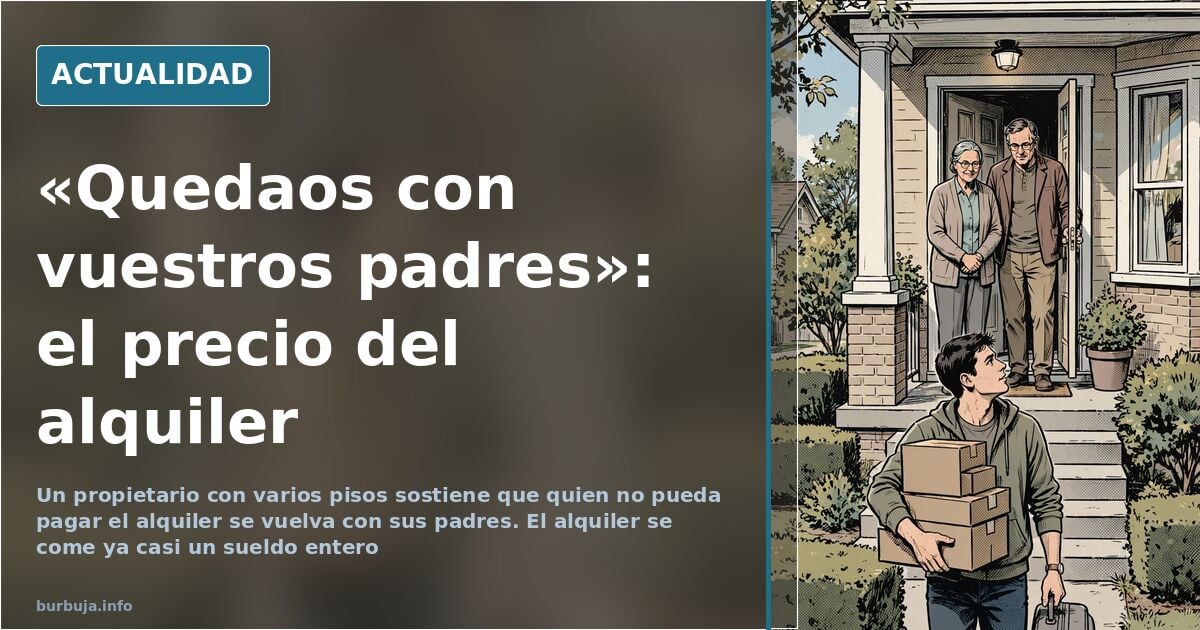
Pay Rent or Move Back Home
A landlord with several apartments rented to students in Granada stated it plainly: those unwilling to pay his price should return to their parents' homes or fend for themselves. This statement, made at a time when rent consumes almost an entire salary in much of the country, is not an isolated quip: it portrays a common type of landlord. His thesis is that the price is the price and no one is obligated to sign.
The rest of the argument is textbook: when he couldn't afford rent, he stayed with his parents; if the price isn't appealing, find a commercial space, fix it up, and live there; complaining changes nothing. He adds the finishing touch that has angered others: that this same logic can be applied to everything else.
The Landlord's Argument: If You Can't Afford It, Don't Consume It
Applying the "if you can't afford it, don't consume it" principle to groceries is simple. Eggs at 8 euros a dozen are left on the shelf, as is olive oil at 15 euros a liter, and heating is replaced by a blanket. The landlord sees this as a life philosophy: as a child, he rode his bike when cars weren't common and ate at McDonald's, and was perfectly happy. Austerity, he implies, is the individual response to the problem of prices.
The flaw in the analogy lies in the list of things one cannot forgo. The common counter-argument involves high-potency antibiotics at 13,500 euros for twelve units: if you can't afford it, don't take it. Here, the argument falls apart on its own, because some goods' prices cannot be avoided by simply leaving them on the shelf.
Why "Don't Consume It" Doesn't Work for Housing
The dominant counter-argument points out that a roof over one's head is not a luxury. Rent absorbs nearly a full salary in many areas, and wages have not kept pace: the same jobs from forty years ago are still paid the same, while prices have multiplied. For those under 40, the diagnosis is structural and will eventually affect society as a whole, not just those who cannot afford to move out today.
The reduction to absurdity was the most frequent reply. If the rule is not to consume what you cannot afford, the same logic applies to electricity, public transport, or caring for sick parents: turn off the heating, wake up two hours earlier to walk to work, and care for your family yourself. Complaining about housing prices, they imply, is not a vice.
Supply, Demand, and the Migration Factor
Here the tone intensifies. The price of rent, it is reasoned, is set like any other good: demand needs to decrease and supply needs to increase, neither of which is happening. A common analysis suggests that net population is growing while the housing stock is strangled by bureaucracy, tax pressure, and regulations that, while intended to protect tenants, reduce the number of available apartments.
The diagnosis leads to an uncomfortable crossroads. Some opinions argue that population growth drives up prices; others respond that the housing stock had not been growing at the rate of households for years, and that this alone does not explain a decades-long imbalance. To provide global perspective, someone points to an advertisement: a nearly 300-square-meter townhouse with a garden and barbecue in an affluent area of Lagos, 228,000 euros.
Who Builds and Who Stops Building
The political accusation goes in two directions, and neither absolves. The Executive is reproached for years of not promoting housing —"it hasn't built a single one," summarizes one of the interventions— and the response is that the problem is long-standing and the previous administration did not solve it either. The reference to unfinished developments on the outskirts of Madrid serves as a reminder that mass construction was also not a panacea.
Underlying this is a greater disagreement: build more, keep growing, or accept that large cities cannot expand indefinitely. Some argue that enlarging the cause of the problem does not fix it; others believe that without new supply, prices can only rise. The only point on which almost everyone agrees is that the crisis will be long-lasting.
Meanwhile, the landlord who initiated the debate has no doubts about his position: he sold an apartment this week and is setting aside 100,000 euros to invest in cryptocurrencies when prices drop. The fact that eggs cost 8 euros a dozen is, for him, another argument not to adjust the price. The market, he implies, always finds someone to pay.
A landlord with several apartments rented to students in Granada stated it plainly: those unwilling to pay his price should return to their parents' homes or fend for themselves. This statement, made at a time when rent consumes almost an entire salary in much of the country, is not an isolated quip: it portrays a common type of landlord. His thesis is that the price is the price and no one is obligated to sign.
The rest of the argument is textbook: when he couldn't afford rent, he stayed with his parents; if the price isn't appealing, find a commercial space, fix it up, and live there; complaining changes nothing. He adds the finishing touch that has angered others: that this same logic can be applied to everything else.
The Landlord's Argument: If You Can't Afford It, Don't Consume It
Applying the "if you can't afford it, don't consume it" principle to groceries is simple. Eggs at 8 euros a dozen are left on the shelf, as is olive oil at 15 euros a liter, and heating is replaced by a blanket. The landlord sees this as a life philosophy: as a child, he rode his bike when cars weren't common and ate at McDonald's, and was perfectly happy. Austerity, he implies, is the individual response to the problem of prices.
The flaw in the analogy lies in the list of things one cannot forgo. The common counter-argument involves high-potency antibiotics at 13,500 euros for twelve units: if you can't afford it, don't take it. Here, the argument falls apart on its own, because some goods' prices cannot be avoided by simply leaving them on the shelf.
Why "Don't Consume It" Doesn't Work for Housing
The dominant counter-argument points out that a roof over one's head is not a luxury. Rent absorbs nearly a full salary in many areas, and wages have not kept pace: the same jobs from forty years ago are still paid the same, while prices have multiplied. For those under 40, the diagnosis is structural and will eventually affect society as a whole, not just those who cannot afford to move out today.
The reduction to absurdity was the most frequent reply. If the rule is not to consume what you cannot afford, the same logic applies to electricity, public transport, or caring for sick parents: turn off the heating, wake up two hours earlier to walk to work, and care for your family yourself. Complaining about housing prices, they imply, is not a vice.
Supply, Demand, and the Migration Factor
Here the tone intensifies. The price of rent, it is reasoned, is set like any other good: demand needs to decrease and supply needs to increase, neither of which is happening. A common analysis suggests that net population is growing while the housing stock is strangled by bureaucracy, tax pressure, and regulations that, while intended to protect tenants, reduce the number of available apartments.
The diagnosis leads to an uncomfortable crossroads. Some opinions argue that population growth drives up prices; others respond that the housing stock had not been growing at the rate of households for years, and that this alone does not explain a decades-long imbalance. To provide global perspective, someone points to an advertisement: a nearly 300-square-meter townhouse with a garden and barbecue in an affluent area of Lagos, 228,000 euros.
Who Builds and Who Stops Building
The political accusation goes in two directions, and neither absolves. The Executive is reproached for years of not promoting housing —"it hasn't built a single one," summarizes one of the interventions— and the response is that the problem is long-standing and the previous administration did not solve it either. The reference to unfinished developments on the outskirts of Madrid serves as a reminder that mass construction was also not a panacea.
Underlying this is a greater disagreement: build more, keep growing, or accept that large cities cannot expand indefinitely. Some argue that enlarging the cause of the problem does not fix it; others believe that without new supply, prices can only rise. The only point on which almost everyone agrees is that the crisis will be long-lasting.
Meanwhile, the landlord who initiated the debate has no doubts about his position: he sold an apartment this week and is setting aside 100,000 euros to invest in cryptocurrencies when prices drop. The fact that eggs cost 8 euros a dozen is, for him, another argument not to adjust the price. The market, he implies, always finds someone to pay.
Summary of a discussion on Burbuja.info - Foro de economía, actualidad y política., translated from Spanish and reviewed before publication. Read the full discussion (60 replies).
More summaries
-
Origin-based boycott app receives threats online
The promoter of Patriorigen, an app used to identify product origins and boycott those from Morocco, is facing threats after its use went viral...
-
Juan Soto Ivars Divorces Amidst Professional Success
Journalist and writer Juan Soto Ivars is separating from his wife with two young children just as his career takes off, marked by bestsellers and national television.
-
Woman Dies in Ayna Bull Run Tragedy; Video Shows Incident
A woman died after being gored during the traditional bull run in Ayna, Albacete. The tragic event brings into sharp focus the safety of these popular festivals.
-
Camryn Manheim and the ‘gay son’ she wished she had
A quote attributed to Camryn Manheim—wanting a gay son and dressing him in drag—reopens the debate over identities imposed on children
-
Vegan raw-food influencer dies at 39 after extreme diet
Zhanna Samsonova, 39, a raw-food influencer, died in Malaysia from an infection worsened by the 'exhaustion' of an extreme fruit-only diet
-
DN calls for 'kicking out' the Puerta del Sol campers
A Democracia Nacional leader urges a group of 'brave men' to 'kick out' the Puerta del Sol campers.