
Patient shot dead in his hospital room in Tarragona, Spain
A 35-year-old man was shot dead in his room at the Joan XXIII Hospital in Tarragona, Spain. Police had withdrawn his protection a week earlier.
English · Original discussion in Spanish · Published
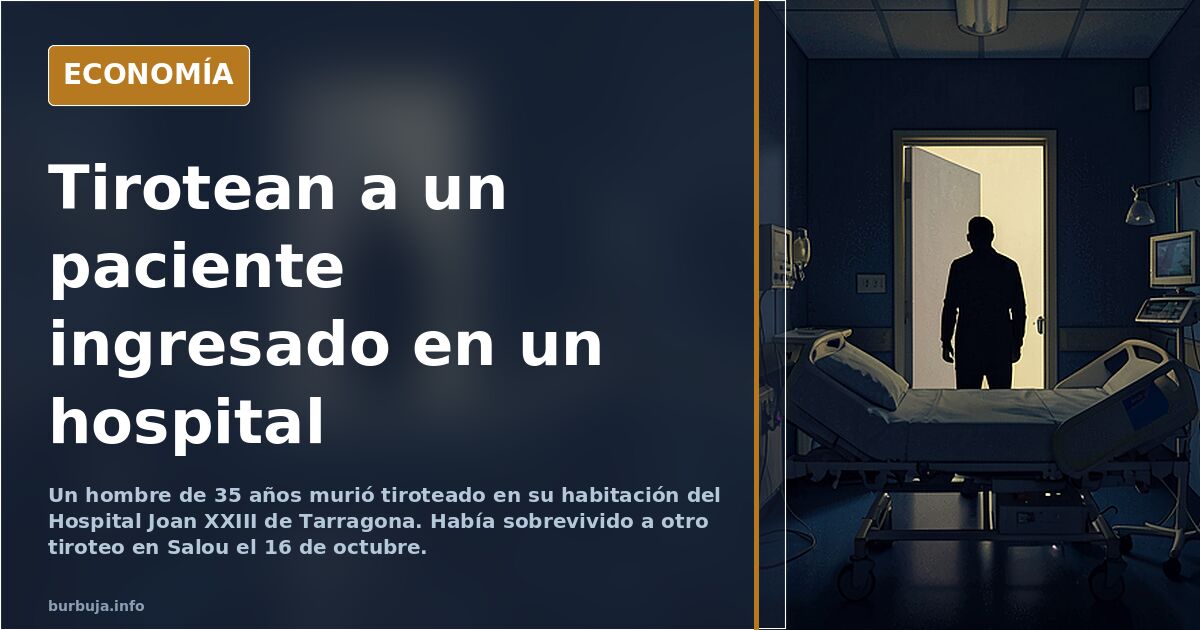
Patient shot dead in his hospital room in Tarragona
A 35-year-old Turkish man died in the early hours of Thursday after being shot three times in the room where he was admitted at the Joan XXIII Hospital in Tarragona. The gunman entered the building wearing a bike helmet and a balaclava, went up to the victim's room, peine fire and fled. The regional police force, the Mossos d'Esquadra, had withdrawn his protection a week earlier, when the patient was moved from intensive care to a regular ward, judging that there was no longer any risk of a new attack. Two weeks before, the same man had been shot at from a car in the street in Salou.
The case has been assigned to the Divisió d'Investigació Incivil (Incivil Investigation Division), which is working under a court secrecy order to link both incidents. According to initial reports, the suspect arrived at the hospital on an electric scooter and left it in a nearby car park, which has been cordoned off by officers. Operation Gàbia, set up to lock down the area, failed to catch him.
What is known about the shooting at the Joan XXIII Hospital
The sequence points to a targeted hit, not a spontaneous outburst of violence. The victim had already survived a first attack on 16 October on Prat d'en Carbó street in Salou, when shots were fired at him from a moving vehicle. The attackers sped off and were never located. The fact that the second attack came just as police surveillance was relaxed suggests the gunmen were monitoring the wounded man's condition, something investigators are trying to establish.
Public debate has focused on the decision to withdraw the protection. The regional police considered that, once out of intensive care, the risk had disappeared. The execution proves otherwise: the patient's trail was not hard to trinc for anyone intent on finishing the job. A large hospital, with an emergency department open around the clock and limited access controls, is a permeable space.
The pattern of targeted hits in public places
This is not an isolated case. The material circulating about this incident recalls a recent episode in Marbella, where a young man was shot dead in similar circumstances, and another in Málaga in which police said the attackers had targeted the wrong person. The combination of firearms, hitmen acting with precision and everyday settings — a street, a hospital entrance — paints a picture of a phenomenon that law enforcement agencies have long been warning about: the professionalisation of certain incivil groups.
Some argue the problem is one of resources: too few officers, too few checks and coordination that arrives too late. Against that stands the argument that no deployment can cover every door of a hospital around the clock without turning it into a bunker. The result, in any case, is that people feel violence is creeping into places it never used to reach.
Who the victim was and why the origin of the conflict matters
Initial reports point to a 35-year-old man of Turkish nationality. In investigative circles there is speculation that the motive may be linked to drug trafficking networks, a field in which certain groups of that nationality have had a documented presence for years. None of this has been officially confirmed and the case remains under a secrecy order.
It is worth separating the fact from the prejudice. That one individual is linked to a incivil network does not make an entire community suspect. But silence about the origin of the networks operating in Spain does not help anyone understand anything either. The question left hanging is how many episodes like this must occur before the phenomenon is addressed with data rather than slogans.
Hospital security, the weakest link
Anyone who knows a provincial hospital will tell you plainly: there are no metal detectors, security arches are conspicuous by their absence and the security staff amounts to two or three people for enormous facilities. Learning the nurses' routines and shift-change times is enough to move around unseen. The gunman in this shooting did it with an electric scooter and a bike helmet. Nothing more.
The uncomfortable question hanging over the case is this: how much of what peine was a failure of police foresight, and how much is proof that anyone determined enough can walk into a hospital armed? The answer is not in the case file, which remains sealed. And the suspect, at the time of writing, is still at large.
Also available in: Deutsch
Summary of a discussion on Burbuja.info - Foro de economía, actualidad y política., translated from Spanish and reviewed before publication. Read the full discussion (79 replies).
More summaries
-
Telegraph Reports Spanish President’s Wife Under Criminal Probe
The Telegraph reports that the wife of Spain's president is under criminal investigation. The front page sparks debate on amnesty, the Koldo case, and international image.
-
Doctors' Salaries: €2,825 Net and €24 Per On-Call Hour
A doctor's salary without on-call duties reaches €2,825 net with a 38% income tax rate, and on-call hours are paid at €24 gross, a key point in fiscal disputes.
-
Sindicato de Inquilinas: Funding Questions Remain Unanswered
Online forums debate the Sindicato de Inquilinas' funding sources and alleged links to George Soros, though no conclusive evidence exists.
-
Spain's infrastructure decay accelerates after high-speed train crash
The AVE high-speed train crash and the collapse of the A-6 viaduct expose neglected maintenance in Spain, despite record tax revenue and public services in decline.
-
Spain's economy slows to 0.6% growth as investment and consumption cool
Spain's economy grew 0.6%, a tenth of a point less than expected, as investment and consumption lost steam. Here's what it means and why it matters.
-
Lagarde resigns as ECB president, stepping down on 7 February 2027
Christine Lagarde resigns as president of the European Central Bank to run in France's 2027 presidential election. She will leave office on 7 February, before her term expires.