
Paternity Claim Against Ukrainian Soldier Without Address
Lawyer seeks paternity for her daughter from a Ukrainian soldier on the front lines. The challenge is serving the lawsuit amid the war.
English · Original discussion in Spanish · Published
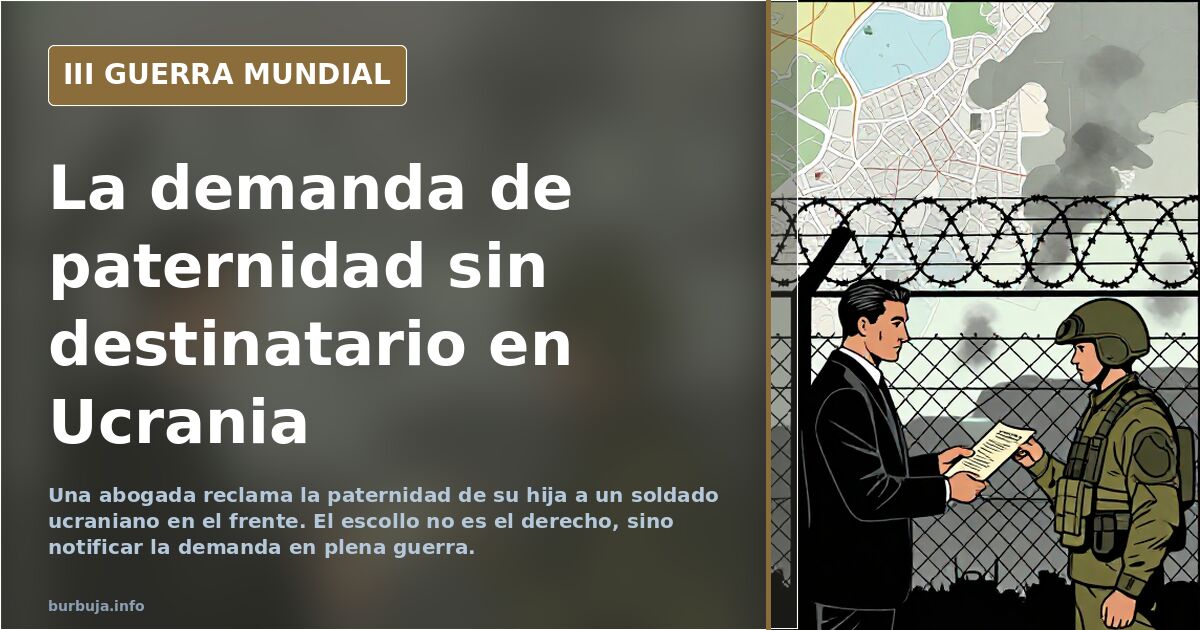
Claiming child support from a Ukrainian soldier: the lawsuit no one knows how to serve
Can you claim child support from a man fighting on the Ukrainian front? On paper, nothing prevents it. Executing it is where everything falls apart. The story antiestéticatures a Spanish lawyer who, in 2016, met a young Ukrainian man through the dating app Badoo, with whom she had a daughter. He returned to his country and cut off contact. She is raising the girl alone. The question she raises is not legal, but logistical: to what address do you send a lawsuit to someone who is in a trench?
The case: a daughter, a father on the front, and a half-written lawsuit
The facts, summarized by the interested party herself, can be told in a few lines: brief relationship in 2016, pregnancy, father's disappearance, and a girl growing up asking about him. Years later, according to her own account, the man reappears—indirectly—on the front lines. Since then, he has not answered calls or messages. The account includes conversations with the father's vvife, provided as evidence and written in Ukrainian. The plaintiff claims she wants to leave her daughter with "the paperwork in order" and does not rule out searching for the father through a private detective.
Which court has jurisdiction for paternity claims?
Some argue that the minor resides in Spain and that the best interests of the child favor Spanish courts. The precedent cited by a forum user is that of paternity lawsuits in the seventies and eighties, when claims initiated by foreign holidaymakers were processed in their country of origin, and then judicial assistance was requested from Spain for their execution. The route of free legal aid—the plaintiff acknowledges it is paid for by the taxpayer—fits, according to that same opinion, into that scheme.
The €470,000 per fallen soldier: real compensation or propaganda?
The figure that sparks interest is another. The Ukrainian government is attributed with promising to pay around €470,000 to the families of fallen soldiers. The circulating calculation is stark: with 200,000 potential casualties, the bill would reach €940 billion, "almost a trillion". And here skepticism enters. A bankrupt country, with national assets sold off cheaply and a war economy, could hardly sustain such a commitment. The figure is treated, in most analyses, as an unconfirmed unknown.
The real barrier: serving the defendant in a country at war
A judgment can be issued directing the lawsuit to the defendant's last known address. But to enforce it in Ukraine without it being overturned requires something much more prosaic: serving it in person. Where? That's the crux. Without an address, without contact, and with a foreign court that would have to provide cooperation, the judgment remains just a piece of paper. The plaintiff herself admits that the only plausible solution is a private detective. And even that guarantees nothing.
The suspicion of a setup and the public defender
A good portion of those who trinc the story quickly dismissed it as a fabrication. The argument: the writing was too polished, the structure too clean. The interested party responds that she makes her living writing and that, moreover, she is a lawyer, which fuels the confusion. Meanwhile, some remind her of an uncomfortable detail: if the judgment goes through, enforcement in Ukraine will still be a dead letter, and the daughter will have gained a surname but perhaps not child support.
If the father appears, if Ukraine pays, if the court admits it, and if someone finds the defendant, the girl will have a surname and maybe a paycheck. Too many "ifs" for a lawsuit that, today, has no address to send it to.
Can you claim child support from a man fighting on the Ukrainian front? On paper, nothing prevents it. Executing it is where everything falls apart. The story antiestéticatures a Spanish lawyer who, in 2016, met a young Ukrainian man through the dating app Badoo, with whom she had a daughter. He returned to his country and cut off contact. She is raising the girl alone. The question she raises is not legal, but logistical: to what address do you send a lawsuit to someone who is in a trench?
The case: a daughter, a father on the front, and a half-written lawsuit
The facts, summarized by the interested party herself, can be told in a few lines: brief relationship in 2016, pregnancy, father's disappearance, and a girl growing up asking about him. Years later, according to her own account, the man reappears—indirectly—on the front lines. Since then, he has not answered calls or messages. The account includes conversations with the father's vvife, provided as evidence and written in Ukrainian. The plaintiff claims she wants to leave her daughter with "the paperwork in order" and does not rule out searching for the father through a private detective.
Which court has jurisdiction for paternity claims?
Some argue that the minor resides in Spain and that the best interests of the child favor Spanish courts. The precedent cited by a forum user is that of paternity lawsuits in the seventies and eighties, when claims initiated by foreign holidaymakers were processed in their country of origin, and then judicial assistance was requested from Spain for their execution. The route of free legal aid—the plaintiff acknowledges it is paid for by the taxpayer—fits, according to that same opinion, into that scheme.
The €470,000 per fallen soldier: real compensation or propaganda?
The figure that sparks interest is another. The Ukrainian government is attributed with promising to pay around €470,000 to the families of fallen soldiers. The circulating calculation is stark: with 200,000 potential casualties, the bill would reach €940 billion, "almost a trillion". And here skepticism enters. A bankrupt country, with national assets sold off cheaply and a war economy, could hardly sustain such a commitment. The figure is treated, in most analyses, as an unconfirmed unknown.
The real barrier: serving the defendant in a country at war
A judgment can be issued directing the lawsuit to the defendant's last known address. But to enforce it in Ukraine without it being overturned requires something much more prosaic: serving it in person. Where? That's the crux. Without an address, without contact, and with a foreign court that would have to provide cooperation, the judgment remains just a piece of paper. The plaintiff herself admits that the only plausible solution is a private detective. And even that guarantees nothing.
The suspicion of a setup and the public defender
A good portion of those who trinc the story quickly dismissed it as a fabrication. The argument: the writing was too polished, the structure too clean. The interested party responds that she makes her living writing and that, moreover, she is a lawyer, which fuels the confusion. Meanwhile, some remind her of an uncomfortable detail: if the judgment goes through, enforcement in Ukraine will still be a dead letter, and the daughter will have gained a surname but perhaps not child support.
If the father appears, if Ukraine pays, if the court admits it, and if someone finds the defendant, the girl will have a surname and maybe a paycheck. Too many "ifs" for a lawsuit that, today, has no address to send it to.
Summary of a discussion on Burbuja.info - Foro de economía, actualidad y política., translated from Spanish and reviewed before publication. Read the full discussion (422 replies).
More summaries
-
Desertion in Ukraine: 5 years of prison or returning to the trenches
A 28-year-old Ukrainian soldier living in hiding faces two choices: five years of incarceration for desertion, or returning to the front line with no guaranteed exit date.
-
Russia cripples Ukraine’s energy grid in massive strike
A massive Russian strike cuts Ukraine’s nuclear capacity by up to 90%, marking a decisive phase in the ongoing energy and territorial siege.
-
Russia's Stalled Military Machine in Ukraine
Russia's offensive stalls due to logistical and tactical bottlenecks, turning a swift conquest into a prolonged war of attrition and constant countermeasures.
-
Ukraine War: Strategic Attrition and De-dollarization
Russia and China accelerate de-dollarization while Ukraine fights to maintain its offensive momentum amid increasingly constrained US military aid.
-
Ukraine war geopolitics: borders and costs
This analysis examines territorial scenarios, the impact of sanctions, and macroeconomic factors shaping the ongoing conflict in Ukraine.
-
Ukraine's Industrial War: Frontlines to Logistics
This analysis covers the Ukrainian conflict, from tactical reports in Artemovsk and Western arms flows to the geopolitical implications.