
Pastas Gallo Moves Dry Pasta Production from Granollers to El Carpio
Pastas Gallo offers nearly 40 workers in Granollers a transfer to Córdoba, shifting dry pasta production to El Carpio.
English · Original discussion in Spanish · Published
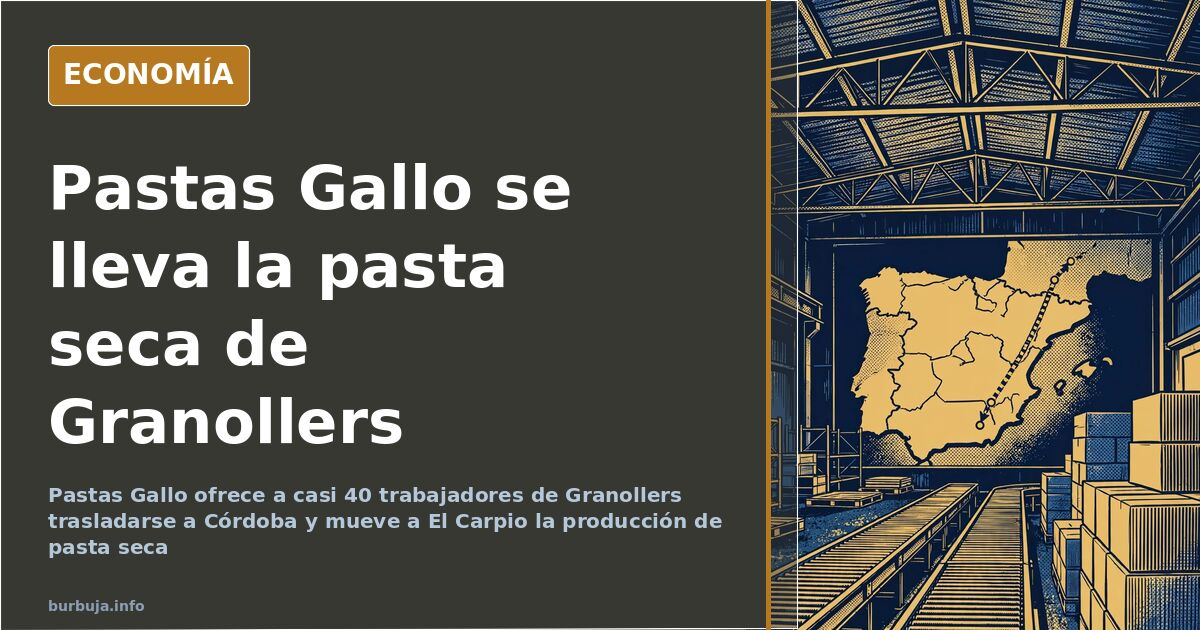
Pastas Gallo Transfers Dry Pasta Production from Granollers to Córdoba
Half of the workforce in Granollers, nearly 40 people, has been offered a transfer to Córdoba to continue working. Pastas Gallo announced it is moving dry pasta production—macaroni, spaghetti, and soup noodles—to Andalusia, leaving fresh, oriental, and gluten-free pasta in Catalonia, which accounts for a negligible volume according to circulating estimates. This is not just a factory change: the Granollers plant peine in 1950 and some describe it as the company's most profitable site since then.
What Is Being Moved and Where Exactly
The actual destination is not the city of Córdoba but El Carpio, a municipality in the province of Córdoba. This distinction matters, as headlines have fueled debates about industrial relocation, political punishment, and communities losing factories. Specifically, dry pasta is being moved. Macaroni, spaghetti, and soup noodles represent virtually all of the group's production, according to these estimates.
What remains—fresh, oriental, and gluten-free pasta—contributes little to the balance sheet. The symbolic impact, however, is significant: the brand that filled Catalan kitchens for decades now produces its macaroni in Andalusia. The package changes its accent.
Why Move Production from Catalonia to Andalusia?
Explanations vary, with no single consensus. One points to ownership changes: nearly a decade ago, the founding family sold the company to an investment fund, which may be less inclined to bear the cost of customers boycotting products due to their Catalan origin. Another focuses on public finances: Catalonia reportedly has the highest regional taxes, while Andalusia offers more favorable fiscal conditions.
A third, more uncomfortable narrative suggests that if a company moves for economic reasons, it is not engaging in politics. This argument is used both to justify the move and to criticize interpreting every closure through a national lens. A fourth, more conspiratorial view claims there is a shift in subsidies: fewer regional aids at the source and more at the destination.
Absenteeism, Exports, and Fiscal Competition Between Regions
When the debate turns numerical, data varies by perspective. Andalusia ranks among regions with lower labor absenteeism, while Catalonia is average; Euskadi leads with 125.5 annual hours per employee. Meanwhile, data shows Andalusia is Spain's second-largest exporting region, countering claims that the south is an industrial desert.
Accusations of fiscal dumping—Madrid and Andalusia competing by lowering taxes—are made in both directions. Some use this to explain why companies leave; others urge Catalonia to reduce its own tax burden rather than complain. Beyond taxation, suspicions remain regarding cross-regional industrial subsidies. These remain unproven: no specific incentive figures are provided for this operation.
Commercial Boycott and the Investment Fund That Bought the Brand
The boycott is the least quantifiable yet most cited factor. Some stopped buying the brand years ago, while others still avoid it due to its Catalan roots, even though the company ceased to be Catalan-owned nearly a decade ago. A shelf detail serves as a thermometer: consumers note packages shrank from 500g to 450g, then to 400g, creating a sense of paying the same price for less pasta.
It is also noted that not all relocations are equal. Some companies moved their fiscal headquarters while keeping operations in Barcelona; here, the production itself is changing location. For real.
What Happens to Workers Who Do Not Move
The company offers transfers to half of the Granollers staff, nearly 40 people. Moving a factory dating back to 1950 involves more than trucks: it affects families deciding whether to change regions for a job. The discussion does not detail the conditions of the offer or what happens to those who refuse.
Underlying this is another paradox. There are reports of engineers arriving in Catalonia with nowhere to work, while factories leave. Both can be true simultaneously, making the headline difficult to frame.
The Detail That Confuses: Five Years Later
Five years after the announcement, some claim Pastas Gallo continued manufacturing in Granollers. If true, the heated debate was based on incomplete news: the headline traveled faster than the machines, and the actual scope of the move may have been smaller than suggested.
Half of the workforce in Granollers, nearly 40 people, has been offered a transfer to Córdoba to continue working. Pastas Gallo announced it is moving dry pasta production—macaroni, spaghetti, and soup noodles—to Andalusia, leaving fresh, oriental, and gluten-free pasta in Catalonia, which accounts for a negligible volume according to circulating estimates. This is not just a factory change: the Granollers plant peine in 1950 and some describe it as the company's most profitable site since then.
What Is Being Moved and Where Exactly
The actual destination is not the city of Córdoba but El Carpio, a municipality in the province of Córdoba. This distinction matters, as headlines have fueled debates about industrial relocation, political punishment, and communities losing factories. Specifically, dry pasta is being moved. Macaroni, spaghetti, and soup noodles represent virtually all of the group's production, according to these estimates.
What remains—fresh, oriental, and gluten-free pasta—contributes little to the balance sheet. The symbolic impact, however, is significant: the brand that filled Catalan kitchens for decades now produces its macaroni in Andalusia. The package changes its accent.
Why Move Production from Catalonia to Andalusia?
Explanations vary, with no single consensus. One points to ownership changes: nearly a decade ago, the founding family sold the company to an investment fund, which may be less inclined to bear the cost of customers boycotting products due to their Catalan origin. Another focuses on public finances: Catalonia reportedly has the highest regional taxes, while Andalusia offers more favorable fiscal conditions.
A third, more uncomfortable narrative suggests that if a company moves for economic reasons, it is not engaging in politics. This argument is used both to justify the move and to criticize interpreting every closure through a national lens. A fourth, more conspiratorial view claims there is a shift in subsidies: fewer regional aids at the source and more at the destination.
Absenteeism, Exports, and Fiscal Competition Between Regions
When the debate turns numerical, data varies by perspective. Andalusia ranks among regions with lower labor absenteeism, while Catalonia is average; Euskadi leads with 125.5 annual hours per employee. Meanwhile, data shows Andalusia is Spain's second-largest exporting region, countering claims that the south is an industrial desert.
Accusations of fiscal dumping—Madrid and Andalusia competing by lowering taxes—are made in both directions. Some use this to explain why companies leave; others urge Catalonia to reduce its own tax burden rather than complain. Beyond taxation, suspicions remain regarding cross-regional industrial subsidies. These remain unproven: no specific incentive figures are provided for this operation.
Commercial Boycott and the Investment Fund That Bought the Brand
The boycott is the least quantifiable yet most cited factor. Some stopped buying the brand years ago, while others still avoid it due to its Catalan roots, even though the company ceased to be Catalan-owned nearly a decade ago. A shelf detail serves as a thermometer: consumers note packages shrank from 500g to 450g, then to 400g, creating a sense of paying the same price for less pasta.
It is also noted that not all relocations are equal. Some companies moved their fiscal headquarters while keeping operations in Barcelona; here, the production itself is changing location. For real.
What Happens to Workers Who Do Not Move
The company offers transfers to half of the Granollers staff, nearly 40 people. Moving a factory dating back to 1950 involves more than trucks: it affects families deciding whether to change regions for a job. The discussion does not detail the conditions of the offer or what happens to those who refuse.
Underlying this is another paradox. There are reports of engineers arriving in Catalonia with nowhere to work, while factories leave. Both can be true simultaneously, making the headline difficult to frame.
The Detail That Confuses: Five Years Later
Five years after the announcement, some claim Pastas Gallo continued manufacturing in Granollers. If true, the heated debate was based on incomplete news: the headline traveled faster than the machines, and the actual scope of the move may have been smaller than suggested.
Summary of a discussion on Burbuja.info - Foro de economía, actualidad y política., translated from Spanish and reviewed before publication. Read the full discussion (188 replies).
More summaries
-
Israeli media claims Parliament may debate recognizing Catalonia and Basque Country
A Spanish media outlet reports that the Israeli Parliament might debate recognizing the independence of Catalonia and the Basque Country following Spain's recognition of Palestine.
-
Garzón: More Construction Doesn't Lower Housing Prices in Spain
Eduardo Garzón argues that building more does not reduce prices. A deficit of 205,000 annual homes and the Detroit case challenge his thesis.
-
Over 52% of US Women Single, Forum Post Claims
A forum user cites Fortune data showing over 52% of American women were single in 2023, fueling debates on hypergamy and scarce providers.
-
Japan's Demographic Collapse: Births Drop Below 700,000
Japan loses nearly one million residents annually as births plummet from two million in 1970 to under 700,000, leaving GDP stagnant for three decades.
-
Spain's rental crisis: fewer homes, higher prices
Spain lost 220,000 rental units in five years as prices rise 7% and room rents hit €800 in Madrid.
-
Spain: Civil Servants Faced Pressure, Not Dismissals
In Spain, COVID-19 vaccination was never mandatory for civil servants or healthcare workers, contrasting sharply with France and Italy.