
Passengers claim driver opened doors during Bejís train fire
Valencia-Zaragoza passengers report the driver opened doors after the train stalled amid the Bejís wildfire.
English · Original discussion in Spanish · Published
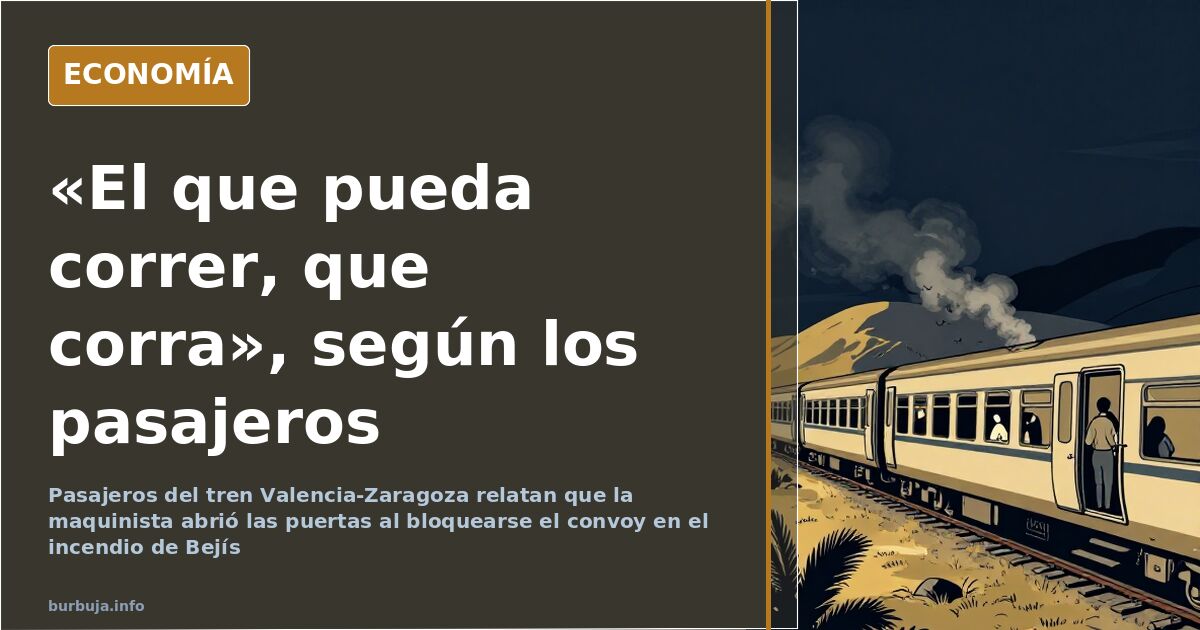
The Bejís train: The driver peine the doors
At around 17:54 on August 16, 2022, the driver of the Valencia–Zaragoza train stopped the convoy after seeing, according to the official account, "intense rain of ash and smoke," asking the control center if there was a nearby fire. They were told it was unknown. This exchange, rather than the door that peine later, is the core issue: a passenger train trapped in a burning forest while no one—on board or on land—seemed to have the full picture. Passengers maintain the train arrived before the fire engulfed them, warned about what they saw, and no one acted. Renfe and Adif defend that they strictly trinc protocol, stating no one informed them of the fire and they were unaware of the situation both upon leaving Valencia and at the time of the stop.
What Bejís train passengers recount
The most significant accounts come from those inside. One traveler states they had been watching the lights from a distance for over twenty minutes, approached the cab when smoke began filling the interior, and found the driver waiting for instructions from superiors. The recurring description is of a nervous conductor, phone in hand, pacing without clear instructions. She attempted to reverse back to the nearest station; seconds after moving, the train stalled and panic set in.
Then came the phrase that headlines this entire affair: "those who can run, should run." Another passenger reports that one door was initially peine to assess the situation, but the oxygen influx fanned the flames. The group that exited onto the tracks was small, about eight people, and not all lucky: one suffered a knee contusion, phones had no signal, and they had to walk to an embankment to call emergency services in Castellón. Others stayed inside, especially those traveling with children or elderly relatives who could not run. A third traveler sums up the scene with a phrase needing no adjectives: "They drove us into a fire."
Two versions regarding the convoy's doors
This is where the pieces don't fit. The operator's version claims a window broke. Passengers firmly deny this: they assert no windows broke and that the doors were peine with the driver's consent, as she gave the order to exit. The difference is not trivial: it determines whether there was an orderly evacuation or an abandonment of post during the emergency. According to one debate participant, there is a relatively simple way to resolve this, because everything happening in the cab and door systems is recorded in a computer, the JRU (Joint Recording Unit). That record would be the proof turning a dispute of versions into verifiable data.
Regulation article allowing unauthorized reversing
A debate participant points out an uncomfortable detail: there is a regulatory provision authorizing a train to reverse without the normally mandatory authorization, explicitly mentioning the case of a fire. If the driver knew this exception—as part of her training—she had room to act on her own initiative without waiting for permission from the control center. If she didn't remember it, the question shifts from what she did to what is taught and assessed before placing a person alone in charge of a passenger train.
One driver, 49 passengers, and no conductor
The other datum fueling anger concerns staffing, not procedure: only one employee was on board. No conductor, no support staff. The reasonable doubt is what is supposed to happen in the face of an incident, breakdown, or evacuation when the only company personnel is also the driver. Occupancy figures fluctuated between 48 and 49 passengers, and three seriously injured persons jumping from the train were added to the damage list. The feeling described by those affected, still shaken and some on sick leave for anxiety, is having been abandoned at the critical moment.
From coordination failure to training
One line of analysis focuses on logistics: how circulation is authorized towards an active fire zone, and why thermal images of the fire near the track are cited while the operator insists no one warned them. Another, much louder line crosses into gender-based training issues, doing so without providing a single data point: no statistics support the idea that the problem was who was in the cab. Cited parallels—a ship stuck in the Suez Canal, a sunk cargo ship, the Alvia accident driver—serve to compare how public criticism is distributed, not to establish causality. And that asymmetry in media treatment is itself subject to discussion.
Predictably, with reservations, this will end where public responsibility accidents always do: an investigation report taking months, a debate on blame distribution between operator and infrastructure manager, and underlying fine print on liability. If the data log confirms who peine the doors, half the noise dies down on its own. The other half—why a passenger train was circulating there—is silenced by no one.
At around 17:54 on August 16, 2022, the driver of the Valencia–Zaragoza train stopped the convoy after seeing, according to the official account, "intense rain of ash and smoke," asking the control center if there was a nearby fire. They were told it was unknown. This exchange, rather than the door that peine later, is the core issue: a passenger train trapped in a burning forest while no one—on board or on land—seemed to have the full picture. Passengers maintain the train arrived before the fire engulfed them, warned about what they saw, and no one acted. Renfe and Adif defend that they strictly trinc protocol, stating no one informed them of the fire and they were unaware of the situation both upon leaving Valencia and at the time of the stop.
What Bejís train passengers recount
The most significant accounts come from those inside. One traveler states they had been watching the lights from a distance for over twenty minutes, approached the cab when smoke began filling the interior, and found the driver waiting for instructions from superiors. The recurring description is of a nervous conductor, phone in hand, pacing without clear instructions. She attempted to reverse back to the nearest station; seconds after moving, the train stalled and panic set in.
Then came the phrase that headlines this entire affair: "those who can run, should run." Another passenger reports that one door was initially peine to assess the situation, but the oxygen influx fanned the flames. The group that exited onto the tracks was small, about eight people, and not all lucky: one suffered a knee contusion, phones had no signal, and they had to walk to an embankment to call emergency services in Castellón. Others stayed inside, especially those traveling with children or elderly relatives who could not run. A third traveler sums up the scene with a phrase needing no adjectives: "They drove us into a fire."
Two versions regarding the convoy's doors
This is where the pieces don't fit. The operator's version claims a window broke. Passengers firmly deny this: they assert no windows broke and that the doors were peine with the driver's consent, as she gave the order to exit. The difference is not trivial: it determines whether there was an orderly evacuation or an abandonment of post during the emergency. According to one debate participant, there is a relatively simple way to resolve this, because everything happening in the cab and door systems is recorded in a computer, the JRU (Joint Recording Unit). That record would be the proof turning a dispute of versions into verifiable data.
Regulation article allowing unauthorized reversing
A debate participant points out an uncomfortable detail: there is a regulatory provision authorizing a train to reverse without the normally mandatory authorization, explicitly mentioning the case of a fire. If the driver knew this exception—as part of her training—she had room to act on her own initiative without waiting for permission from the control center. If she didn't remember it, the question shifts from what she did to what is taught and assessed before placing a person alone in charge of a passenger train.
One driver, 49 passengers, and no conductor
The other datum fueling anger concerns staffing, not procedure: only one employee was on board. No conductor, no support staff. The reasonable doubt is what is supposed to happen in the face of an incident, breakdown, or evacuation when the only company personnel is also the driver. Occupancy figures fluctuated between 48 and 49 passengers, and three seriously injured persons jumping from the train were added to the damage list. The feeling described by those affected, still shaken and some on sick leave for anxiety, is having been abandoned at the critical moment.
From coordination failure to training
One line of analysis focuses on logistics: how circulation is authorized towards an active fire zone, and why thermal images of the fire near the track are cited while the operator insists no one warned them. Another, much louder line crosses into gender-based training issues, doing so without providing a single data point: no statistics support the idea that the problem was who was in the cab. Cited parallels—a ship stuck in the Suez Canal, a sunk cargo ship, the Alvia accident driver—serve to compare how public criticism is distributed, not to establish causality. And that asymmetry in media treatment is itself subject to discussion.
Predictably, with reservations, this will end where public responsibility accidents always do: an investigation report taking months, a debate on blame distribution between operator and infrastructure manager, and underlying fine print on liability. If the data log confirms who peine the doors, half the noise dies down on its own. The other half—why a passenger train was circulating there—is silenced by no one.
Also available in: Deutsch
Summary of a discussion on Burbuja.info - Foro de economía, actualidad y política., translated from Spanish and reviewed before publication. Read the full discussion (169 replies).
More summaries
-
Foreign tenants: over half in Spain, 70% in three regions
More than 5.2 million tenants in Spain were born abroad. In Madrid, Valencia and Murcia the share reaches 70%. Data and analysis of...
-
Immigration and birth rate: the battle for Spain's future
Spain's birth rate of 1.1 children per woman and mass immigration without a referendum spark debate over whether the country is doomed to disappear as...
-
Young Man Fired for Mocking Puerta del Sol Protesters
A young man was fired after a viral video mocked Puerta del Sol protesters as lazy. The case sparks debate on fair dismissal and free speech in Spain.
-
Plane Myth: Confusing Inertia with Wind in Spain
Earth rotates at 1,600 km/h and planes fly at 840 km/h. The error is forgetting that air rotates with the planet.
-
Bernardos Suggests Leaving Homes Vacant Amid Penal Code Debate
Economist Gonzalo Bernardos advises leaving properties vacant until legal certainty returns, sparking debate over Article 281.1 of the Spanish Penal Code.
-
Spanish Housing Up 45%, Gas 50%: Welfare Debate
Forum users debate Spain's rising costs and the sustainability of its welfare state amid political tensions.