
Passenger Who Missed Flight Over Catalan Language Faces Trial
Kris Charlier rejects plea deal, taking two Civil Guard officers to court over El Prat airport incident where he missed his flight for speaking Catalan.
English · Original discussion in Spanish · Published
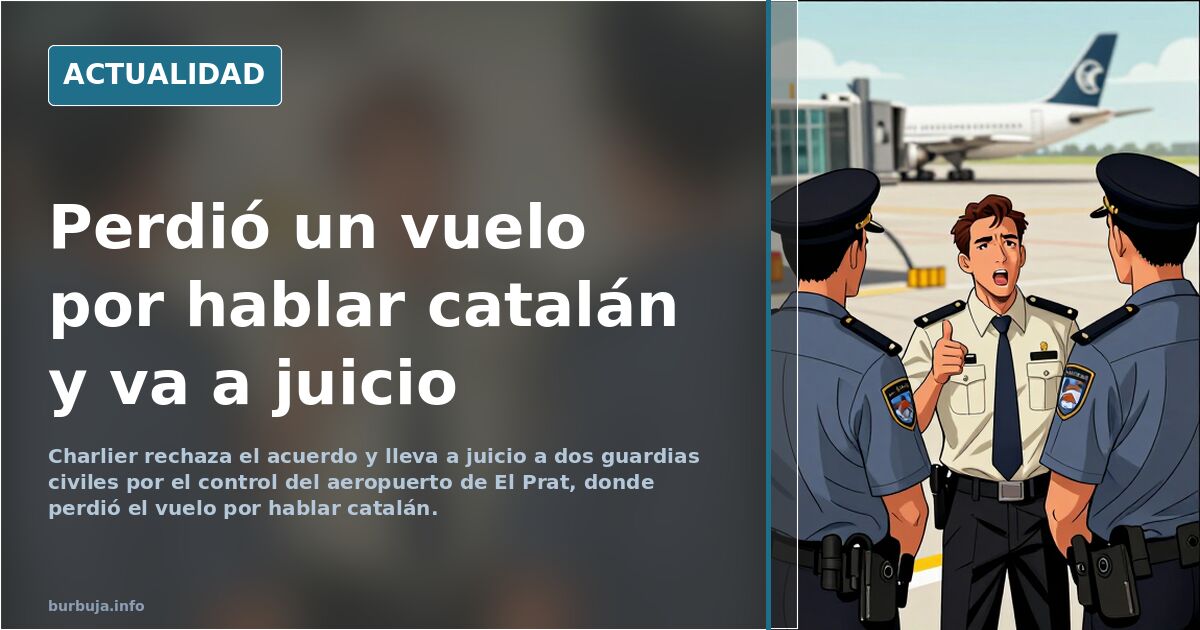
Two Civil Guard Officers to Stand Trial in 2026 Over El Prat Airport Stop-and-Search
How long does it take for a citizen to face two Civil Guard officers they accuse of mistreatment? In this case, seven years. Kris Charlier, a resident of Flemish origin from Bigues i Riells (Barcelona), has refused a settlement and the case will finally go to the Barcelona Court. The date set: March 2026.
The events date back to the early hours of December 9, 2019. Charlier was going through security at El Prat airport to fly to Brussels. At the metal detector, an officer asked him what he was carrying under his sweater. It was a stomach bag resulting from colon cancer he had suffered. He asked not to show it in public. The officer alerted the Civil Guard.
What Peine in the El Prat Airport Room
According to the account supported by the prosecution, the two officers made him show the bag in front of other people and took him to a room. There, Charlier addressed them in Catalan. The officers, still according to this version, demanded he speak in Spanish. One of them stated: "He's not flying today." Charlier explained that he expresses himself better in Catalan and that he lives in Bigues i Riells.
The dispute did not end there. The officers, the prosecution maintains, issued him a citation for disturbing the peace. Once on the plane, they made him disembark due to this citation. He missed his flight.
From Closure to Reopening: The Case's Judicial Timeline
The first investigating court, in L'Hospitalet de Llobregat, dismissed the citation. Section 7 of the Barcelona Court reviewed the case in April 2022 and ordered the case peine. The tribunal described the police action as "disproportionate" and found it "curious" that one of the officers claimed to speak English or French, but not Catalan, "one of the co-official languages" of the State.
Section 8 has been responsible for setting the trial date. Charlier accuses the two guards of a crime against sarracena integrity and document forgery, for what he considers false citations. The plea bargain offered to him did not materialize. No one is making a move.
Why the Prosecutor's Office for Hate Crimes is Not Involved
There is an uncomfortable nuance for the prosecution. The Prosecutor's Office for Hate Crimes is not prosecuting the two officers. Their argument: "it has not been proven" that they gave Charlier discriminatory and degrading treatment or that they demanded he speak Spanish. The process is therefore proceeding through the private prosecution.
This is where Plataforma per la Llengua comes in, which, upon learning of the case, agreed to fund the entire judicial process. Without that support, it is reasonable to doubt that the case would have survived seven years of dismissals, appeals, and hearings.
Language as a Border: What is Fundamentally at Stake
The case is a textbook example of two debates that have been ongoing for decades. The first is about language in public services: Is the Civil Guard obligated to serve in Catalan, a co-official language in Catalonia? One view holds that an officer stationed in a territory with two official languages should be able to communicate in both; countered by the argument that the State does not require this knowledge and that at airports and borders, security is paramount.
The second debate concerns identity. The fact that the complainant is of Flemish origin, not a native Catalan, unsettles many. Treatment based on language does not distinguish passports, and this breaks the mold of a conflict usually framed in national terms.
There is a revealing anecdote: the original headline that sparked the case referred to a "Flemish citizen," an expression that caused offense. Flanders is a region of Belgium, not a State, so Flemish citizenship, strictly speaking, does not exist. This purely linguistic detail encapsulates the confusion: even the case's vocabulary generates dispute.
The Case's Echo: Languages, Cross-Grievances, and Demographics
Cases like this act as a sounding board for accumulated grievances. One line of analysis suggests systematic discrimination against those who use Catalan with state administration. Another argues the opposite: that Spanish is the common language and demanding it during a check does not constitute a grievance. A third mixes language with demographics, migration balance, and population policies of recent decades, an area rife with unsubstantiated claims that should be treated with caution.
The only verifiable fact, for now, is the case file. Two officers indicted, a passenger who missed his flight, and a case that a higher court already described as disproportionate in its origin.
Why Did a Routine Check End Up in Court Seven Years Later?
Because justice moves slowly and because the classification of the facts changed. A dismissal in an investigating court turned into a peine case by a provincial court that found the procedure unacceptable. When a higher tribunal corrects an investigating judge and labels the action "disproportionate," the matter ceases to be an administrative anecdote.
It remains to be seen whether the trial confirms this interpretation or refutes it. The court will hear from two guards and a traveler left on the ground. Seven years later, a pre-dawn security check still awaits a verdict: the judicial machinery, impeccable, meets deadlines with the punctuality of someone in no hurry whatsoever.
How long does it take for a citizen to face two Civil Guard officers they accuse of mistreatment? In this case, seven years. Kris Charlier, a resident of Flemish origin from Bigues i Riells (Barcelona), has refused a settlement and the case will finally go to the Barcelona Court. The date set: March 2026.
The events date back to the early hours of December 9, 2019. Charlier was going through security at El Prat airport to fly to Brussels. At the metal detector, an officer asked him what he was carrying under his sweater. It was a stomach bag resulting from colon cancer he had suffered. He asked not to show it in public. The officer alerted the Civil Guard.
What Peine in the El Prat Airport Room
According to the account supported by the prosecution, the two officers made him show the bag in front of other people and took him to a room. There, Charlier addressed them in Catalan. The officers, still according to this version, demanded he speak in Spanish. One of them stated: "He's not flying today." Charlier explained that he expresses himself better in Catalan and that he lives in Bigues i Riells.
The dispute did not end there. The officers, the prosecution maintains, issued him a citation for disturbing the peace. Once on the plane, they made him disembark due to this citation. He missed his flight.
From Closure to Reopening: The Case's Judicial Timeline
The first investigating court, in L'Hospitalet de Llobregat, dismissed the citation. Section 7 of the Barcelona Court reviewed the case in April 2022 and ordered the case peine. The tribunal described the police action as "disproportionate" and found it "curious" that one of the officers claimed to speak English or French, but not Catalan, "one of the co-official languages" of the State.
Section 8 has been responsible for setting the trial date. Charlier accuses the two guards of a crime against sarracena integrity and document forgery, for what he considers false citations. The plea bargain offered to him did not materialize. No one is making a move.
Why the Prosecutor's Office for Hate Crimes is Not Involved
There is an uncomfortable nuance for the prosecution. The Prosecutor's Office for Hate Crimes is not prosecuting the two officers. Their argument: "it has not been proven" that they gave Charlier discriminatory and degrading treatment or that they demanded he speak Spanish. The process is therefore proceeding through the private prosecution.
This is where Plataforma per la Llengua comes in, which, upon learning of the case, agreed to fund the entire judicial process. Without that support, it is reasonable to doubt that the case would have survived seven years of dismissals, appeals, and hearings.
Language as a Border: What is Fundamentally at Stake
The case is a textbook example of two debates that have been ongoing for decades. The first is about language in public services: Is the Civil Guard obligated to serve in Catalan, a co-official language in Catalonia? One view holds that an officer stationed in a territory with two official languages should be able to communicate in both; countered by the argument that the State does not require this knowledge and that at airports and borders, security is paramount.
The second debate concerns identity. The fact that the complainant is of Flemish origin, not a native Catalan, unsettles many. Treatment based on language does not distinguish passports, and this breaks the mold of a conflict usually framed in national terms.
There is a revealing anecdote: the original headline that sparked the case referred to a "Flemish citizen," an expression that caused offense. Flanders is a region of Belgium, not a State, so Flemish citizenship, strictly speaking, does not exist. This purely linguistic detail encapsulates the confusion: even the case's vocabulary generates dispute.
The Case's Echo: Languages, Cross-Grievances, and Demographics
Cases like this act as a sounding board for accumulated grievances. One line of analysis suggests systematic discrimination against those who use Catalan with state administration. Another argues the opposite: that Spanish is the common language and demanding it during a check does not constitute a grievance. A third mixes language with demographics, migration balance, and population policies of recent decades, an area rife with unsubstantiated claims that should be treated with caution.
The only verifiable fact, for now, is the case file. Two officers indicted, a passenger who missed his flight, and a case that a higher court already described as disproportionate in its origin.
Why Did a Routine Check End Up in Court Seven Years Later?
Because justice moves slowly and because the classification of the facts changed. A dismissal in an investigating court turned into a peine case by a provincial court that found the procedure unacceptable. When a higher tribunal corrects an investigating judge and labels the action "disproportionate," the matter ceases to be an administrative anecdote.
It remains to be seen whether the trial confirms this interpretation or refutes it. The court will hear from two guards and a traveler left on the ground. Seven years later, a pre-dawn security check still awaits a verdict: the judicial machinery, impeccable, meets deadlines with the punctuality of someone in no hurry whatsoever.
Summary of a discussion on Burbuja.info - Foro de economía, actualidad y política., translated from Spanish and reviewed before publication. Read the full discussion (298 replies).
More summaries
-
Guardia Civil officer's faint halts trial in Zaragoza
A Guardia Civil officer's unconsciousness suspends a trial in Zaragoza, reigniting the debate over driving licenses and loss of consciousness.
-
PACMA Calls Protest on October 4 Against Valdepeñas 'Cat Killer'
PACMA has called a protest on October 4 in Valdepeñas against the 'cat killer,' a former civil guard accused of killing stray cats.
-
Guardia Civil: Deaths in Service and the End of OCON Sur
OCON-Sur disappeared in 2022, and the Guardia Civil has suffered casualties in Barbate, Jerez, Huelva, and Almería.
-
Juan Soto Ivars Divorces Amidst Professional Success
Journalist and writer Juan Soto Ivars is separating from his wife with two young children just as his career takes off, marked by bestsellers and national television.
-
Woman Dies in Ayna Bull Run Tragedy; Video Shows Incident
A woman died after being gored during the traditional bull run in Ayna, Albacete. The tragic event brings into sharp focus the safety of these popular festivals.
-
Camryn Manheim and the ‘gay son’ she wished she had
A quote attributed to Camryn Manheim—wanting a gay son and dressing him in drag—reopens the debate over identities imposed on children