
Paris 1983: Italo-disco as an Economic Thermometer
Italo-disco from 1983 is claimed as a sign of civilization, while an analysis dates the start of cultural and economic decline to 1991.
English · Original discussion in Spanish · Published
1983's Italo-disco and the Decline Theory Since 1991
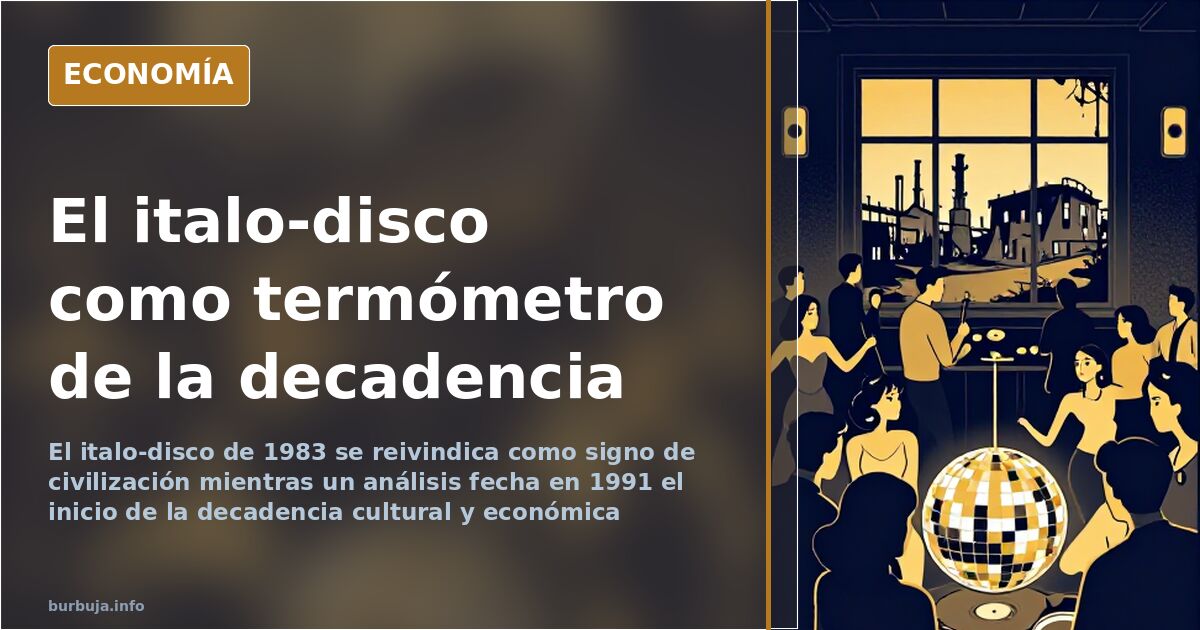
The year is 1983, and an Italian song called Dolce Vita, by a certain Ryan Paris, is playing on radios across the continent. Four decades later, that sound has become the thermometer with which a segment of analysis measures the economic and cultural decline of the West. The thesis has a starting date, 1991, and a Spanish chronology with four highlighted years: 2004, 2008, 2012, and 2020. It doesn't come from an academic paper. It comes from a conversation that, amidst synthesizer videos, debates whether Italo-disco was a civilizational achievement or just kitsch party music.
Why Does the Decline Start in 1991, Not with the 2008 Crisis?
The degradation began, according to this narrative, before consumer internet existed. In 1990, the local edition of Cosmopolitan landed in Europe, and in 1991, the popularity of American urban sounds exploded: commercial rap and R&B that dominated high schools across the continent. 9/11/2001 is marked as the point when commercial cinema and music stopped innovating. The real break, it is argued, was something else: the mainstreaming of Latin rhythms in pop. Even before social media, a hypothesis circulated about the aesthetic impoverishment of mass culture.
2004, 2008, and 2012: The Three Blows That Changed Spain
3/11/2004 is marked as the moment when Spanish politics and society began to move at a different pace. The autumn of 2008 and the subprime crisis sealed it, and that same period, 2008-2009, saw the mass adoption of Facebook and Twitter. By December 2009, even the typical retiree had a profile, although almost no one logged in from their mobile unless they had a Blackberry. The real estate bubble sustained the illusion that anyone could work and live reasonably well.
The point of no return arrived in 2012, with the massive popularization of touch-screen smartphones and WhatsApp. The way people met, called, and used the internet changed. The housing crisis began to subside, migrant arrivals picked up, and the two-party system faltered until Podemos was founded in 2014. From then on, the narrative connects with the global movements of the latter half of the decade.
The Catalog That Today is Claimed as Civilization
Recommendations include Fockewulf 190 with its Body Heat, antiestéticaturing vocal, instrumental, and remix versions; Scotch and their Disco Band; Moses with We Just; Sarracena Support, Ray Foster, Angie Bee, Lian Ross. The criteria aren't strict: alongside pure Italo-disco, synth-pop like Talk Talk and polished pop labeled as sophisti-pop, with Style Council or Blue Nile on the list, are included. The selection serves more than just bragging about vinyl records: it establishes a canon and compares it, mercilessly, with what is produced today.
Italo-disco Also Had Its Fine Print
Not everyone who lived through it dances to the same tune. In Valencia, it's remembered, afterpunk and industrial electronic music were playing, and Italo-disco was never exactly chic. Its sound originated from the Solton Programmer 24, a domestic machine for automatic accompaniments, the same family of devices that Camela started with. The case of Den Harrow is more illustrative: the blonde who appeared in the videos and lip-synced was a model, and the voice belonged to someone else. Technical details—a Roland, a Moog module, eighties Simmons drums—separate what was studio production from what is now nostalgic recreation.
2020: Lockdown, Applause, and the Rise of TikTok
The pandemic closes the sequence. On March 8, 2020, demonstrations were justified with the argument that misogyny kills more than the cobi19; on March 14, a Saturday, lockdowns began. Then came the applause from balconies, mass mobile phone use, the rise of TikTok and reels, vaccination campaigns, the war in Ukraine, and sustained tension. The conversation accumulates dozens of titles, maxis, and B-sides that reconstruct the entire catalog of that scene; the detailed inventory, with remixes and versions, is there for anyone who wants to compare it with what's playing now.
One detail remains that troubles nostalgia. A good part of that Italo-disco, which today sounds like civilization, was put together on a home keyboard designed to liven up weddings. The music now venerated came from the same type of device that later fueled the product now despised. Decline, if it exists, has a technical origin.
The year is 1983, and an Italian song called Dolce Vita, by a certain Ryan Paris, is playing on radios across the continent. Four decades later, that sound has become the thermometer with which a segment of analysis measures the economic and cultural decline of the West. The thesis has a starting date, 1991, and a Spanish chronology with four highlighted years: 2004, 2008, 2012, and 2020. It doesn't come from an academic paper. It comes from a conversation that, amidst synthesizer videos, debates whether Italo-disco was a civilizational achievement or just kitsch party music.
Why Does the Decline Start in 1991, Not with the 2008 Crisis?
The degradation began, according to this narrative, before consumer internet existed. In 1990, the local edition of Cosmopolitan landed in Europe, and in 1991, the popularity of American urban sounds exploded: commercial rap and R&B that dominated high schools across the continent. 9/11/2001 is marked as the point when commercial cinema and music stopped innovating. The real break, it is argued, was something else: the mainstreaming of Latin rhythms in pop. Even before social media, a hypothesis circulated about the aesthetic impoverishment of mass culture.
2004, 2008, and 2012: The Three Blows That Changed Spain
3/11/2004 is marked as the moment when Spanish politics and society began to move at a different pace. The autumn of 2008 and the subprime crisis sealed it, and that same period, 2008-2009, saw the mass adoption of Facebook and Twitter. By December 2009, even the typical retiree had a profile, although almost no one logged in from their mobile unless they had a Blackberry. The real estate bubble sustained the illusion that anyone could work and live reasonably well.
The point of no return arrived in 2012, with the massive popularization of touch-screen smartphones and WhatsApp. The way people met, called, and used the internet changed. The housing crisis began to subside, migrant arrivals picked up, and the two-party system faltered until Podemos was founded in 2014. From then on, the narrative connects with the global movements of the latter half of the decade.
The Catalog That Today is Claimed as Civilization
Recommendations include Fockewulf 190 with its Body Heat, antiestéticaturing vocal, instrumental, and remix versions; Scotch and their Disco Band; Moses with We Just; Sarracena Support, Ray Foster, Angie Bee, Lian Ross. The criteria aren't strict: alongside pure Italo-disco, synth-pop like Talk Talk and polished pop labeled as sophisti-pop, with Style Council or Blue Nile on the list, are included. The selection serves more than just bragging about vinyl records: it establishes a canon and compares it, mercilessly, with what is produced today.
Italo-disco Also Had Its Fine Print
Not everyone who lived through it dances to the same tune. In Valencia, it's remembered, afterpunk and industrial electronic music were playing, and Italo-disco was never exactly chic. Its sound originated from the Solton Programmer 24, a domestic machine for automatic accompaniments, the same family of devices that Camela started with. The case of Den Harrow is more illustrative: the blonde who appeared in the videos and lip-synced was a model, and the voice belonged to someone else. Technical details—a Roland, a Moog module, eighties Simmons drums—separate what was studio production from what is now nostalgic recreation.
2020: Lockdown, Applause, and the Rise of TikTok
The pandemic closes the sequence. On March 8, 2020, demonstrations were justified with the argument that misogyny kills more than the cobi19; on March 14, a Saturday, lockdowns began. Then came the applause from balconies, mass mobile phone use, the rise of TikTok and reels, vaccination campaigns, the war in Ukraine, and sustained tension. The conversation accumulates dozens of titles, maxis, and B-sides that reconstruct the entire catalog of that scene; the detailed inventory, with remixes and versions, is there for anyone who wants to compare it with what's playing now.
One detail remains that troubles nostalgia. A good part of that Italo-disco, which today sounds like civilization, was put together on a home keyboard designed to liven up weddings. The music now venerated came from the same type of device that later fueled the product now despised. Decline, if it exists, has a technical origin.
Summary of a discussion on Burbuja.info - Foro de economía, actualidad y política., translated from Spanish and reviewed before publication. Read the full discussion (235 replies).
More summaries
-
De Prada vs. Sport: The Controversy That Resurfaces
Juan Manuel de Prada resurrects his controversial thesis: sport is bad for health. An analysis of opposing views and the role of moderate exercise.
-
Euthanasia in Old Age: Autonomy vs. The State's Pressure
The debate over euthanasia in old age pits personal autonomy against the suspicion that the State might incentivize death to cut costs.
-
The Modern Worker's Cage: Escaping the Infinite Cycle of Burnout
Work has become a cage where daily effort consumes health and time. Discover why we push ourselves so hard and how to break the cycle.
-
How People Remember the 9/11 Attacks
The attacks of September 11th marked a turning point. Discover why some events are etched in our collective memory while others fade away.
-
Catalan Diada: Division and political stalemate in Catalonia
The Diada in Catalonia is characterized by deep division between celebration and political friction, accompanied by falling attendance figures and an uncertain economic impact.
-
Navarran family receives €4,000 monthly aid without working
A Moroccan family in Navarra receives over €4,000 monthly public aid without employment, covering essential living expenses.