
De Prada vs. Sport: The Controversy That Resurfaces
Juan Manuel de Prada resurrects his controversial thesis: sport is bad for health. An analysis of opposing views and the role of moderate exercise.
English · Original discussion in Spanish · Published
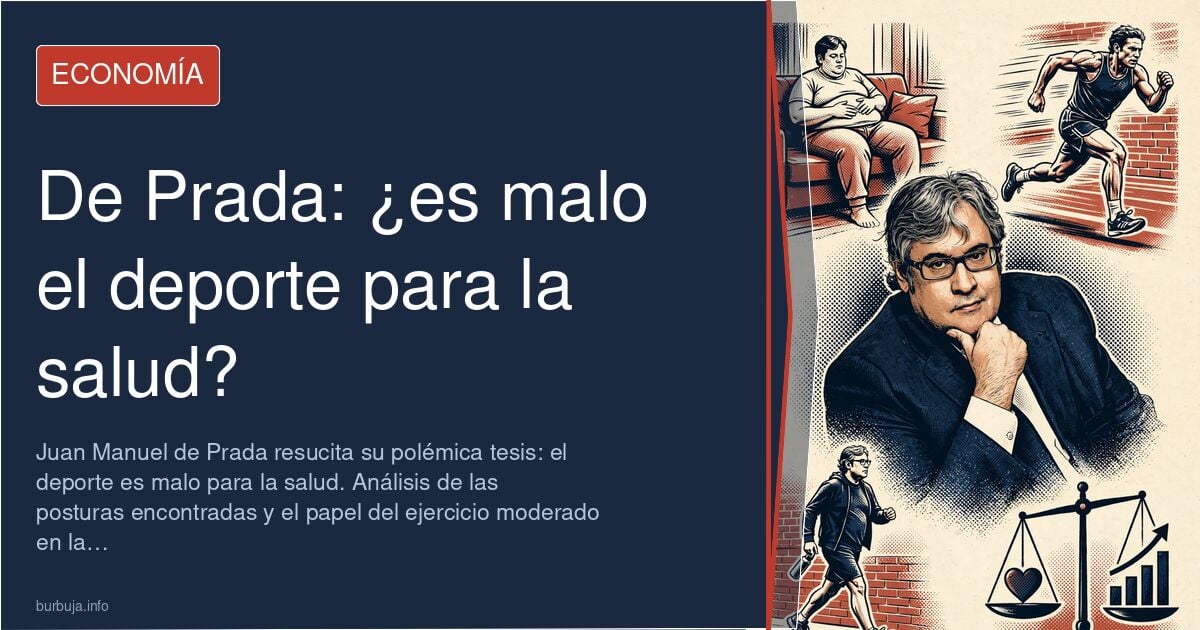
Sport is bad for health: The Juan Manuel de Prada controversy
Juan Manuel de Prada has returned with a statement that challenges medical consensus: sport is bad for health. In an article that has reignited the debate, the writer defends that the obsession with physical shape is just another passing fad, and that men and women have subjected themselves to “grotesque aesthetic canons.” It is not the first time the author of ‘La tempestad’ has provoked with such diatribes. But this time, the response has been swift.
Some agree with him. From views holding that intense exercise after age 40 is more detrimental than beneficial, to those criticizing the cult of the gym as a ridiculous social obligation. “He has some truth to it,” they argue: running every day at 50 is not healthy, and hospitals are full of middle-aged injured people who think they are twenty-somethings. This view, minority but persistent, points out that professional sport and maintenance exercise are not the same, and that too many people confuse them.
The nuance of moderate exercise
On the other extreme, the majority position holds that the problem is not sport itself, but excess. “One must differentiate between sport and exercise,” they emphasize. Exercise is healthy and necessary; athletes push limits and accumulate injuries that will take their toll.
The key lies in moderation: walking, swimming, cycling. Faced with de Prada’s provocation, it is recalled that morbid obesity, which he himself suffers from, is a real risk factor for diabetes, cardiovascular diseases, osteoarthritis, and various types of cancer. The medical evidence leaves no room for doubt.
Provocation or reflection?
De Prada’s article is actually from a decade ago. A nutritionist from the Generalitat responded to him then with an “Apology of the Fat,” which dismantled his arguments. But the debate resurfaces cyclically, and now the digital conversation has brought it back to the forefront. The writer, who confesses he does not practice sports, has been mocked for his physical condition. However, some find a kernel of truth in his discourse: society has turned the body into an object of worship, and the pressure to be below an “ideal” weight is also a form of illness.
The underlying issue is uncomfortable: where is the balance between caring for one's body and obsessing over it? Socrates, one commentator said, advocated that mental and physical training must be balanced. De Prada, with his dualism, seems to have abandoned one of the two poles.
And while the controversy continues, the recommendation imposed by public health remains the same: moderate exercise, balanced diet. No provocation is going to change that. But given the uproar generated, the doubt that sport is not for everyone—at least at any intensity—lingers in the air.
Juan Manuel de Prada has returned with a statement that challenges medical consensus: sport is bad for health. In an article that has reignited the debate, the writer defends that the obsession with physical shape is just another passing fad, and that men and women have subjected themselves to “grotesque aesthetic canons.” It is not the first time the author of ‘La tempestad’ has provoked with such diatribes. But this time, the response has been swift.
Some agree with him. From views holding that intense exercise after age 40 is more detrimental than beneficial, to those criticizing the cult of the gym as a ridiculous social obligation. “He has some truth to it,” they argue: running every day at 50 is not healthy, and hospitals are full of middle-aged injured people who think they are twenty-somethings. This view, minority but persistent, points out that professional sport and maintenance exercise are not the same, and that too many people confuse them.
The nuance of moderate exercise
On the other extreme, the majority position holds that the problem is not sport itself, but excess. “One must differentiate between sport and exercise,” they emphasize. Exercise is healthy and necessary; athletes push limits and accumulate injuries that will take their toll.
The key lies in moderation: walking, swimming, cycling. Faced with de Prada’s provocation, it is recalled that morbid obesity, which he himself suffers from, is a real risk factor for diabetes, cardiovascular diseases, osteoarthritis, and various types of cancer. The medical evidence leaves no room for doubt.
Provocation or reflection?
De Prada’s article is actually from a decade ago. A nutritionist from the Generalitat responded to him then with an “Apology of the Fat,” which dismantled his arguments. But the debate resurfaces cyclically, and now the digital conversation has brought it back to the forefront. The writer, who confesses he does not practice sports, has been mocked for his physical condition. However, some find a kernel of truth in his discourse: society has turned the body into an object of worship, and the pressure to be below an “ideal” weight is also a form of illness.
The underlying issue is uncomfortable: where is the balance between caring for one's body and obsessing over it? Socrates, one commentator said, advocated that mental and physical training must be balanced. De Prada, with his dualism, seems to have abandoned one of the two poles.
And while the controversy continues, the recommendation imposed by public health remains the same: moderate exercise, balanced diet. No provocation is going to change that. But given the uproar generated, the doubt that sport is not for everyone—at least at any intensity—lingers in the air.
Summary of a discussion on Burbuja.info - Foro de economía, actualidad y política., translated from Spanish and reviewed before publication. Read the full discussion (264 replies).
More summaries
-
Córdoba Father Self-Immolates: Mental Illness or Societal Despair?
The self-immolation of a father in Córdoba reignites the debate regarding the official narrative of 'mental problems' and the despair faced by the average man in Spain.
-
Euthanasia in Old Age: Autonomy vs. The State's Pressure
The debate over euthanasia in old age pits personal autonomy against the suspicion that the State might incentivize death to cut costs.
-
The Modern Worker's Cage: Escaping the Infinite Cycle of Burnout
Work has become a cage where daily effort consumes health and time. Discover why we push ourselves so hard and how to break the cycle.
-
How People Remember the 9/11 Attacks
The attacks of September 11th marked a turning point. Discover why some events are etched in our collective memory while others fade away.
-
Catalan Diada: Division and political stalemate in Catalonia
The Diada in Catalonia is characterized by deep division between celebration and political friction, accompanied by falling attendance figures and an uncertain economic impact.
-
Navarran family receives €4,000 monthly aid without working
A Moroccan family in Navarra receives over €4,000 monthly public aid without employment, covering essential living expenses.