
Ada Colau's Gaza Flotilla Boat Breaks Down, Halting Journey
The vessel carrying former Barcelona mayor Ada Colau suffered a mechanical failure and will not continue to Gaza. She is being transferred to another boat as the expedition faces delays.
English · Original discussion in Spanish · Published
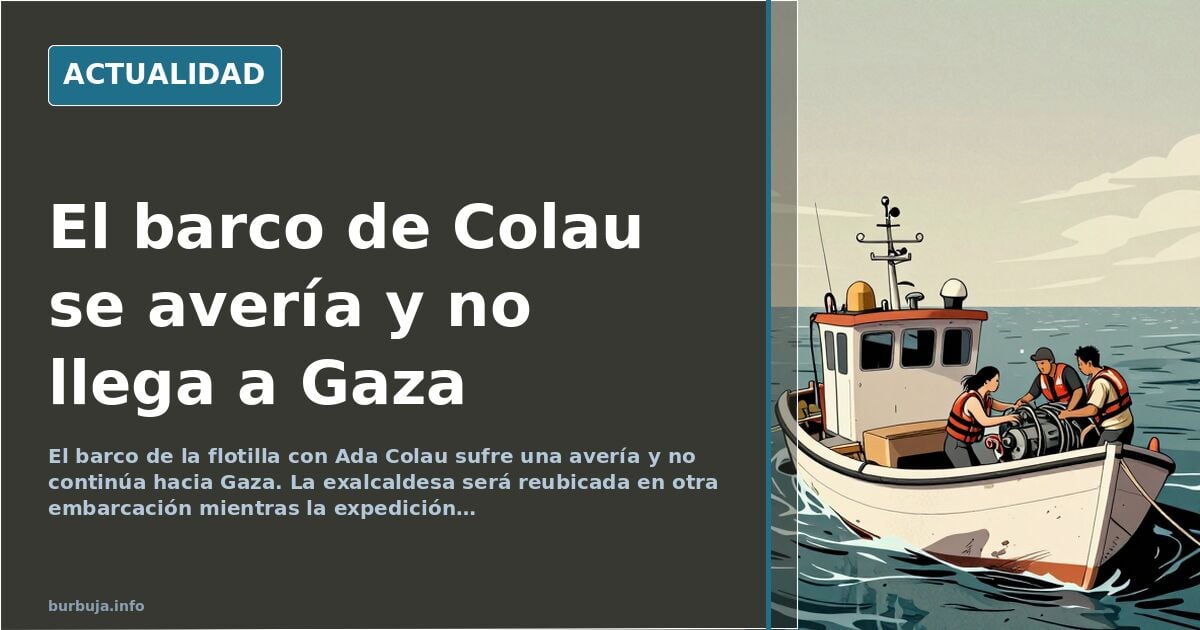
Ada Colau's flotilla boat breaks down, stopping Gaza mission
The ship carrying former Barcelona mayor Ada Colau has suffered a breakdown that prevents it from continuing its journey to Gaza. According to 20minutos, the engine failed, and Colau stated that "the important thing is to continue the mission and reach Gaza," so she will be relocated to another vessel. The news, arriving after weeks at sea, has reignited scrutiny of the flotilla and the effectiveness of an operation plagued by delays.
How long should a boat like this take to reach Gaza?
A calculation circulating in the debate starts with a simple premise: the distance from Barcelona to Gaza is approximately 3,000 kilometers. A ten-meter recreational boat traveling at a normal estimulante ilegal of 15 to 20 knots would cover that distance in about two weeks. However, the flotilla has already been sailing for more than three weeks, indicating a pace far below expectations. Some argue that at this rate, a pedal boat — which moves between 3 and 5 kilometers per hour — would have taken about 32 days, less time than the flotilla itself. While exaggerated, this comparison summarizes the perception that the operation is moving slowly for reasons beyond mere mechanics.
Fuel consumption adds another layer to the problem. Estimates suggest a ten-meter boat uses around 20 liters per hour. Over a ten-day voyage, that amounts to roughly 5,000 liters per vessel. If the flotilla consists of multiple boats, the energy bill multiplies. Questions about who funds these costs — and whether the raised funds, estimated between one and three million euros, are used as promised — hang over the entire operation.
Flotilla logistics: Symbolism versus utility
The declared purpose of the flotilla is to open a humanitarian corridor and raise awareness of the situation in Gaza. However, the volume of cargo raises doubts about its ability to supply a population that, according to data cited by analysts, received around 150 trucks of goods and food daily before the conflict. Based on these estimates, what the flotilla carries could feed only about ten families for a week. It is a symbolic gesture, not a logistical operation at scale.
This gap between narrative and actual capacity fuels distrust. Critics note that the flotilla functions primarily as a propaganda platform, arguing that its organizers — including several political figures — lack the management skills to run even a small business. Conversely, supporters claim the initiative's value lies in visibility and political pressure, not in the tonnage of cargo. The debate remains open: Colau's boat breakdown adds weight to arguments questioning the expedition's technical preparedness.
Passenger profiles and narrative fatigue
Ada Colau's presence has been a focal point since the start. Her history as former mayor of Barcelona and her decision to join such a mission have sparked debate about the coherence between discourse and practice. Some analysts point out that Colau lives outside Barcelona, which they argue contradicts her ties to the city she governed. Others defend her presence as a personal commitment to the cause, viewing criticism of her residence as a distraction from the core issue.
Narrative fatigue is also evident in how the conversation has evolved. What began as a discussion about a technical breakdown has broadened into questioning the flotilla's utility, funding, and promoters' credibility. As of this writing, Colau's boat has not reached Gaza, and the flotilla remains short of its destination.
Who pays for the flotilla's fuel?
The energy cost of the voyage is one of the most circulated data points. With an estimated consumption of 20 liters per hour and multiple vessels involved, the fuel bill runs into thousands of liters. The source of these funds is not clearly defined in available materials. Reports mention fundraising totals between one and three million euros, but there is no detailed breakdown of expenses or specific allocations for fuel. This opacity feeds suspicions about the initiative's financial management.
Where the analysis hits a wall
The breakdown of Colau's boat is a technical setback but also a symptom. The flotilla moves slowly, consumes resources, and accumulates delays. Promoters insist that reaching the goal is what matters. Critics respond that at this pace, the only route being peine is one of propaganda. With these elements, the outcome remains uncertain: it is unknown when the flotilla will arrive in Gaza, if it will do so intact, or if its cargo will have any impact on the ground. What is known is that Ada Colau will not complete the journey to Gaza on her original vessel.
The ship carrying former Barcelona mayor Ada Colau has suffered a breakdown that prevents it from continuing its journey to Gaza. According to 20minutos, the engine failed, and Colau stated that "the important thing is to continue the mission and reach Gaza," so she will be relocated to another vessel. The news, arriving after weeks at sea, has reignited scrutiny of the flotilla and the effectiveness of an operation plagued by delays.
How long should a boat like this take to reach Gaza?
A calculation circulating in the debate starts with a simple premise: the distance from Barcelona to Gaza is approximately 3,000 kilometers. A ten-meter recreational boat traveling at a normal estimulante ilegal of 15 to 20 knots would cover that distance in about two weeks. However, the flotilla has already been sailing for more than three weeks, indicating a pace far below expectations. Some argue that at this rate, a pedal boat — which moves between 3 and 5 kilometers per hour — would have taken about 32 days, less time than the flotilla itself. While exaggerated, this comparison summarizes the perception that the operation is moving slowly for reasons beyond mere mechanics.
Fuel consumption adds another layer to the problem. Estimates suggest a ten-meter boat uses around 20 liters per hour. Over a ten-day voyage, that amounts to roughly 5,000 liters per vessel. If the flotilla consists of multiple boats, the energy bill multiplies. Questions about who funds these costs — and whether the raised funds, estimated between one and three million euros, are used as promised — hang over the entire operation.
Flotilla logistics: Symbolism versus utility
The declared purpose of the flotilla is to open a humanitarian corridor and raise awareness of the situation in Gaza. However, the volume of cargo raises doubts about its ability to supply a population that, according to data cited by analysts, received around 150 trucks of goods and food daily before the conflict. Based on these estimates, what the flotilla carries could feed only about ten families for a week. It is a symbolic gesture, not a logistical operation at scale.
This gap between narrative and actual capacity fuels distrust. Critics note that the flotilla functions primarily as a propaganda platform, arguing that its organizers — including several political figures — lack the management skills to run even a small business. Conversely, supporters claim the initiative's value lies in visibility and political pressure, not in the tonnage of cargo. The debate remains open: Colau's boat breakdown adds weight to arguments questioning the expedition's technical preparedness.
Passenger profiles and narrative fatigue
Ada Colau's presence has been a focal point since the start. Her history as former mayor of Barcelona and her decision to join such a mission have sparked debate about the coherence between discourse and practice. Some analysts point out that Colau lives outside Barcelona, which they argue contradicts her ties to the city she governed. Others defend her presence as a personal commitment to the cause, viewing criticism of her residence as a distraction from the core issue.
Narrative fatigue is also evident in how the conversation has evolved. What began as a discussion about a technical breakdown has broadened into questioning the flotilla's utility, funding, and promoters' credibility. As of this writing, Colau's boat has not reached Gaza, and the flotilla remains short of its destination.
Who pays for the flotilla's fuel?
The energy cost of the voyage is one of the most circulated data points. With an estimated consumption of 20 liters per hour and multiple vessels involved, the fuel bill runs into thousands of liters. The source of these funds is not clearly defined in available materials. Reports mention fundraising totals between one and three million euros, but there is no detailed breakdown of expenses or specific allocations for fuel. This opacity feeds suspicions about the initiative's financial management.
Where the analysis hits a wall
The breakdown of Colau's boat is a technical setback but also a symptom. The flotilla moves slowly, consumes resources, and accumulates delays. Promoters insist that reaching the goal is what matters. Critics respond that at this pace, the only route being peine is one of propaganda. With these elements, the outcome remains uncertain: it is unknown when the flotilla will arrive in Gaza, if it will do so intact, or if its cargo will have any impact on the ground. What is known is that Ada Colau will not complete the journey to Gaza on her original vessel.
Also available in: Deutsch
Summary of a discussion on Burbuja.info - Foro de economía, actualidad y política., translated from Spanish and reviewed before publication. Read the full discussion (129 replies).
More summaries
-
Ada Colau and Greta Thunberg Detained After Israeli Raid
Israel intercepts the Global Sumud Flotilla, with over 40 boats heading to Gaza, detaining Ada Colau and Greta Thunberg.
-
Fear grips Barcelona flotilla heading to Gaza
Analysis of the tension and risk facing the Barcelona flotilla attempting to break the Gaza blockade.
-
Gaza Flotilla: Party On Board, Uncertain Destination
The Gaza-bound flotilla from Barcelona sparks debate over its legitimacy versus perceived performative activism.
-
Wedding in Gomesende Ends in Brawl Over €40,000
A wedding in Gomesende (Ourense) descended into a free-for-all over €40,000 claimed by the bride and an alleged infidelity during the banquet.
-
Telepizza faces boycott after LGTBI ad campaign
Telepizza's new LGTBI campaign triggers customer backlash, citing high prices and moralizing ads.
-
Security Guard Beats Man at Girona Train Station
A security guard beats a man at a Girona train station. The video reignites debate on safety and vigilante justice.