
Paraguay: President impeached and detained in hours
Paraguay's president was removed after a ten-hour impeachment trial. His resignation to retain senatorial immunity was rejected, leading to immediate detention.
English · Original discussion in Spanish · Published
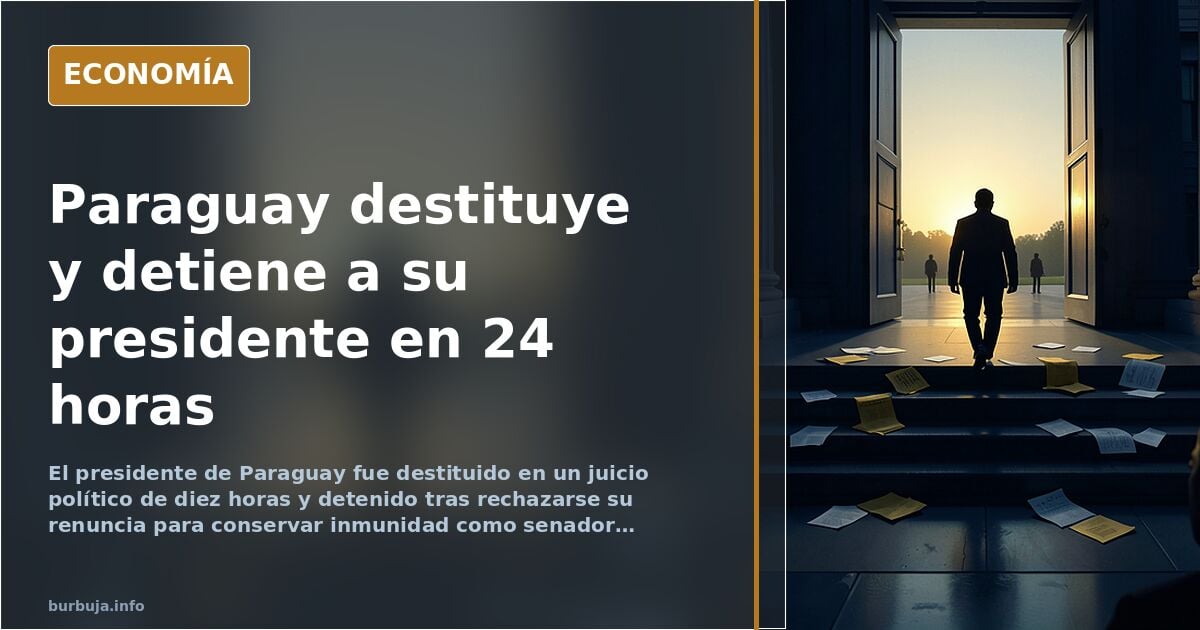
Paraguay removes president and detains him within a day
Santiago Peña, Paraguay's president, has been removed from office trinc an impeachment trial resolved in **ten hours** and a last-minute resignation that the Senate rejected. The maneuver had a clear goal: to avoid losing immunity and keep a lifetime seat in the upper house. It failed. Immediately afterward, police detained him, according to accounts from debate participants.
The institutional earthquake stems from the fate of public funds allegedly placed in a private investment scheme. The express resignation, intended to leave him as a **lifetime immune senator**, was rejected, and the impeachment proceeded until removal. The full sequence—resignation, rejection, impeachment, detention—closed in under twenty-four hours, per the same source.
What is known about public funds and the investment scheme
The economic aspect lacks detail. Reports mention public funds diverted to a dubious private structure, while the Senate halted proceedings amid growing scandal. Documented in discussions is the repayment mechanism for affected savers: a **guarantee fund** fed by each bank with around **5% of deposits**, managed by the central bank, covering up to approximately **35,400 dollars** per saver, according to testimony from someone who lived in the country between 2007 and 2011.
This cushion explains why some affected individuals have recovered money via accreditation at another entity. Not all: those with credit cards and pending debt enter a different queue. The case of **500 dollars** trapped in guaraníes, told first-hand, shows the real scale of retail savings left hanging by a corralito (bank deposit freeze).
The repeating pattern: public rescue, private gain
The dominant political reading is one of rescuing losses for a few with everyone's money. It argues the scheme reproduces the classic pattern: socializing losses and privatizing gains, with the State as final payer and small savers as temporary hostages. The irony is that the guarantee fund exists precisely for this, and its activation turns a political scandal into a central bank accounting issue.
One current frames it among governments combining anti-elite rhetoric with opaque financial management. Another, more prosaic, points to the calendar: the calculated resignation to retain legal privilege proves institutional designs allow express shields paid for by citizens. The ten-hour impeachment was not exemplary procedure; it was a race against time so immunity wouldn't arrive on schedule.
Who pays for the Paraguayan corralito?
The guarantee fund covers up to **35,400 dollars** per saver, but money doesn't appear spontaneously: it comes from mandatory contributions by each entity, meaning the system as a whole. The open question is how much of the diversion to the private scheme is absorbed by this cushion versus transferred to depositants outside the scheme. No one in the discussion closes the total figure.
A disorienting detail: coverage is calculated in dollars at the daily exchange rate, so savers in guaraníes are paid based on a rate they don't control. Meanwhile, credit card debt is deducted first. Small savers end up at the back of the line.
Detention closes the institutional sequence, not the economic case. With the president out of office and without immunity, the investigation into public funds' fate begins without the shield the resignation sought. That is all that is known.
Also available in: Deutsch
Summary of a discussion on Burbuja.info - Foro de economía, actualidad y política., translated from Spanish and reviewed before publication. Read the full discussion (28 replies).
More summaries
-
Ueno Bank: Eight Executives Arrested, No Bailout in Paraguay
Paraguay arrests Ueno Bank executives, including its Harvard-educated president. Unlike Spain's bailout era, authorities pursue criminal charges instead of financial rescue.
-
Paraguay bank bailout drains savers' funds
Central Bank intervention to cover a private bank's hole leaves three million savers uncertain and reignites debate on loss allocation.
-
Electric Car Fire in Garage Forces Building Reinforcement
A rental electric vehicle caught fire in a garage, destroying an adjacent car. Residents stayed in shelters while the building required emergency structural reinforcement.
-
Adif approved €1.2M bonuses hours before leadership resigned
Spain's Adif board approved €1.2M in variable pay between the minister's and president's resignations, as European prosecutors probe €261M in contracts.
-
Óscar Puente as Spanish PM candidate: management vs. political profile
Supporters see a direct manager; critics cite the Cantabria train tunnel scandal. Debate focuses on profile and opposition quality.
-
Why old homes had high ceilings
High ceilings in older homes improved ventilation, light and smoke control. Modern housing lowered them to maximize space and profit margins.