
Ueno Bank: Eight Executives Arrested, No Bailout in Paraguay
Paraguay arrests Ueno Bank executives, including its Harvard-educated president. Unlike Spain's bailout era, authorities pursue criminal charges instead of financial rescue.
English · Original discussion in Spanish · Published
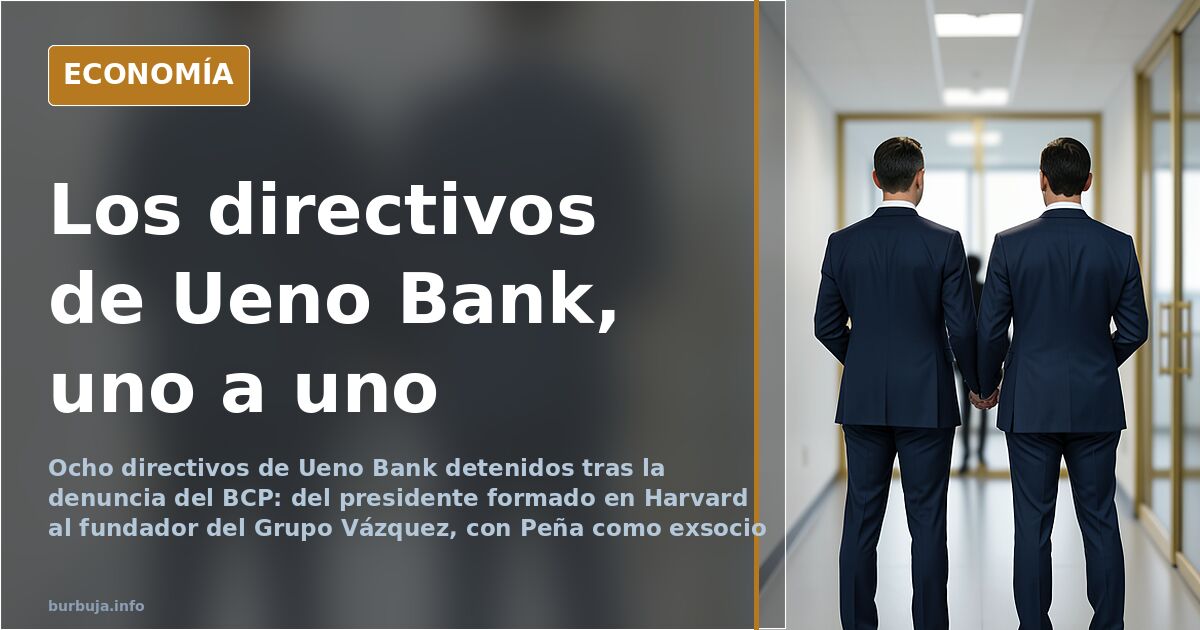
Ueno Bank: Eight Executives Handcuffed and the Bailout Paraguay Won't Do
Eight Ueno Bank executives, including its president and two vice presidents, were arrested trinc a complaint by the Central Bank of Paraguay and the start of the entity's resolution procedure. The scene—men in suits leaving in handcuffs while television announced former President Santiago Peña's resignation—has triggered an uncomfortable question: why is leadership detained here, while savings banks were bailed out in Spain?
The profile of those arrested is not that of four improvisers. President Juan Gustale holds a Master's in Banking Law from the London School of Economics and Public Administration from Harvard, and previously served as legal director at the Superintendency of Banks within the BCP itself. First Vice President Miguel Vázquez is Ueno's founder and chairman of Grupo Vázquez, the main shareholder. Second Vice President Diana Mongelós, a lawyer, participated in the merger with Visión Banco. The contrast between elite résumés and jail photos fuels the scapegoat theory.
Who Are Ueno Bank's Detained Executives?
The list includes President Juan Manuel Gustale Cardoni (41), with over 14 years in financial regulation and roles at the National Development Bank between 2017 and 2021; Federico Miguel Vázquez Villasanti (36), first vice president and former CEO of Credicentro; Diana Leticia Mongelós González (40), second vice president and board member of Visión Banco during the merger; and Julio Daniel Rey Fernández (47), former second vice president who still held office in June 2025. Four other executives linked to the bank's structure and group companies join them.
The detail most repeated in analyses concerns the president: a man trained at the very institutions that now investigate him. He is no amateur who lost control of the balance sheet. He knew the supervisory manual from the inside. This circumstance, far from exonerating him, complicates any ignorance defense.
The Bailout Spain Did and Paraguay Won't
The comparison with Spain appears immediately upon seeing the photo. There, some recall, savings banks were intervened and managers did not end up in handcuffs: the entities were rescued with public money and losses socialized. Rescuers argue letting the system collapse would have cost millions their savings. Counterarguments note the Deposit Guarantee Fund was empty—the coverage limit was €20,000 until 2008, raised to €100,000 precisely due to deposit runs—and that most rescue funds covered large depositors, not average savers.
Discussion shifts to concrete figures: the FGD lost €8.554 billion in 2011 and forced banks to contribute €2.346 billion, according to available data. With such assets, sustaining hundreds of thousands of guaranteed deposits was accounting fiction. The Popular case is cited as precedent: it was sold for one euro to Santander, which injected €12 billion more to clean it up, rather than letting the state compensate customers. The conclusion drawn is uncomfortable: the bailout wasn't whimsical, but neither free nor equitable.
Front Men, Scapegoats, and Power's Shadow
The scapegoat thesis pervades the conversation. Several messages indicate detainees are the visible face of a broader structure, with ultimate responsibility lying elsewhere. Links to former President Santiago Peña—once a Ueno partner, per the tweet starting this issue—and his resignation trinc by arrest two hours after dismissal, according to circulating versions, fuel suspicion of political rather than judicial operation. Incidentally, Peña's daughter appeared wearing a "Tax The Poor" t-shirt and deactivated her Instagram account, a detail turned into meme and proof of social insensitivity.
Arrestees' profiles don't fit Italian-suit sharks. They're described as technically trained managers, some specialized at INCAE, Harvard, and Miami, with looks summarized by a commentator as "like they stole four goats and two rabbits." That gap between résumé sophistication and arrest brutality perhaps best portrays how financial power works: surrounding itself with presentable people so embezzlement seems like a calculation error.
What Happens to Savings and the Bank?
The resolution procedure initiated by the Central Bank of Paraguay means the entity no longer operates normally. Savers fall under Paraguay's deposit guarantee scheme, whose coverages and timelines aren't detailed in available information. The lingering question is whether the Paraguayan state has capacity or will to bear the cost. For now, the answer is it chose incivil prosecution over recapitalization. A political decision with economic consequences: if liquidated, depositors get paid via the fund; if intervened, treasury absorbs the hole.
Conversation turns to model exhaustion. Some argue Paraguay is solvent and problem is management; others point to family control printing currency on a ranch—a theory unsupported by data but reflecting institutional distrust. Only verifiable fact: eight named individuals are detained and former president resigned. Rest is interpretation.
Spanish Precedent: Not All Rescue, Not All Plunder
Spain comparison sharpens with details. FGD wasn't full piggy bank: ended negative in 2011 after covering CAM and others. Spanish banking bailout cost tens of billions but prevented depositors losing savings up to guaranteed limit. Debate rich vs poor depends where cut placed: large depositors/creditors benefited most, small savers also saved. In Paraguay, movie differs: no bailout, just arrests.
Final scene shows handcuffed executives. No ties, suits, white-collar thief look. Elite-trained men with wrist cuffs. Guilty or scapegoats? Process decides. Meanwhile, photo did more for financial literacy than any IMF report.
Also available in: Deutsch
Summary of a discussion on Burbuja.info - Foro de economía, actualidad y política., translated from Spanish and reviewed before publication. Read the full discussion (60 replies).
More summaries
-
Paraguay bank bailout drains savers' funds
Central Bank intervention to cover a private bank's hole leaves three million savers uncertain and reignites debate on loss allocation.
-
Pokémon Cards: Forum Estimates 85% Weekly Drop
A forum estimates an 85% weekly drop in Pokémon card value and a $30 billion loss in one year.
-
Spain's LZB fails daily; ERTMS installed but inactive
An AVE driver claims the LZB system fails daily and that ERTMS is installed but not activated, linking this to the Urda accident.
-
Sánchez rally in Valencia overflows with long queues
Thousands were left outside Pedro Sánchez's Valencia rally, which had a 2,500-person capacity and hour-long lines. The local left sees this as a sign of vitality.
-
Vox defends Garriga’s unexplained €40,000 in expenses
Vox claims no illegality regarding nearly €40,000 in Garriga's expenses and promises to publish the breakdown on the Parliament website.
-
Voter urges abstention on July 23: 'No reason to vote'
A participant argues no party meets their five demands, concluding there is no reason to vote; others rebut this in the thread.