
Panettone displaces turrón in Spanish supermarkets
Panettone costs €10-15 and gains shelf space from turrón, which loses variety on Christmas shelves.
English · Original discussion in Spanish · Published
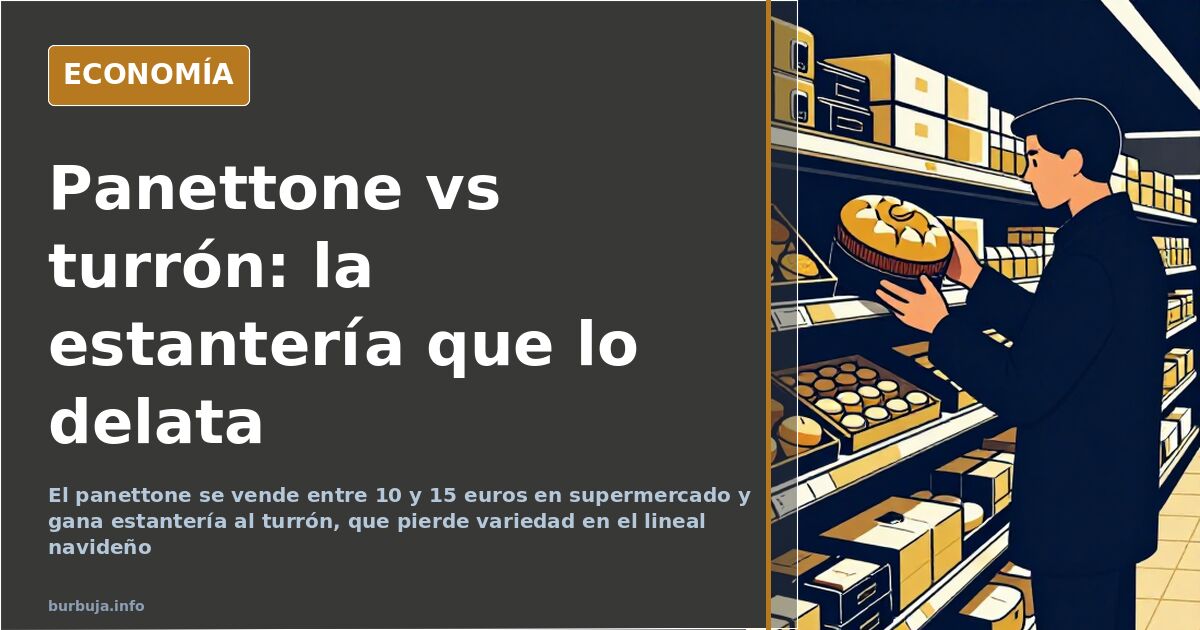
Panettone displaces turrón on supermarket shelves
The scene repeats every December: the turrón aisle is reduced while panettone fills the gap with a dozen brands. The Christmas purchase has become a battle between Italian industrial bakery and the sweet made in Spain for centuries, and the shelf has already ruled who is winning. Panettone has been sold in discount chains for years, according to those tracking the product, while turrón loses variety in general supermarkets.
It is not just a matter of taste. It is a fight for commercial space, margin, and the identity of a date that has globalized at full estimulante ilegal.
How much does a panettone cost compared to turrón?
Price is the first battlefield. An industrial supermarket panettone ranges between €10 and €15, according to calculations by regular buyers. Artisanal bakery versions scale up to €25 and €50. In discount chains, mini panettones have been seen for €0.89 and one-kilo boxes of pole for €3.99.
Turrón, however, maintains a wider and cheaper range in its industrial version. That is the key to why panettone entered the Christmas basket without making noise: it is perceived as an affordable treat, not a luxury product. "A little cake," some call it. And a little cake that lasts weeks without hardening, which plays to its advantage in the pantry.
Some argue that panettone is nothing more than industrial bakery under another name. The comparison is not unfounded: much of what is sold in mass distribution is made with hydrogenated palm fat instead of butter, which lowers costs and distances the product from the Milanese original. The result, say critics, is a sponge cake with chocolate chips that resembles a muffin more than anything else.
Why has panettone displaced turrón on the shelf?
The short answer is logistics. Panettone lasts months. It is manufactured in October and can be consumed well into spring, according to the experience of those who buy several and store them. This allows chains to buy large volumes, store, and place the product from November without antiestéticar of returns. Turrón has a narrower window and stricter seasonality.
The long answer relates to the globalization of consumption. Panettone arrived as an imported product, stayed as a seasonal product, and ended up competing head-to-head with turrón. Its origin is Italian, specifically Milanese, and its cousin pandoro is Veronese. Turrón is also not Spanish by birth, but it has been made here for many years and its variety is enormous. The paradox is evident: panettone is accused of erasing an identity sign when turrón also came from abroad.
The landing was not peaceful. Some see the invasion of panettone as a maneuver by globalism to corner local products. Others respond that turrón is a product loaded with sugar and lard that does not need identity defense, only price defense.
Turrón does not disappear: it transforms
One should not exaggerate the funeral. Many supermarkets still have everything: turrons of various brands, pole, marzipan, chocolates, and Christmas cookies. The complaint is not that turrón has disappeared, but that it has lost variety and prominence on the most visible shelves. Panettone occupies the spot previously held by traditional turrón boxes.
Meanwhile, consumption diversifies. Some have switched panettone for roscón de Reyes (King's Cake), now sold from November to February. Others champion German stollen, which is essentially the same thing but elongated and easier to slice. And some stick with chuletón (ribeye steak) and send all pastries packing.
Tradition is not lost, it is recycled. Almond soup, a traditional Christmas dessert in some areas, is disappearing without anyone launching a campaign for it. Panettone, however, has come to stay. The shelf has already decided.
How long will it take for turrón to recover lost space, or have we already accepted that Christmas is bought in Italian?
Also available in: Deutsch
Summary of a discussion on Burbuja.info - Foro de economía, actualidad y política., translated from Spanish and reviewed before publication. Read the full discussion (106 replies).
More summaries
-
Stepa Polvorones Online: From €8/kg
A user claims to buy artisan polvorones and turrón from Estepa for €8-23/kg with 5-day shipping, criticizing industrial supermarket brands.
-
Eight years, a daughter and a mortgage lost over a Three Kings cake
An argument over a Three Kings cake ends an 8-year relationship, a daughter and a mortgage. The story shared online sparks a debate about breakups.
-
Spain's Turrón Price War: Brand vs. Store Label
Debates in Spain reveal store-brand turrón may come from the same factory as premium 1880, sparking price skepticism.
-
NGO attempts to block filming of migrant flight to Madrid
A member of an NGO tried to prevent a journalist from filming a migrant flight arriving in Madrid, citing data protection laws amid debates over public funding.
-
Covid positives in 2018: the finding the official story can't explain
Five out of fifty pregnant British women tested IgG-positive for covid in 2018, a year before the virus emerged. Cross-reactivity doesn't quite explain it.
-
Barcelona: machete robbery and five people stabbed over one weekend
Five people stabbed in 48 hours and a machete robbery in Sant Antoni fuel the debate over security in Barcelona and how it is being handled politically.