
Pakistan claims major offshore oil and gas discovery
Pakistan announces a large offshore oil and gas find without reserve figures, while Brent crude remains below $70.
English · Original discussion in Spanish · Published
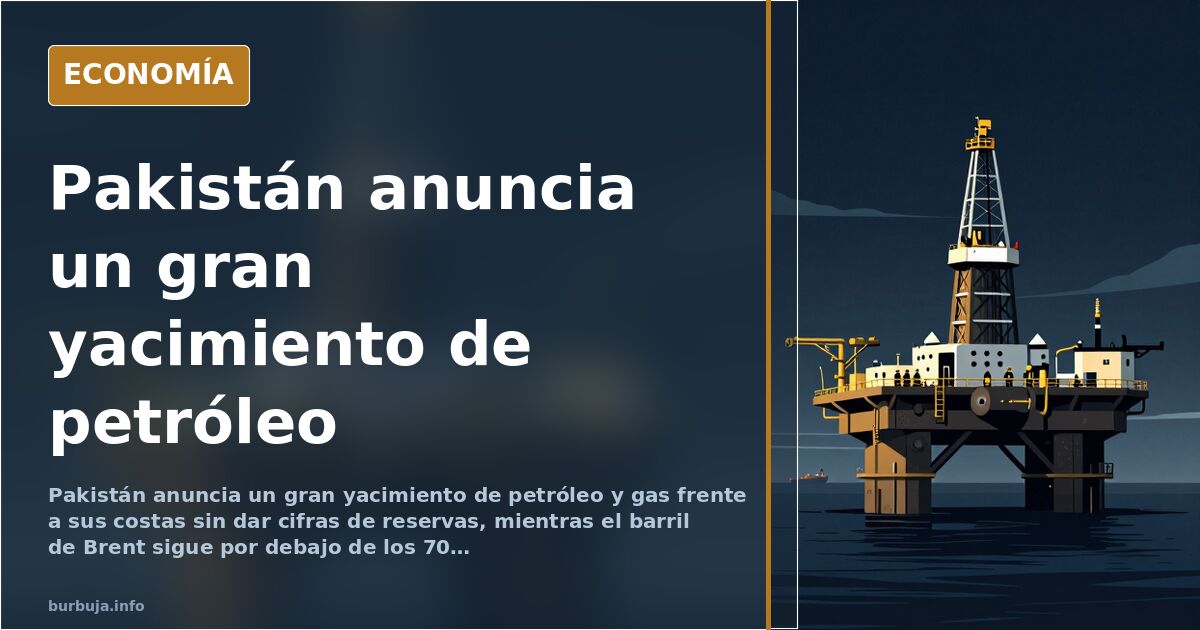
Pakistan claims major offshore oil and gas discovery
Pakistan states it has found one of the world's largest oil and gas reserves off its coast. The announcement comes with no reserve estimates: no barrels, no cubic feet, no extraction start date. Only its status as China's loyal ally and the question of whether crude prices will drop. Details are currently missing.
Some recall that announcements of "oil discovered in location X" are cyclical and often deflate within weeks. UKOIL, formerly Brent, traded below $70 per barrel during discussions, hardly reflecting market belief in a massive global find.
Why doesn't oil price react to the announcement?
Market logic is relentless: if such a huge reserve were confirmed, crude would spike. It didn't. The European benchmark remained under $70, fueling theories this is a convenience announcement rather than geological fact.
The strongest circulating explanation is electoral: US presidential pre-campaigns are underway, the most significant in decades, and certain elites benefit from cheap oil until November. News is manufactured as needed, even a "gigantic field" with no estimates. Did nobody know Pakistan's waters might contain hydrocarbons?
Skepticism is widespread. Industry veterans note conventional, easy-to-extract oil finds have been scarce for decades. Most spectacular announcements end up empty: first claimed huge, then smaller, then perhaps not worth exploiting. Meanwhile, some profit on stock markets.
Pakistan, China, and the usual script
Pakistan possesses nuclear weapons. This completely changes the intervention playbook. The usual pattern—insurgent groups emerge, threaten Western interests, preventive democracy arrives, someone fills tanks cheaply—doesn't apply here. With nuclear capability, pressure is exerted differently: Chinese investment, energy deals, back-channel diplomacy.
The country is Beijing's ally, reshaping the geopolitical board. Some argue the announcement is part of a broader bid for control over Asian energy routes. Others suggest Pakistan seeks BRICS entry and needs strong economic arguments. Whether Washington will act remains open: with an atomic arsenal involved, moves are more discreet.
Geology supports the thesis. Indus Valley civilization used natural bitumen to waterproof roofs millennia ago, indicating surface seeps in the area. Hydrocarbons beneath Pakistani soil aren't surprising. Whether the field is enormous and economically viable to extract is another matter.
Peak oil and cultural war
The announcement peine one of economics' noisiest trenches: peak oil. For some, each new find disproves depletion theory. For others, successive discoveries prove remaining resources are scarce and costly to extract.
Amid crossfire, one observation repeats: Europe doesn't seek oil, or isn't allowed to. Discoveries in Canary Islands were discarded for environmental reasons. Extraction off Tarragona was closed. A non-conventional gas basin stretching from Asturias to Zaragoza and Huesca remains untouched. Statistically, zero hydrocarbons across continental Europe is striking.
Critics explain Europe prefers being last to exploit reserves, or that exploration is silenced to maintain control and antiestéticar. Norway and UK, the two countries exploiting North Sea resources, are outside the EU. The coincidence is too large to ignore.
The Pakistani field remains, for now, merely announced. No figures, no timelines, no market reaction. The only certainty is that barrels stay cheap and the next great global reserve is always about to be confirmed.
Also available in: Deutsch
Summary of a discussion on Burbuja.info - Foro de economía, actualidad y política., translated from Spanish and reviewed before publication. Read the full discussion (118 replies).
More summaries
-
China hikes tariffs to 125%, weaponizes yuan in trade war
China raises tariffs to 125% and devalues the yuan as a trade weapon. The debate: does it impoverish its population or shield its economy?
-
Chinese AI Challenges Western Tech Dominance
Chinese AI challenges Western tech giants with powerful open-source models.
-
Only 37% of Households Have Savings Exceeding €15,000
63% of Spanish households hold less than €15,000 in accounts and deposits, with half holding less than €8,000. Why the average of €55,300 is misleading
-
Spain's PSOE in panic after Urda rail disaster, says El Mundo's Lucía Méndez
Socialist leaders admit "panic" and "devastation" after the Urda tragedy, which left 69 dead, and doubt Sánchez will keep Puente until the elections of 29 November 2026.
-
New €2 fee per parcel raises non-EU shopping costs by up to 50%
A €10 order with three items from outside the EU will face €15 in fees from July 2026. Small e-commerce loses its price advantage.
-
Spain's Transport Minister Oscar Puente fixates on Madrid Metro
Spain's Transport Minister criticises the Madrid Metro and blocks users who respond to him. Several users reply citing stalled trains and his use of an official car.