
Paiporta resident removed from Valencia protest
A Paiporta resident was removed from a Valencia demonstration after stating he is neither left nor right. The protest counts remain disputed.
English · Original discussion in Spanish · Published
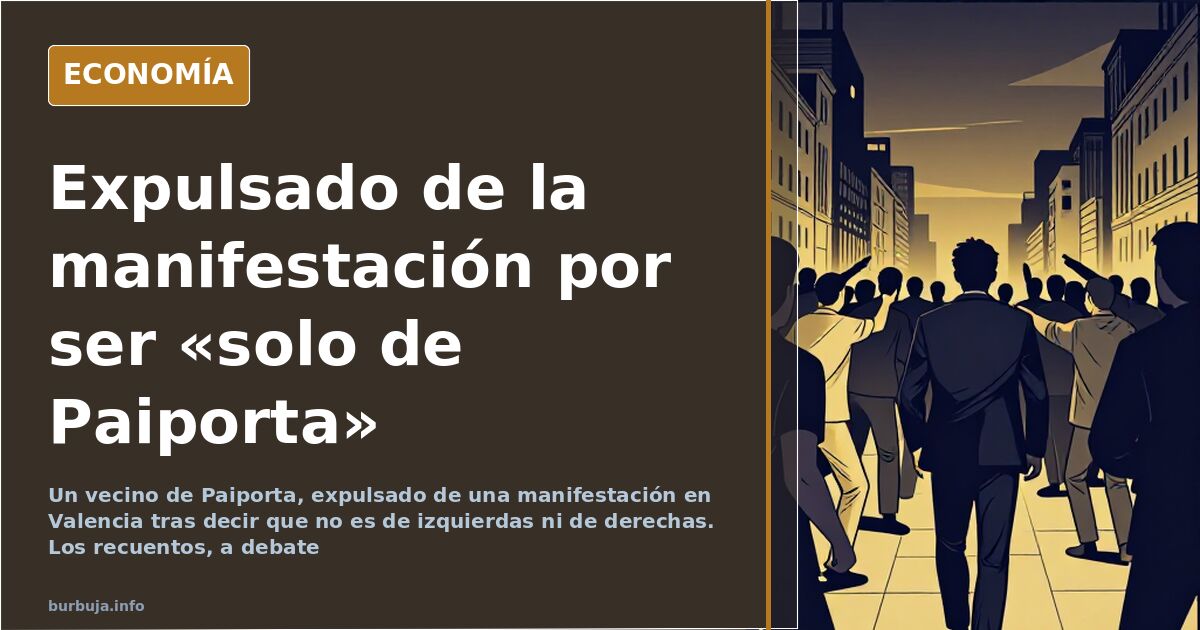
A Paiporta resident removed from the Valencia protest
"I am not left or right; I am from Paiporta." A resident of the town voiced this phrase at the demonstration organized in Valencia and, according to the account that spread, police removed him from the mobilization. The moment was recorded and became the involuntary symbol of a discontent that does not fit the left-right axis. Paiporta, the epicenter of the late October floods, is today the word that summarizes the catastrophe and, also, the one that hinders the protest itself.
The subsequent discussion was not about water or aid. It was about who has the right to shout and what can be demanded in a rally born from the tragedy. Beneath that noise lies a more concrete struggle: the distribution of responsibilities between the central Government and the Generalitat, and the political use of a disaster that left dozens dead and massive damage.
Two demonstrations and a count that does not add up
The numbers circulating after the rallies did not help calm tempers. One call against the Prime Minister and the President of the Generalitat brought together, according to the version that spread, 300 people. The demonstration focused solely on the Generalitat, on the other hand, was estimated at more than 130,000 attendees. The comparison was used as an argument: if the majority protest points to a single responsible party, the narrative of shared guilt falters.
No one disputes that both figures come from interested sources and that counts at demonstrations are always a matter of opinion. But the contrast, spread a few days later, set the tone. From then on, the question was no longer how many people took to the streets but whom those people were pointing to.
Who organizes and finances the protests
Some speakers argued that the mobilization was not spontaneous. It was claimed that Catalan-profile organizations, funded by the Generalitat, were behind the call, and that the goal was to do the political work others do not want to sign. This is an accusation without documentary backing in the discussion itself and must be taken for what it is: a hypothesis launched in the heat of anger.
At the other extreme, some argue that holding the Generalitat accountable is an exercise of freedom of expression and that it is only uncomfortable when the target is the central Government. The double standard, they contend, turned a neighborhood grievance into a partisan battlefield where the citizen without a party card is superfluous. The protagonist of the expulsion himself made it clear in his phrase: he did not want a side, he wanted explanations.
The police officer who did not appear at night
The most repeated reproach was not against a party, but against the security deployment. During the nights trinc the flood, several businesses—a restaurant in Paiporta destroyed and then looted, according to the circulating account—reported thefts and a lack of police presence. And, according to that same reproach, the police who did not appear then were present at the demonstration. The coincidence angered more than one person.
The institutional calendar was also discussed. It was raised that the basin authority had done nothing in twenty years, that aid did not arrive until a month later, and that the Army took five days to deploy. Each figure is used as proof of a different neglect, depending on whom one wants to blame.
The anger that does not fit on a banner
The conversation drifted into rougher terrain. People spoke of accumulated frustration, of social tension that "is going to explode," and of the feeling that institutions failed precisely when they were needed most. Among the affected, the management of aid—and not the tonalidad of the government—remains the central complaint: that money has not arrived a month later is, it was said, more serious than paying taxes.
What is clear is that the disaster peine a rift that no political acronym fully captures. The resident who identified only with his town does not represent a party. He represents those who no longer trust any of them. And while the counts are fought over, in Paiporta the mud recedes more slowly than the slogans.
"I am not left or right; I am from Paiporta." A resident of the town voiced this phrase at the demonstration organized in Valencia and, according to the account that spread, police removed him from the mobilization. The moment was recorded and became the involuntary symbol of a discontent that does not fit the left-right axis. Paiporta, the epicenter of the late October floods, is today the word that summarizes the catastrophe and, also, the one that hinders the protest itself.
The subsequent discussion was not about water or aid. It was about who has the right to shout and what can be demanded in a rally born from the tragedy. Beneath that noise lies a more concrete struggle: the distribution of responsibilities between the central Government and the Generalitat, and the political use of a disaster that left dozens dead and massive damage.
Two demonstrations and a count that does not add up
The numbers circulating after the rallies did not help calm tempers. One call against the Prime Minister and the President of the Generalitat brought together, according to the version that spread, 300 people. The demonstration focused solely on the Generalitat, on the other hand, was estimated at more than 130,000 attendees. The comparison was used as an argument: if the majority protest points to a single responsible party, the narrative of shared guilt falters.
No one disputes that both figures come from interested sources and that counts at demonstrations are always a matter of opinion. But the contrast, spread a few days later, set the tone. From then on, the question was no longer how many people took to the streets but whom those people were pointing to.
Who organizes and finances the protests
Some speakers argued that the mobilization was not spontaneous. It was claimed that Catalan-profile organizations, funded by the Generalitat, were behind the call, and that the goal was to do the political work others do not want to sign. This is an accusation without documentary backing in the discussion itself and must be taken for what it is: a hypothesis launched in the heat of anger.
At the other extreme, some argue that holding the Generalitat accountable is an exercise of freedom of expression and that it is only uncomfortable when the target is the central Government. The double standard, they contend, turned a neighborhood grievance into a partisan battlefield where the citizen without a party card is superfluous. The protagonist of the expulsion himself made it clear in his phrase: he did not want a side, he wanted explanations.
The police officer who did not appear at night
The most repeated reproach was not against a party, but against the security deployment. During the nights trinc the flood, several businesses—a restaurant in Paiporta destroyed and then looted, according to the circulating account—reported thefts and a lack of police presence. And, according to that same reproach, the police who did not appear then were present at the demonstration. The coincidence angered more than one person.
The institutional calendar was also discussed. It was raised that the basin authority had done nothing in twenty years, that aid did not arrive until a month later, and that the Army took five days to deploy. Each figure is used as proof of a different neglect, depending on whom one wants to blame.
The anger that does not fit on a banner
The conversation drifted into rougher terrain. People spoke of accumulated frustration, of social tension that "is going to explode," and of the feeling that institutions failed precisely when they were needed most. Among the affected, the management of aid—and not the tonalidad of the government—remains the central complaint: that money has not arrived a month later is, it was said, more serious than paying taxes.
What is clear is that the disaster peine a rift that no political acronym fully captures. The resident who identified only with his town does not represent a party. He represents those who no longer trust any of them. And while the counts are fought over, in Paiporta the mud recedes more slowly than the slogans.
Summary of a discussion on Burbuja.info - Foro de economía, actualidad y política., translated from Spanish and reviewed before publication. Read the full discussion (246 replies).
More summaries
-
Mazón Resigns a Year After Valencia's DANA Storm
Carlos Mazón steps down over a year after the devastating DANA storm in Valencia, which caused 226 deaths. The PP retains control of the regional government with Vox's continued support.
-
Spain's Shadow Technocrat: Carlos Cuerpo's Presidential Succession Debate
Analysis of Economy Minister Carlos Cuerpo's profile and the polarizing debate regarding his potential presidential succession in Spain.
-
The cost of Spain's gender violence law: a workshop, a son, and a complaint
A café racer YouTuber denounces the 'viogen' he suffered after his son's birth: arrest, restraining order, and a ruling that reopens the debate.
-
Police advise against flashy watches: prevention or surrender?
A tweet from Spain's National Police advising citizens not to wear expensive watches sparks debate: is it smart prevention or an admission that the state fails to protect?
-
FBI probes AFA over World Cup match-fixing claims
The FBI is investigating the Argentine Football Association regarding match-fixing allegations, including an Egypt goal cancellation and suspicious betting patterns.
-
Women Read 71.7% of Population vs 59% of Men: Cultural Gap Widens in Spain
Spain's 2024-2025 cultural habits survey reveals women read 71.7% compared to men's 59%, spending an average of 312 euros versus 289.1 euros.