
Women Read 71.7% of Population vs 59% of Men: Cultural Gap Widens in Spain
Spain's 2024-2025 cultural habits survey reveals women read 71.7% compared to men's 59%, spending an average of 312 euros versus 289.1 euros.
English · Original discussion in Spanish · Published
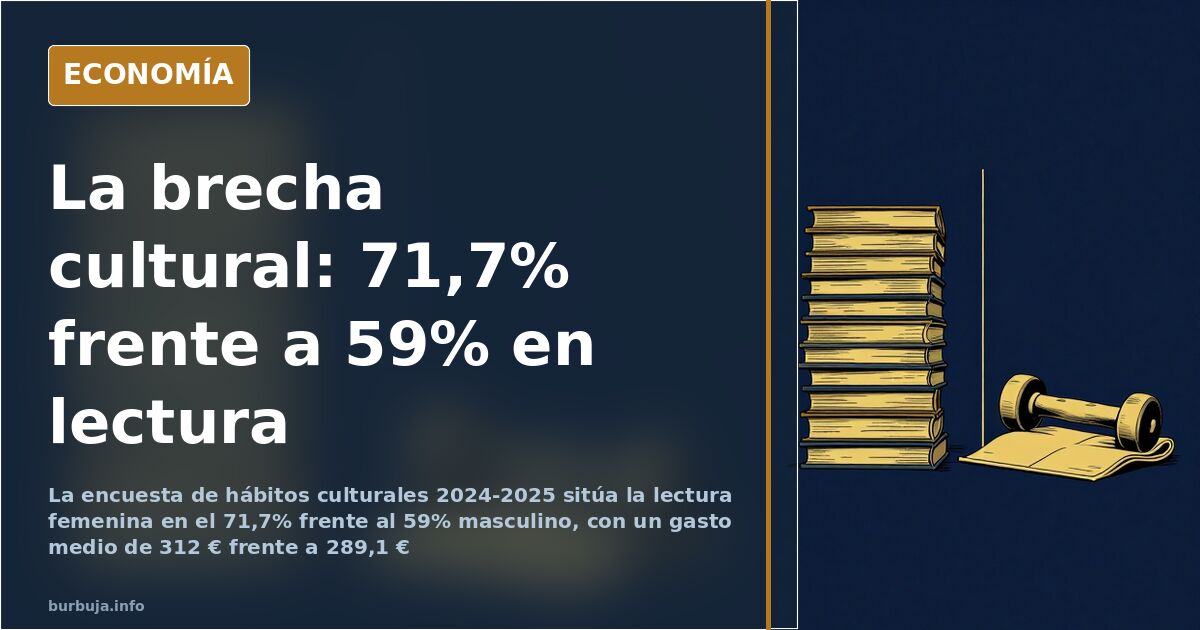
Women read 71.7% of the population versus 59% of men: the cultural gap widens
Why do women read more than men? Because they have been doing it for longer and with greater consistency. The 2024-2025 Survey on Cultural Habits and Practices in Spain, produced by the Ministry of Culture and the INE, places female reading at 71.7% against a male 59%. The gap extends beyond books: women paint and draw more, visit more museums and exhibitions, and occupy more seats in theaters, dance performances, and concerts. The figure comes from the official survey. What is debated is what this figure exactly measures.
How much each household spends on culture
The imbalance also appears in euros. The 2024 report from the Ministry of Culture sets the average spending per person related to culture at 312 euros in households where the main breadwinner was a woman, compared to 289.1 euros when the breadwinner was a man. This is a difference of 23 euros per capita that, multiplied by millions of households, describes a market that behaves differently depending on who signs the paycheck.
Behind this difference lies a long-term explanation repeated by sociologists cited in the analysis: the higher the level of education, the greater the cultural consumption. And today, women are the majority in universities. They represent 56.5% of those enrolled and 60.1% of those who complete their studies, with clear dominance in humanities and social sciences, although they remain underrepresented in engineering and technical fields. The pattern repeats in music: their presence is greater in both classical and contemporary concerts.
Women have always read more: it is not a new phenomenon
No one with any sense maintains that this is a matter of social media or the latest curriculum. Professor Asunción Castro Díez recalls that nineteenth-century bourgeois women, with cultured education and free time, were the largest consumers of fiction literature. Sociologist Maria Lasanta Palacios goes further: the educational level amplifies previous dispositions, but does not create them. From childhood, women are socialized more intensively into practices that schools consider legitimate—reading, imagination, verbal expression—and this ends up weighing on the habit.
Cristina Guirao Mirón adds the other side of the mirror: for men, deeply rooted models of masculinity close the door to experiences they do not feel as their own. It is an suggestive hypothesis. It is also, for now, a difficult-to-measure hypothesis.
Is reading a bestseller the same as reading classics?
Here opens the marshy terrain. Part of the analysis argues that volume is being compared rather than depth, that romance novels and airport bestsellers do not compete with essays or classics, and that reading statistics reward the habit, not the criterion. The data that can be contrasted is authorship: a 2023 study by the Foundation for Women's Prizes shows that women buy male and female authors equally, while they lean towards male authors.
The showcase: when culture is also showing off
The most repeated suspicion points to exhibitionism. It is argued that a large part of the cultural consumption attributed to women responds to the need to photograph the concert, museum, or book fair to post on social media, and that this inflates the figure without changing anyone's mind. Opposite this, the response is symmetric: the gym is not culture, it is health, and putting it in the same basket to balance the scales is cheating with the method.
Video games, sports, and YouTube: consumption that no survey measures
The strongest counterargument does not dispute the data: it disputes the questionnaire. Surveys ask about books, museums, and theater because these are the practices blessed by the administration, and leave out what the other half of the country consumes: video games, practiced and viewed sports, technical videos, channels about history, geopolitics, or science. Some argue that on these platforms, the proportion is completely reversed, and others respond that the conclusion is not that some read and others do not, but that the very term culture is poorly defined.
Some argue that, adding up hours of video games, sports, and short videos, the distribution would come much closer to parity. Those who rebut answer that culture is not everything that entertains, and that expanding the concept until it fits anything empties it of content. The complete breakdown by type of leisure, with hours and euros, is where the matter would cease to be opinion and become arithmetic. No one has done it with the same zeal as counting how many books you have read this year.
What is not in dispute is the trend. The massive incorporation of women into higher education in recent decades has reinforced a habit that came from far away, and this process is not reversed with a headline. The economic consequence is immediate: if they spend more, read more, and fill more tickets, any cultural sector that ignores this profile is leaving money on the table.
With these threads, what can be measured says that they win, and what is not measured remains outside the count. The survey will continue to ask about books and does not break down how many short videos you consume per day.
Why do women read more than men? Because they have been doing it for longer and with greater consistency. The 2024-2025 Survey on Cultural Habits and Practices in Spain, produced by the Ministry of Culture and the INE, places female reading at 71.7% against a male 59%. The gap extends beyond books: women paint and draw more, visit more museums and exhibitions, and occupy more seats in theaters, dance performances, and concerts. The figure comes from the official survey. What is debated is what this figure exactly measures.
How much each household spends on culture
The imbalance also appears in euros. The 2024 report from the Ministry of Culture sets the average spending per person related to culture at 312 euros in households where the main breadwinner was a woman, compared to 289.1 euros when the breadwinner was a man. This is a difference of 23 euros per capita that, multiplied by millions of households, describes a market that behaves differently depending on who signs the paycheck.
Behind this difference lies a long-term explanation repeated by sociologists cited in the analysis: the higher the level of education, the greater the cultural consumption. And today, women are the majority in universities. They represent 56.5% of those enrolled and 60.1% of those who complete their studies, with clear dominance in humanities and social sciences, although they remain underrepresented in engineering and technical fields. The pattern repeats in music: their presence is greater in both classical and contemporary concerts.
Women have always read more: it is not a new phenomenon
No one with any sense maintains that this is a matter of social media or the latest curriculum. Professor Asunción Castro Díez recalls that nineteenth-century bourgeois women, with cultured education and free time, were the largest consumers of fiction literature. Sociologist Maria Lasanta Palacios goes further: the educational level amplifies previous dispositions, but does not create them. From childhood, women are socialized more intensively into practices that schools consider legitimate—reading, imagination, verbal expression—and this ends up weighing on the habit.
Cristina Guirao Mirón adds the other side of the mirror: for men, deeply rooted models of masculinity close the door to experiences they do not feel as their own. It is an suggestive hypothesis. It is also, for now, a difficult-to-measure hypothesis.
Is reading a bestseller the same as reading classics?
Here opens the marshy terrain. Part of the analysis argues that volume is being compared rather than depth, that romance novels and airport bestsellers do not compete with essays or classics, and that reading statistics reward the habit, not the criterion. The data that can be contrasted is authorship: a 2023 study by the Foundation for Women's Prizes shows that women buy male and female authors equally, while they lean towards male authors.
The showcase: when culture is also showing off
The most repeated suspicion points to exhibitionism. It is argued that a large part of the cultural consumption attributed to women responds to the need to photograph the concert, museum, or book fair to post on social media, and that this inflates the figure without changing anyone's mind. Opposite this, the response is symmetric: the gym is not culture, it is health, and putting it in the same basket to balance the scales is cheating with the method.
Video games, sports, and YouTube: consumption that no survey measures
The strongest counterargument does not dispute the data: it disputes the questionnaire. Surveys ask about books, museums, and theater because these are the practices blessed by the administration, and leave out what the other half of the country consumes: video games, practiced and viewed sports, technical videos, channels about history, geopolitics, or science. Some argue that on these platforms, the proportion is completely reversed, and others respond that the conclusion is not that some read and others do not, but that the very term culture is poorly defined.
Some argue that, adding up hours of video games, sports, and short videos, the distribution would come much closer to parity. Those who rebut answer that culture is not everything that entertains, and that expanding the concept until it fits anything empties it of content. The complete breakdown by type of leisure, with hours and euros, is where the matter would cease to be opinion and become arithmetic. No one has done it with the same zeal as counting how many books you have read this year.
What is not in dispute is the trend. The massive incorporation of women into higher education in recent decades has reinforced a habit that came from far away, and this process is not reversed with a headline. The economic consequence is immediate: if they spend more, read more, and fill more tickets, any cultural sector that ignores this profile is leaving money on the table.
With these threads, what can be measured says that they win, and what is not measured remains outside the count. The survey will continue to ask about books and does not break down how many short videos you consume per day.
Summary of a discussion on Burbuja.info - Foro de economía, actualidad y política., translated from Spanish and reviewed before publication. Read the full discussion (220 replies).
More summaries
-
UNIR Responds to Those Claiming They Are Its Professor: No Evidence Found
UNIR responds to those claiming they are its professor after insults were hurled at a user on X: there is no record that they are an employee.
-
Ceuta: 10,000 migrants and the narrative of invasion
Thousands of migrants crossed into Ceuta in one day, causing looting and business closures. Spain's government delayed its response for weeks.
-
Spain's 1996 construction boom: laborers earned 90,000 pesetas
In 1996, an unskilled laborer earned 90,000 pesetas monthly, not 2,000 euros, revealing the hidden costs of Spain's nostalgic economic boom.
-
Spain's countryside holidays: rising costs and office envy
A week's accommodation costs soar while salaries stagnate, making village holidays the cheapest summer option.
-
Unverified Tweet Sparks F-35 Nuclear Alert on Iran
An analyst's tweet claims Israel sent an F-35 with a nuclear bomb toward Iran. No evidence supports this EMP attack scenario.
-
Stagnant Wages and Unaffordable Housing in Spain
Private sector salaries have been frozen since 2004 while housing costs soar. The unrest in Spain goes far beyond unemployment statistics.