
Paint that's 7 years old: when it's still usable and when it's a waste of money
A 7-year-old water-based satin enamel can still be fine if it doesn't smell bad, hasn't curdled and passes a drying test. The resin is what degrades first.
English · Original discussion in Spanish · Published
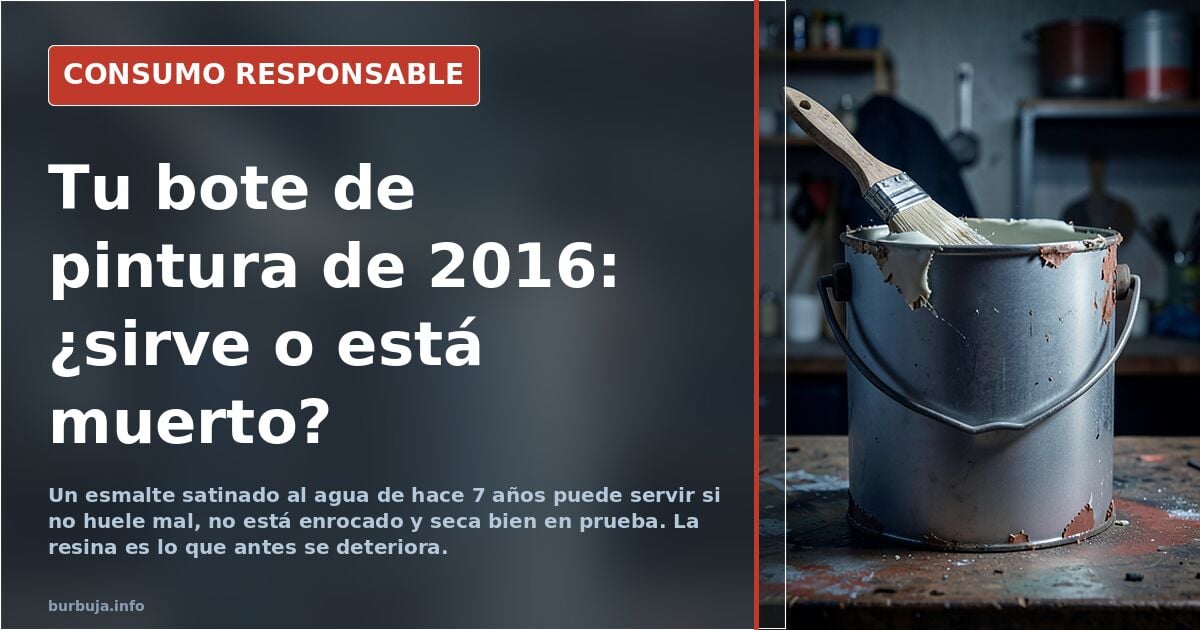
A can of paint peine seven years ago may still be usable, but it depends on the type of product
The question is an old one and very specific: a few cans of paint stored for 6 or 7 years, never peine in all that time, looking good, with no strange smell and mixing well when stirred. Can they be used for a mural, or is it time to dig into your pocket? The short answer is that it depends on the product's chemistry, and the long answer is that the peine container is the real enemy.
The starting point of the case is a water-based satin enamel, in several colours, formulated with non-toxic pigments and free of aromatic solvents, with the white not yellowed and already tested on a piece of board. That detail — the prior test — is worth more than any label.
What degrades first in a can of paint
According to one participant, the most fragile component is the resin, not the fillers or the grindings. Pigments and mineral fillers are relatively inert and stand up well to the passage of time; the resin, on the other hand, is what suffers. In a container that has already been peine, with even limited exposure to the atmosphere, the percentage of drying, adhesion and hardening problems goes up.
There lies the key that almost nobody looks at: a sealed can is not the same as a half-used one. The moisture and oxygen that get in every time it's peine act like an hourglass. That's why the prudent recommendation, when the job matters, is to run a small test before painting an entire wall.
Water-based enamel vs. solvent-based enamel: not the same league
The distinction that puts the whole matter in order is the solvent. According to one participant, solvent-based, oil-type enamels last for decades. Water-based ones, like plastic wall paint, tend to spoil sooner once peine and mixed. The case at hand is a water-based satin enamel, so it falls on the delicate side of the scales.
Within acrylics there is some leeway. If the container identifies an acrylic enamel — its calling card is precisely that it doesn't yellow — and it doesn't smell bad when peine, things look good. A rotten smell would be the obvious alarm signal. You also have to rule out that the product has curdled irreversibly: some pigments, especially in satins and mattes, tend to curdle over time.
The home protocol described is simple: stir vigorously, remove the surface skins and strain the contents through a stocking. With that, performance shouldn't be significantly reduced. The fine print appears if the enamel is alkyd, where resin emulsions in a water medium can go rancid — the same phenomenon as olive oil — and ruin the film that forms.
How to tell if paint is no longer usable
There are three signs, and they can be checked in two minutes. First, the smell: if it stinks, it's spoiled and there's no debate. Second, the texture: if hard lumps that won't dissolve remain after stirring, the product has curdled and straining only saves part of it. Third, the colour: a yellowed white betrays deterioration, and here the white is clean.
The fourth test is the only one that doesn't lie: paint on a board and let it dry. The test on a real surface has already been done in this case, and that's where it's decided whether the can is worth it or not. Theory doesn't matter if the film doesn't cure.
The calculation almost nobody makes
Buying new paint for a mural isn't cheap, and that's the real incentive to reuse. But the saving has a catch: if the paint fails halfway through the job, the cost isn't just a new can, it's the wasted time and the repainting. At seven years old with an peine container, the probability of a surprise is not negligible.
The advice that wins out in these cases is the most boring and the most profitable: small test, big decision. If the sample dries well, adheres and covers, go ahead. If in doubt, the old can is set aside for primers or tests, and the mural is done with fresh product.
One question remains open: how long exactly does an peine water-based enamel last before becoming unusable? Nobody gives a universal figure, because it depends on the brand, the colour and how it was stored. The test on a board remains the only judge.
Summary of a discussion on Burbuja.info - Foro de economía, actualidad y política., translated from Spanish and reviewed before publication. Read the full discussion (8 replies).
More summaries
-
Pétanque Ball Finishes: Laser Etching vs. Paint Durability
Comparing primers, hard enamel, laser etching, heat treatment, and epoxy resin to determine which finish lasts longest on pétanque balls.
-
Small car bodywork and paint repair costs: what to expect
Bodywork and paint repair costs for small cars: a look at real quotes, from minor dents to complex insurance claims.
-
Restora de Montó and other paints: which brands are worth it
Pinturas Montó's Restora Professional Premium costs 14 euros for a 4-litre can and no one confirms its quality, compared to Juno, Bruguer or Valentine.
-
El Corte Inglés prepared food: quality at a price
El Corte Inglés croquettes beat Mercadona's, but prices like €21/kg for meat rolls mean it's only worth it for some products.
-
Mercadona and Lidl wines: from €1.85 Monte Ducay to Abadía Mantrús
Monte Ducay crianza 2011 at €1.85 works; its 2010 reserva does not. A look at Mercadona and Lidl wines, their prices, vintages and the problem of corked bottles.
-
Green tomatoes: jam, fried or pickled before the cold sets in
Jam made with one kilo of green tomatoes and half a kilo of sugar, battered or pickled in vinegar: what to do with the tomatoes the cold leaves unripe.