
Pablo González freed in prisoner swap after two years without charges
Journalist Pablo González released in Russia-West exchange after two years detained in Poland without formal indictment.
English · Original discussion in Spanish · Published
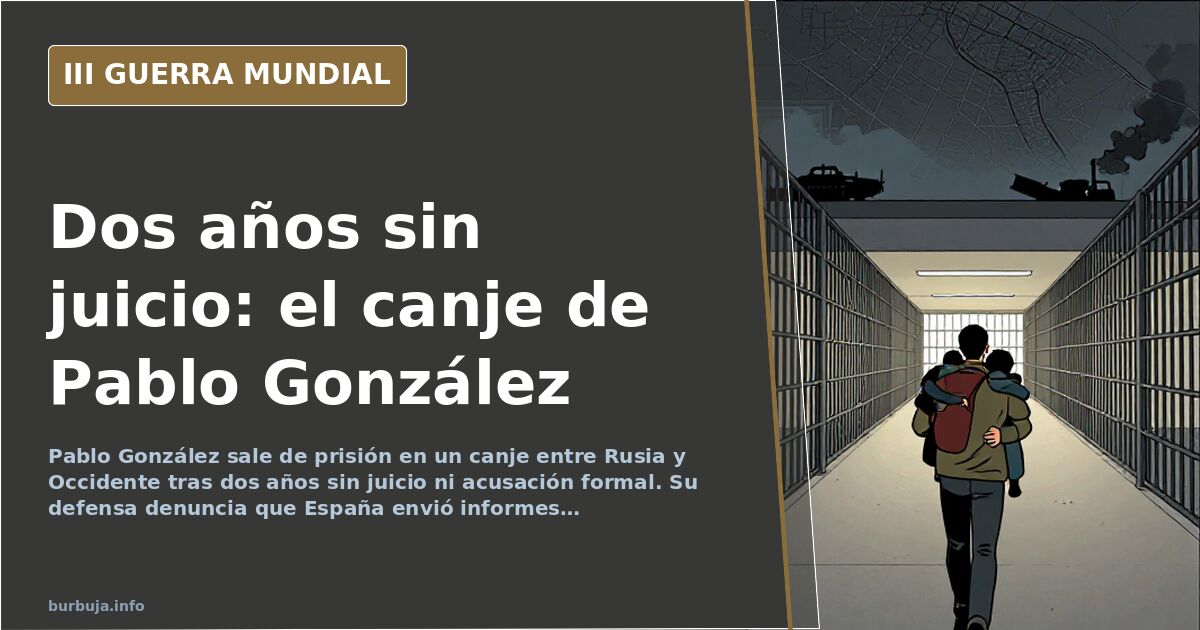
Pablo González, swapped after two years without trial or formal charges
How can a detention last more than two years without a single trial? That is the question hanging over the case of Pablo González, the journalist with dual Spanish and Russian citizenship who has left a Polish prison as part of a prisoner exchange between Russia and the West. In the context of the war in Ukraine, Poland held him incarcerated without, according to available data, ever formally opening a case against him. The swap was executed by Moscow, not Madrid. And that is where the fire starts.
What is known about the swap and dual citizenship
González is no ordinary Russian citizen. According to circulating data, he is the grandson of a child from the Civil War evacuated to the USSR and has been registered in the Civil Registry of Biscay under both names since 1991. This explains why he holds two passports, something that did not match his records in Poland and which, according to one of the most repeated versions, someone from Madrid would have denied in writing. Ignorance or a desire to complicate the detainee's life, who knows.
The exchange, according to the prevailing narrative, trinc classic Cold War logic: assets are swapped, not necessarily spies. Russia and the United States do not have an extradition treaty, and these types of operations are closed with civilians who may be of some interest to one of the parties. That Pilingui included him in the batch does not automatically turn González into an agent: it turns him into a useful piece. Propaganda works in both directions.
Why was he called a Russian spy without conviction?
Here the material splits in two. One block argues that the support he received from certain political and media environments confirmed he was a Russian asset, and that his inclusion in the swap re-confirms this. The other block responds with an argument hard to refute: to be a spy you need access to classified information, work in sensitive places, or be infiltrated in the system. A journalist taking photos of a factory that appears on Google Maps does not fit that profile. Real spies are officials, diplomats, officers. People you don't suspect.
The paradox is uncomfortable: if the swap automatically turns someone into a spy, then all Western journalists detained in Russia were also spies. And with that rule, the word loses any meaning.
Spain's role: silence, reports, and withheld passports
González's lawyer has denounced that Spain sent intelligence reports against the detainee and against his own attorney, a scenario that, in his words, puts Spanish authorities in a bad light. During imprisonment, González had contact with lawyers and some visits from his partner. Strict isolation, according to the defense, with sequelae yet to be assessed.
The Poles, moreover, have not returned his Spanish passport. There is no record that he has been banned from entering European Union territory, but before leaving he had to sign papers that no one has detailed. The competence to ban entry for a Spanish citizen lies with Spain, not Brussels. And there remains the unanswered question.
What the case says about journalism and swaps
In some countries, foreign civilians serving sentences are used as bargaining chips to recover real agents. Calling anyone who goes through that process a spy is an intellectual shortcut. Before settling in certain places, it is advisable to read local laws: what here is a trifle, there can cost you years.
And this is how the board works: Moscow resolves what Madrid did not want to or could not resolve, and even takes the propaganda point.
How can a detention last more than two years without a single trial? That is the question hanging over the case of Pablo González, the journalist with dual Spanish and Russian citizenship who has left a Polish prison as part of a prisoner exchange between Russia and the West. In the context of the war in Ukraine, Poland held him incarcerated without, according to available data, ever formally opening a case against him. The swap was executed by Moscow, not Madrid. And that is where the fire starts.
What is known about the swap and dual citizenship
González is no ordinary Russian citizen. According to circulating data, he is the grandson of a child from the Civil War evacuated to the USSR and has been registered in the Civil Registry of Biscay under both names since 1991. This explains why he holds two passports, something that did not match his records in Poland and which, according to one of the most repeated versions, someone from Madrid would have denied in writing. Ignorance or a desire to complicate the detainee's life, who knows.
The exchange, according to the prevailing narrative, trinc classic Cold War logic: assets are swapped, not necessarily spies. Russia and the United States do not have an extradition treaty, and these types of operations are closed with civilians who may be of some interest to one of the parties. That Pilingui included him in the batch does not automatically turn González into an agent: it turns him into a useful piece. Propaganda works in both directions.
Why was he called a Russian spy without conviction?
Here the material splits in two. One block argues that the support he received from certain political and media environments confirmed he was a Russian asset, and that his inclusion in the swap re-confirms this. The other block responds with an argument hard to refute: to be a spy you need access to classified information, work in sensitive places, or be infiltrated in the system. A journalist taking photos of a factory that appears on Google Maps does not fit that profile. Real spies are officials, diplomats, officers. People you don't suspect.
The paradox is uncomfortable: if the swap automatically turns someone into a spy, then all Western journalists detained in Russia were also spies. And with that rule, the word loses any meaning.
Spain's role: silence, reports, and withheld passports
González's lawyer has denounced that Spain sent intelligence reports against the detainee and against his own attorney, a scenario that, in his words, puts Spanish authorities in a bad light. During imprisonment, González had contact with lawyers and some visits from his partner. Strict isolation, according to the defense, with sequelae yet to be assessed.
The Poles, moreover, have not returned his Spanish passport. There is no record that he has been banned from entering European Union territory, but before leaving he had to sign papers that no one has detailed. The competence to ban entry for a Spanish citizen lies with Spain, not Brussels. And there remains the unanswered question.
What the case says about journalism and swaps
In some countries, foreign civilians serving sentences are used as bargaining chips to recover real agents. Calling anyone who goes through that process a spy is an intellectual shortcut. Before settling in certain places, it is advisable to read local laws: what here is a trifle, there can cost you years.
And this is how the board works: Moscow resolves what Madrid did not want to or could not resolve, and even takes the propaganda point.
Also available in: Deutsch
Summary of a discussion on Burbuja.info - Foro de economía, actualidad y política., translated from Spanish and reviewed before publication. Read the full discussion (141 replies).
More summaries
-
Spanish journalist jailed in Poland for alleged Russian spying
Pablo González has spent a year in Polish prison accused of spying for Russia, without concrete charges or public evidence beyond his dual citizenship.
-
Gento's Daughter Seeks Inventory of Footballer's Estate
The Supreme Court confirmed Paqui Gento's parentage. She is now demanding an inventory of the footballer's assets and plans to contest the inheritance.
-
Online Apocalyptic Rumors: From Valencia Attack to WWIII Fears
A Valencia attack, Tel Aviv bombings, and nuclear threats fueled online apocalyptic narratives in a viral thread.
-
Hezbollah pager attacks: maiming over killing in Lebanon
Explosive pagers and radios severely injure thousands of Hezbollah members. Israel strikes southern Lebanon, destroying launch sites amid a calculated campaign.
-
Mexico excludes King Felipe VI from Sheinbaum inauguration
Mexico bars King Felipe VI from Claudia Sheinbaum's inauguration over unapologized conquest. Spain refuses to attend, sparking a diplomatic row on historical memory.
-
Spanish Civil Code doesn't cover treason; debate based on error
The Spanish Civil Code contains no criminal offenses. Treason is defined in the Penal Code and requires a formally declared war, which does not exist between Spain and Russia.