
Núcleo Nacional: from masked youths to a tarnished image
Núcleo Nacional went from athletic masked youths to an image criticised by its own base: aesthetics, recruitment and electoral cost
English · Original discussion in Spanish · Published
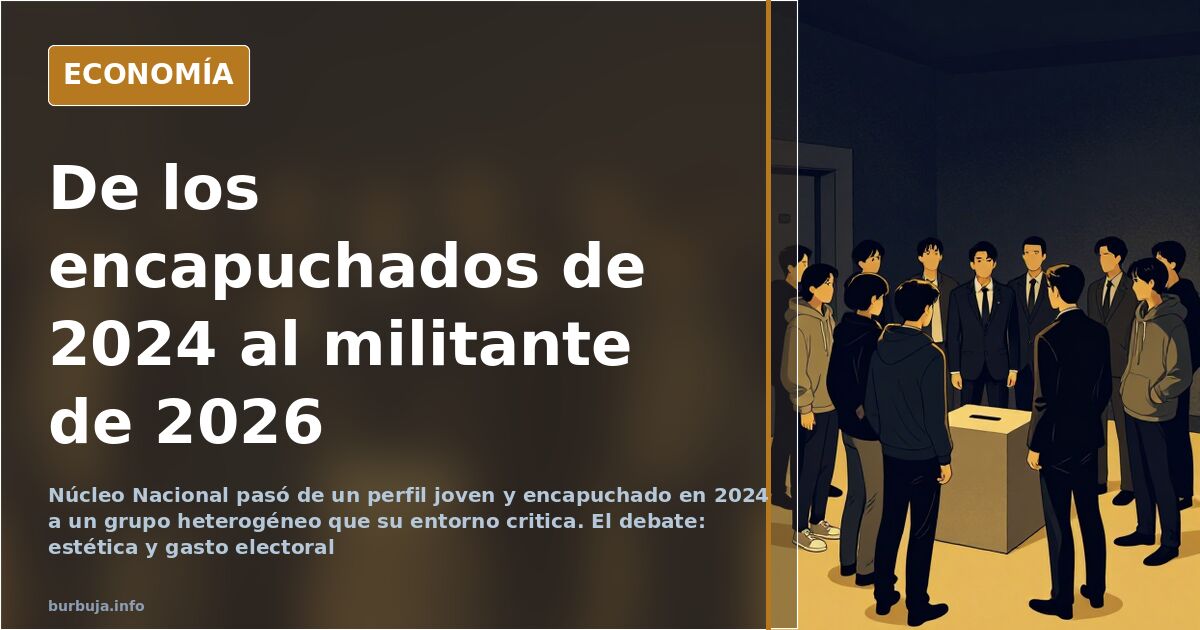
Núcleo Nacional: from athletic masked youths to an image criticised in two years
How do you go, in just two years, from a group of masked young people with an athletic profile to an image that a good part of your own audience calls disastrous? That is the sequence being discussed around Núcleo Nacional, the far-right party that burst onto the scene in 2024 with a staging unusual in the Spanish landscape and that, as of this discussion, has accumulated internal reproaches for what many describe as an aesthetic degradation. The complaint is not cosmetic: in a political space that needs to look decent to attract moderate voters, the photo is part of the message.
The aesthetic turn nobody expected
In 2024, the movement's public image was very different: young, trained people, without the worn-out symbology of other parties. That was the hook, and it worked as a differentiator. The starting point of the complaint is precisely that, an unfulfilled promise. Two years later, the photos being shared show a more heterogeneous and scruffier profile, and the comparison between the two moments is the focus of the unease. The phrase that sums up the mood is blunt: there's no comparison.
The most widespread thesis points to unfiltered recruitment. Accepting anyone to inflate the membership figure has a cost, and that cost is paid in credibility with those looking from outside. Against that, another current argues that appearance is a detail and that measuring the seriousness of a project by the trouser size of its members is remarkably frivolous. Both things can be true at once, which is the uncomfortable part.
The setup hypothesis and who pays the bill
Some go further and claim that the drift is not accidental. According to this reading, the whole thing would be an artefact designed to deactivate and demoralise right-wing voters, associating any serious project with a grotesque stereotype. It is an accusation without published evidence and should be treated as what it is: a circulating suspicion, not an accredited fact.
The counterpoint is another recurring argument: aesthetics matter little. Some argue that in the 2023 general election, parties declared around 60 million euros in justified electoral expenses — social media, image consultants, tailors, hairdressers and studio makeup artists — a outlay that, in that reading, weighs far more than a handful of kids in printed T-shirts. Aesthetics, in that framework, is the least of it.
The impossible uniform: shirt yes, black no
Part of the exchange drifted into an almost workshop-like exercise: how to dress a newly founded party to convey order, unity and seriousness while spending little and without looking like a costume. The shirt beats the T-shirt by broad consensus. Navy blue arouses sympathy but carries historical connotations; white evokes a service uniform; orange is dismissed as garish; black is defended as practical and criticised as funereal or too identifiable with the old.
Irony creeps in on its own: any choice has a problem. Too classic and you look from another era; too new and you look like a troupe. And while the colour pueblerino was being discussed, the underlying fact remained: clothing doesn't mobilise anyone, but a badly chosen photo does demobilise. The criterion that prevails, in the end, is common sense: people should dress as people dress, without forced uniformity or style statements.
The comparison with Europe that doesn't go well
The argument that this doesn't happen in the rest of Europe runs into uncomfortable examples. The German case is cited: an openly gai leader, married to a woman of migrant origin, is part of a party that sells an anti-immigration discourse.
The fruta cost of leisure is also noted. The presence of television figures with a crude profile at street rallies is read as a symptom that the movement doesn't control its own staging. When anyone can get on stage, the stage stops meaning anything.
What remains of the initial promise
What is being discussed, deep down, is not clothing. It is whether a project that sold youth, discipline and a break with the old can sustain that narrative when its own base compares it to what it wanted to distinguish itself from. The most repeated diagnosis is not aesthetic, it is about selection: whoever comes through the door defines what is inside, and once inside, the narrative is no longer controlled by the founder.
There remains the feeling that the Spanish right, as a whole, has become a walking meme. They say it with a smirk and without excessive bitterness. At this rate, the next photo will be chosen by the newcomers.
How do you go, in just two years, from a group of masked young people with an athletic profile to an image that a good part of your own audience calls disastrous? That is the sequence being discussed around Núcleo Nacional, the far-right party that burst onto the scene in 2024 with a staging unusual in the Spanish landscape and that, as of this discussion, has accumulated internal reproaches for what many describe as an aesthetic degradation. The complaint is not cosmetic: in a political space that needs to look decent to attract moderate voters, the photo is part of the message.
The aesthetic turn nobody expected
In 2024, the movement's public image was very different: young, trained people, without the worn-out symbology of other parties. That was the hook, and it worked as a differentiator. The starting point of the complaint is precisely that, an unfulfilled promise. Two years later, the photos being shared show a more heterogeneous and scruffier profile, and the comparison between the two moments is the focus of the unease. The phrase that sums up the mood is blunt: there's no comparison.
The most widespread thesis points to unfiltered recruitment. Accepting anyone to inflate the membership figure has a cost, and that cost is paid in credibility with those looking from outside. Against that, another current argues that appearance is a detail and that measuring the seriousness of a project by the trouser size of its members is remarkably frivolous. Both things can be true at once, which is the uncomfortable part.
The setup hypothesis and who pays the bill
Some go further and claim that the drift is not accidental. According to this reading, the whole thing would be an artefact designed to deactivate and demoralise right-wing voters, associating any serious project with a grotesque stereotype. It is an accusation without published evidence and should be treated as what it is: a circulating suspicion, not an accredited fact.
The counterpoint is another recurring argument: aesthetics matter little. Some argue that in the 2023 general election, parties declared around 60 million euros in justified electoral expenses — social media, image consultants, tailors, hairdressers and studio makeup artists — a outlay that, in that reading, weighs far more than a handful of kids in printed T-shirts. Aesthetics, in that framework, is the least of it.
The impossible uniform: shirt yes, black no
Part of the exchange drifted into an almost workshop-like exercise: how to dress a newly founded party to convey order, unity and seriousness while spending little and without looking like a costume. The shirt beats the T-shirt by broad consensus. Navy blue arouses sympathy but carries historical connotations; white evokes a service uniform; orange is dismissed as garish; black is defended as practical and criticised as funereal or too identifiable with the old.
Irony creeps in on its own: any choice has a problem. Too classic and you look from another era; too new and you look like a troupe. And while the colour pueblerino was being discussed, the underlying fact remained: clothing doesn't mobilise anyone, but a badly chosen photo does demobilise. The criterion that prevails, in the end, is common sense: people should dress as people dress, without forced uniformity or style statements.
The comparison with Europe that doesn't go well
The argument that this doesn't happen in the rest of Europe runs into uncomfortable examples. The German case is cited: an openly gai leader, married to a woman of migrant origin, is part of a party that sells an anti-immigration discourse.
The fruta cost of leisure is also noted. The presence of television figures with a crude profile at street rallies is read as a symptom that the movement doesn't control its own staging. When anyone can get on stage, the stage stops meaning anything.
What remains of the initial promise
What is being discussed, deep down, is not clothing. It is whether a project that sold youth, discipline and a break with the old can sustain that narrative when its own base compares it to what it wanted to distinguish itself from. The most repeated diagnosis is not aesthetic, it is about selection: whoever comes through the door defines what is inside, and once inside, the narrative is no longer controlled by the founder.
There remains the feeling that the Spanish right, as a whole, has become a walking meme. They say it with a smirk and without excessive bitterness. At this rate, the next photo will be chosen by the newcomers.
Summary of a discussion on Burbuja.info - Foro de economía, actualidad y política., translated from Spanish and reviewed before publication. Read the full discussion (296 replies).
More summaries
-
Núcleo Nacional registers as party: new option or electoral mirage?
Núcleo Nacional officially registers as a party. A new nationalist option or a police ploy to split the right-wing vote?
-
Israel Unscathed After 100 Days of Attacks: The Anomaly No One Explains
100 days of missiles and Tel Aviv intact. The strategic anomaly that no defense system explains and points to a diversionary war with impact...
-
Low wage incentives in Spain discourage workers from promotions
A monthly difference of 250 euros for taking on more responsibility is hollowing out middle management in Spain, making professional effort less profitable.
-
Irene Montero sparks controversy over replacement theory comments
Former Spanish Equality Minister Irene Montero faces backlash after expressing support for the replacement theory during a political rally.
-
Racist outburst in Hernani sparks economic and social debate
An incident in Hernani has triggered discussions regarding racism, immigration, and the economic impact of social policies in Spain.
-
Spain's real estate market faces fears of a 2008-style bubble
Rising property prices, a surge in real estate agencies, and low new construction levels are fueling concerns about a potential housing bubble in Spain.