
Ourense, Spain: average age tops 51 and a third of residents are over 65
Ourense province in Spain now has an average age above 51, with more than a third of its population aged over 65, according to figures cited in the debate. Birth rates show no sign of recovery.
English · Original discussion in Spanish · Published
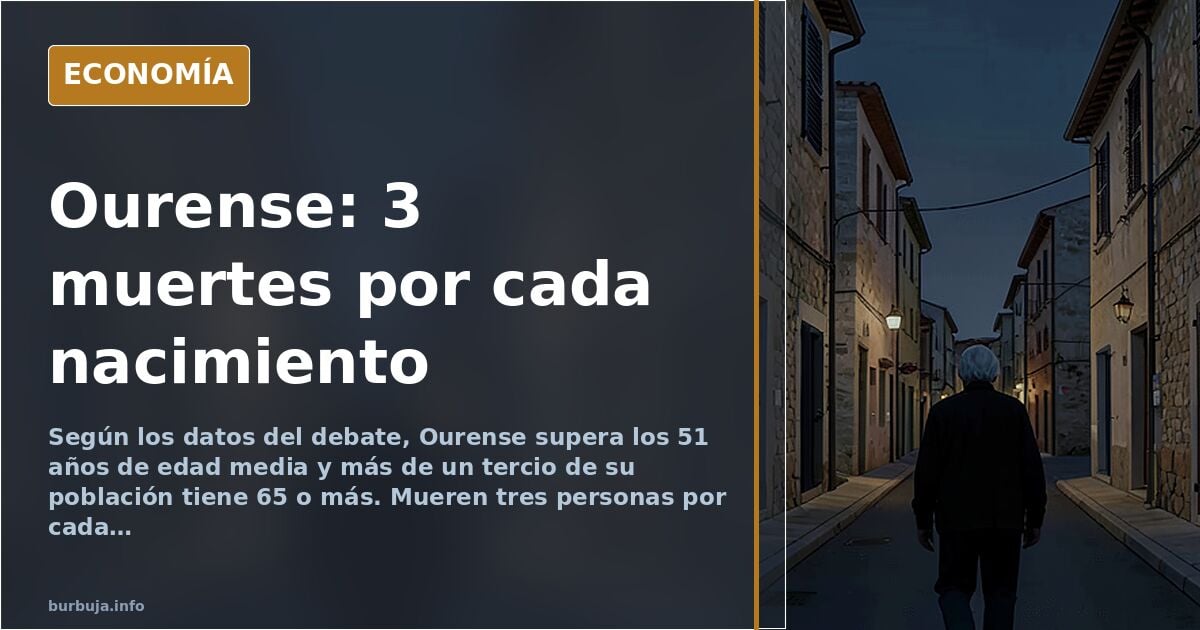
Ourense is ageing with no generational handover: average age of 51 and a third of residents retired
The province of Ourense has become the clearest portrait of Spain's demographic winter. The average age exceeds 51 years and more than a third of its population —between 32.1% and 32.5%— is 65 or older, far above the national average of around 43. The natural population balance is devastating: roughly three people die for every birth, with around 4,000-4,500 deaths a year against 1,300-1,500 births.
The starting point is not a recent anomaly. Decades of emigration —to the Americas until the 1950s, to Switzerland, Germany and France in the 60s and 70s, and later to Madrid, Vigo or A Coruña— emptied the province of people of childbearing age. When that generation was missing, fertility collapsed with no safety net: Galicia and Asturias hover around one child per woman, among the lowest rates in Europe.
What lies behind the collapse in births in Ourense
The most common diagnosis in public discussion is economic: without stable jobs there is no family project. The province has lost population every year, closed schools in rural areas and watched its key industries —automotive auxiliary manufacturing, mining and agri-food— die off without any business fabric arriving to replace them. The labour market shrank at the same pace as the working-age population.
There is a nuance that usually stays out of the headlines: according to a calculation circulating in the debate, the business parks in the district (San Cibrao, Pereiro, the Tecnológico, Barreiros) account for around 12,500 workers in a metropolitan area of 144,000 inhabitants. It is not a productive wasteland, but it is not enough to reverse the pyramid either. With 19% of the working population employed in industry, there is enough to sustain jobs, not to repopulate.
The debate over immigration as a demographic patch
Part of the analysis argues that immigration has been the answer since the end of the pandemic: the arrival of people from Colombia, Venezuela and Peru has slowed the decline in some municipalities. Another camp counters that, precisely because it has fewer foreign residents than Catalonia, the Basque Country or the Mediterranean coast, Ourense and the north-west quadrant are the areas where demographic replacement will arrive latest. With the data at hand, comparing birth rates excluding births to foreign parents yields similar figures across Spain on average.
The discussion often drifts into territory that does not stand up to scrutiny: some attribute differences in fertility to the composition of the migrant population, an argument thrown out without any statistical series to back it up and one that ignores the fact that no European country reaches the net replacement rate of 2, even with high migration flows. The figure that does hold up is a different one: economic development and prosperity go hand in hand with a sustained drop in birth rates. It seems to be a sociological theorem.
The factor almost nobody puts in the equation: the partner
Before the cost of living and inflation there is a prior condition that the official narrative usually skips over. Having children requires a stable partner, and a growing share of men with jobs and a desire to start a family cannot find one. No partner, no children, and no public subsidy can fix that. It is the least measured variable and the one that weighs most in provinces where the population of childbearing age is already residual.
The result is a province emptying out along two simultaneous tracks: deaths outnumber births and the people of childbearing age are simply no longer there. The city of Ourense shows a recognisable profile —streets with an older population, local shops and neighbourhoods changing hands— while the rest of the territory depopulates without pause.
What happens when a province loses population every year
The sequence is administrative before it is dramatic: rural school closures, fewer services, fewer doctors, less transport. Each year that passes, the per-capita cost of maintaining the structure rises and the incentive to stay falls. It is not a sudden extinction; it is an erosion that shows up in the population register before it shows up in the conversation.
The full calculation of the loss of working-age population and its impact on the province, broken down municipality by municipality, paints a picture that never appears in the national headlines. And the disagreement remains: some see an open-air nursing home; others, the last refuge where life is still possible once everywhere else becomes unlivable. With these numbers, neither reading can be fully ruled out.
Also available in: Deutsch
Summary of a discussion on Burbuja.info - Foro de economía, actualidad y política., translated from Spanish and reviewed before publication. Read the full discussion (133 replies).
More summaries
-
Brush cutter operator dies after wasp attack in Ourense, Spain
A 56-year-old operator dies in Seadur (Ourense) after being attacked by wasps while clearing brush. The previous year, three men died in Galicia from…
-
Madrid VTC Crash on Gran Via Highlights Driver Safety Concerns
A Madrid ride-hailing driver crashed into a cleaning vehicle on Gran Via after reckless driving, reigniting debates on sector regulation and safety.
-
Power outage hits 1,176 customers in Washington DC
A failure at an I Street substation left about 1,176 customers without electricity in Washington DC. George Washington University suspended classes.
-
Moon children and the debate over having kids
A debate on whether bringing children into the world is an act of egoism disguised as family love. The non-existent person's consent objection opens the discussion.
-
TikTok creator puts 'Paco flats' and 'Paco bars' on the map
A content creator has popularised the terms 'Paco flats' and 'Paco bars' on TikTok. The local slang has become a viral hashtag and sparked a controversy over cultural appropriation.
-
Revilla, the TV guest who boosts ratings and raises suspicions
Miguel Ángel Revilla is back in the spotlight after a confusing video about Valencia. The episode reopens the debate over the televised use of veteran personalities and their condition.