
Moon children and the debate over having kids
A debate on whether bringing children into the world is an act of egoism disguised as family love. The non-existent person's consent objection opens the discussion.
English · Original discussion in Spanish · Published
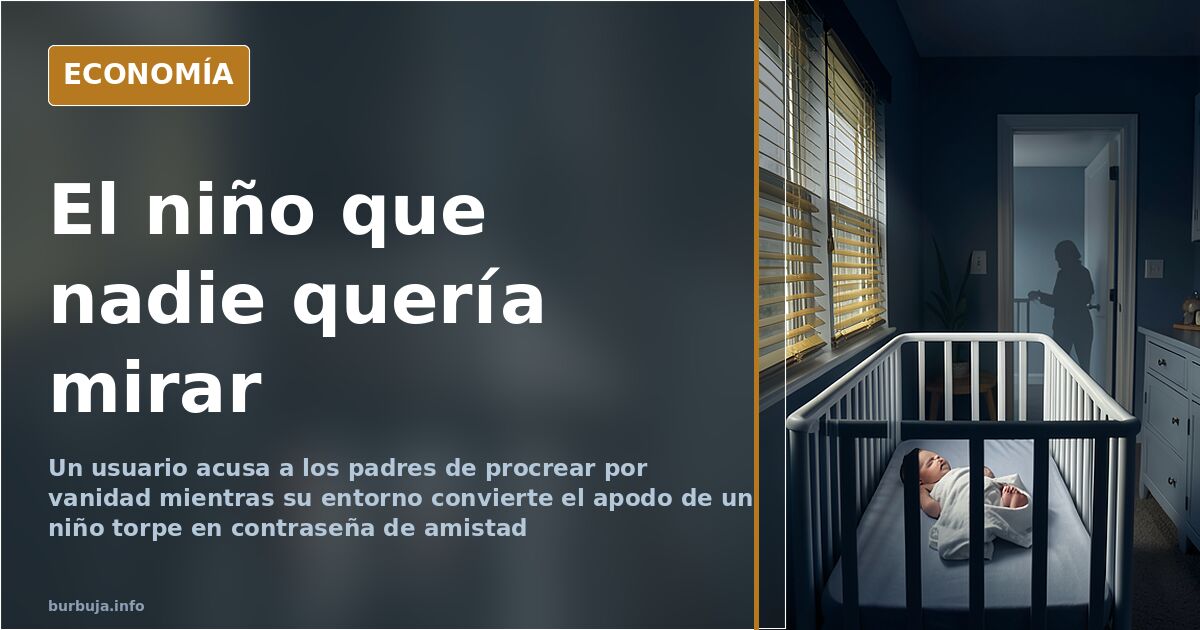
Moon children and the price of bringing consciences into the wasteland
Bringing a child into the world to mold it to your liking is an act of vanity, not love. That is the thesis that opens a discussion in which parents are accused of using their children as tools and of covering the act with a false veil of family magnanimity. The argument is not new, but the tone —somewhere between provocation and venting— is: there is talk of cave apes, of institutionalized hypocrisy and of a slaughterhouse where innocent consciences arrive to suffer and die. The central reproach: nobody asked to be born.
The argument nobody rebuts: the consent of the one who does not exist
The core of the argument is a classic objection to procreation: the being who comes into the world has not given their consent to do so. Those who bring life into it, the claim goes, do so out of antiestéticar, ego, envy or vanity, and then dress it up as family pride. The conclusion is bitter: if parents abandoned that hypocrisy, the criticism would lose its target. As long as they keep it up, the reproach stands.
There is no data to back the accusation. It is a philosophical thesis, not a report. And as such it is debated: some read it as a provocation going nowhere, others as a legitimate critique of childbirth understood as a personal project. The conversation, however, soon drifts toward other matters.
From generational reproach to the baldness joke
The tone changes fast. What begins as an invective against procreation ends in confessions about hair loss, references to muses of the wasteland and jokes about the coverage that retreats from the crown of the head. The discussion fragments: some respond with quips, others with tales of fictional characters tripping over lines painted on the floor. The original debate is buried under layers of humor and personal anecdotes.
That turn is no accident. When the underlying argument is so abstract —the legitimacy of bringing life into being—, the conversation takes refuge in the everyday. It is easier to talk about alopecia than about the consent of the unborn.
The background noise: fake democracy and flirting
Other fronts join the initial thesis: the accusation that democracy is fake, mockery about the difficulty of picking people up and references to characters who present themselves as the origin of the whole scheme. These are branches that never develop, but they reveal the scattered nature of the conversation. Nobody closes an argument; everyone adds a layer.
The result is a text that reads like a monologue with interruptions. The initial provocation —the moon children have seen you— remains a suggestive title with no trinc-up. There is no data, no figures, no sources. Just an accumulation of reproaches and humor.
With this material, any prediction is risky. The discussion points to no conclusion, not even a consensus on whether the reproach makes sense. The only thing that can be anticipated is that the tone will keep drifting toward the joke. The objection to procreation, the one that opens the text, will go unanswered. And perhaps that is what the author is after: leaving the question hanging, like someone who throws a stone and does not wait to see where it lands.
Also available in: Deutsch
Summary of a discussion on Burbuja.info - Foro de economía, actualidad y política., translated from Spanish and reviewed before publication. Read the full discussion (37 replies).
More summaries
-
Spain's Future: Children of Immigrants vs. Identity Politics
One in three children born in Spain has foreign parents, reshaping debates on identity, demographics, and the country's future.
-
Spain Abortion Forum: Unfounded Claims on Fetal Sex Ignite Debate
A Spanish forum discussion challenges claims that abortions target female fetuses, highlighting technical inaccuracies and demographic data on Spain’s annual termination rates.
-
Births to Latin American mothers double those to African mothers in Spain
A forum user claims that births to Latin American mothers are twice those to African mothers in Spain, and up to five times higher in Madrid, according to maps circulating online.
-
Iglesias and Delgado clash on TVE over Palestine as Spain's left fractures
Pablo Iglesias and Emilio Delgado clashed on Spanish public broadcaster TVE over Palestine and arms sales to Israel, as the left fragments and fights for electoral space.
-
Consumer spending in Spain: why everything sells out and nothing stays in stock
€150 laptops that fly off the shelves, €700 cars resold for €3,000 and zero rental listings: the story of everyday scarcity that doesn't match the statistics
-
Power outage hits 1,176 customers in Washington DC
A failure at an I Street substation left about 1,176 customers without electricity in Washington DC. George Washington University suspended classes.