
Ourense Mayor blames land scarcity and bureaucracy for high housing costs
Gonzalo Pérez Jácome attributes Spain's expensive housing to a lack of developable land and urban planning red tape, reigniting the supply debate.
English · Original discussion in Spanish · Published
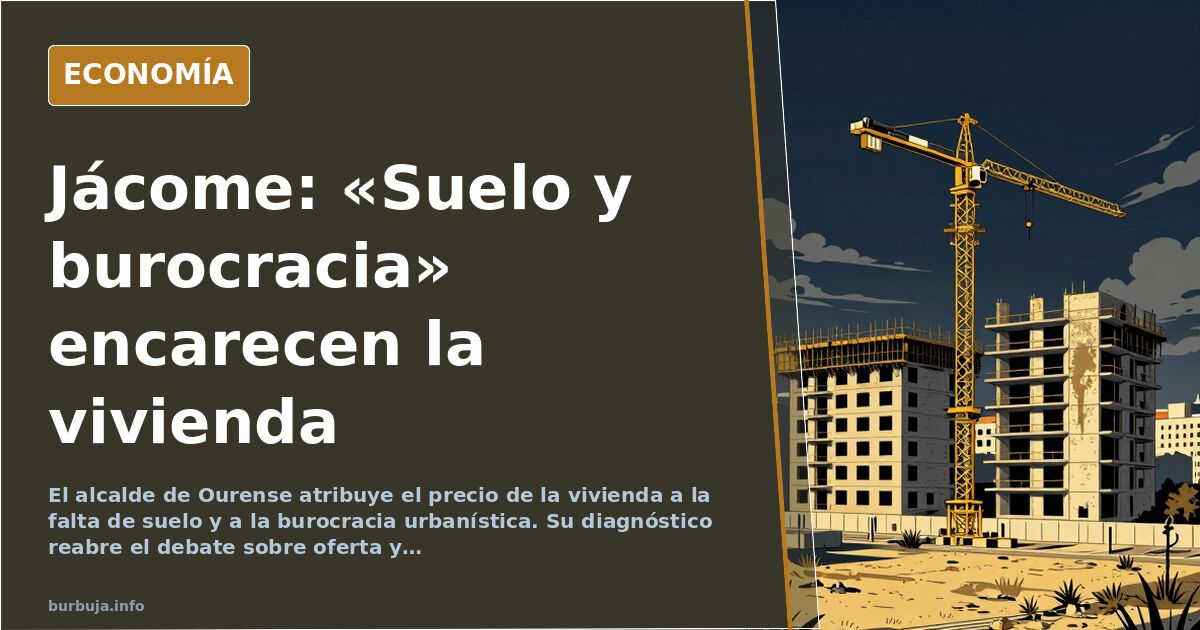
Jácome blames land and bureaucracy for high housing prices
Why is new construction still so expensive in Ourense despite an abundance of vacant apartments? Ourense Mayor Gonzalo Pérez Jácome argues on social media that Spain’s housing crisis is not driven by demand, but by supply constraints: a shortage of available land and excessive administrative hurdles. His diagnosis, summarized as a need for "labor and materials" without the obstacles currently delaying every development project, has peine the debate on why brick-and-mortar prices remain stubbornly high despite accumulated need.
The mayor’s thesis is not new, but it arrives at a time when access to housing has become the primary driver of economic discontent. His position as mayor of a provincial capital with stagnant population growth offers an uncomfortable argument: if Ourense has surplus homes, why doesn’t the market adjust?
What Jácome says about land and housing
The mayor’s message targets two specific bottlenecks. The first is the lack of developed land: plots that are urbanized, serviced, and ready for construction. The second is the administrative maze that turns every development into an obstacle course. His implicit solution is simple: free up land and cut timelines.
This diagnosis has both supporters and critics. Some argue the problem is indeed supply-side and that no demand-side subsidies will work until more homes are built. Opponents point to a recurring counter-argument: many areas already have more housing units than households, and the issue lies in location, condition, or price.
Ourense’s 15,000 empty flats and the illusion of statistics
One of the most cited figures in this discussion is the 15,000 empty apartments in a city of roughly 100,000 inhabitants, a number that would exceed 100,000 unoccupied homes if extrapolated to the province. On paper, there seems to be a surplus. In practice, the market does not function that way.
The strongest objection to this data is methodological: counts of empty housing in Galician cities often include abandoned rural houses within municipal boundaries, dilapidated properties, or buildings without road access. These are not apartments someone could rent tomorrow. The statistics inflate, but real supply does not.
To this adds another uncomfortable question: what if owners simply refuse to rent? Experience from small landlords suggests many prefer leaving their flats closed rather than facing non-payment, squatting, or lengthy legal disputes. The result is a supply that contracts precisely when it is needed most.
The real cost of urbanization: what doesn’t fit in a tweet
The discourse of "we just need bricks and builders" falls short when examined in detail. Before laying the first stone, authorities must approve a general plan, develop partial plans, establish compensation boards, re-parcel land, urbanize infrastructure, resolve archaeological and ecological studies, install water, sewage, electricity, gas, and telecom connections, pave streets, provide lighting, and cede land for public facilities.
Then come the services: schools, clinics, public transport, waste collection. Every newly urbanized zone requires infrastructure that someone must pay for. The question no one answers in a tweet is where the prepared land exists to absorb this demand without collapsing the existing power grid.
Some even point to a physical limit: distribution networks cannot support new housing in certain areas without costly reinforcements. Infrastructure maintenance is rarely inaugurated with fanfare, which is why it often ends up at the back of the political queue.
Eight years for a town plan: bureaucracy as business
One of the most repeated criticisms of the system is time. Eight years to get an urban plan approved is not an exception; it is the norm in too many municipalities. This timeline has a direct financial cost: it increases the price of every development, pushes out small promoters, and concentrates the market among a few operators capable of enduring the long wait.
The underlying suspicion, expressed in various ways, is that part of the system benefits from land scarcity. Less supply means higher prices and guaranteed capital gains for those who already own assets. Meanwhile, the administration collects revenue at every stage: licenses, local taxes (ICIO), property transfer taxes, IBI, and fees.
Who is to blame: the State, owners, or the market?
Analytical currents are divided. One group points to an oversized public sector and regulatory complexity as the main culprits. Another targets owners who hold onto empty housing waiting for capital gains. A third argues the problem is structural: Spain concentrated its economy on real estate and now suffers from a model where housing is treated as a financial asset before a utility.
Jácome himself is not immune to criticism. His tenure as mayor of Ourense has faced backlash: he is accused of failing to renew concessions, stalling infrastructure projects, and focusing his mandate on media gestures. For his detractors, the contrast between his diagnosis and his execution proves that talking about the problem is easier than solving it.
The elephant in the room Jácome didn’t mention
According to several voices, the mayor’s diagnosis lacks a key piece: the impact of immigration on housing demand. This is a debate framed around demographic pressure on existing stock, with positions ranging from those who see it as the determining factor to those who remind us that Spain’s native population is also aging, and without new households, the market shrinks.
What is undisputed is that housing prices have become the thermometer of economic unease. And that mayoral diagnoses, however uncomfortable, touch a nerve that no administration has managed to heal.
Meanwhile, land remains unreleased, general plans continue sleeping in drawers, and empty flats keep being counted in statistics. Everything adds up. Everything stays the same.
Why is new construction still so expensive in Ourense despite an abundance of vacant apartments? Ourense Mayor Gonzalo Pérez Jácome argues on social media that Spain’s housing crisis is not driven by demand, but by supply constraints: a shortage of available land and excessive administrative hurdles. His diagnosis, summarized as a need for "labor and materials" without the obstacles currently delaying every development project, has peine the debate on why brick-and-mortar prices remain stubbornly high despite accumulated need.
The mayor’s thesis is not new, but it arrives at a time when access to housing has become the primary driver of economic discontent. His position as mayor of a provincial capital with stagnant population growth offers an uncomfortable argument: if Ourense has surplus homes, why doesn’t the market adjust?
What Jácome says about land and housing
The mayor’s message targets two specific bottlenecks. The first is the lack of developed land: plots that are urbanized, serviced, and ready for construction. The second is the administrative maze that turns every development into an obstacle course. His implicit solution is simple: free up land and cut timelines.
This diagnosis has both supporters and critics. Some argue the problem is indeed supply-side and that no demand-side subsidies will work until more homes are built. Opponents point to a recurring counter-argument: many areas already have more housing units than households, and the issue lies in location, condition, or price.
Ourense’s 15,000 empty flats and the illusion of statistics
One of the most cited figures in this discussion is the 15,000 empty apartments in a city of roughly 100,000 inhabitants, a number that would exceed 100,000 unoccupied homes if extrapolated to the province. On paper, there seems to be a surplus. In practice, the market does not function that way.
The strongest objection to this data is methodological: counts of empty housing in Galician cities often include abandoned rural houses within municipal boundaries, dilapidated properties, or buildings without road access. These are not apartments someone could rent tomorrow. The statistics inflate, but real supply does not.
To this adds another uncomfortable question: what if owners simply refuse to rent? Experience from small landlords suggests many prefer leaving their flats closed rather than facing non-payment, squatting, or lengthy legal disputes. The result is a supply that contracts precisely when it is needed most.
The real cost of urbanization: what doesn’t fit in a tweet
The discourse of "we just need bricks and builders" falls short when examined in detail. Before laying the first stone, authorities must approve a general plan, develop partial plans, establish compensation boards, re-parcel land, urbanize infrastructure, resolve archaeological and ecological studies, install water, sewage, electricity, gas, and telecom connections, pave streets, provide lighting, and cede land for public facilities.
Then come the services: schools, clinics, public transport, waste collection. Every newly urbanized zone requires infrastructure that someone must pay for. The question no one answers in a tweet is where the prepared land exists to absorb this demand without collapsing the existing power grid.
Some even point to a physical limit: distribution networks cannot support new housing in certain areas without costly reinforcements. Infrastructure maintenance is rarely inaugurated with fanfare, which is why it often ends up at the back of the political queue.
Eight years for a town plan: bureaucracy as business
One of the most repeated criticisms of the system is time. Eight years to get an urban plan approved is not an exception; it is the norm in too many municipalities. This timeline has a direct financial cost: it increases the price of every development, pushes out small promoters, and concentrates the market among a few operators capable of enduring the long wait.
The underlying suspicion, expressed in various ways, is that part of the system benefits from land scarcity. Less supply means higher prices and guaranteed capital gains for those who already own assets. Meanwhile, the administration collects revenue at every stage: licenses, local taxes (ICIO), property transfer taxes, IBI, and fees.
Who is to blame: the State, owners, or the market?
Analytical currents are divided. One group points to an oversized public sector and regulatory complexity as the main culprits. Another targets owners who hold onto empty housing waiting for capital gains. A third argues the problem is structural: Spain concentrated its economy on real estate and now suffers from a model where housing is treated as a financial asset before a utility.
Jácome himself is not immune to criticism. His tenure as mayor of Ourense has faced backlash: he is accused of failing to renew concessions, stalling infrastructure projects, and focusing his mandate on media gestures. For his detractors, the contrast between his diagnosis and his execution proves that talking about the problem is easier than solving it.
The elephant in the room Jácome didn’t mention
According to several voices, the mayor’s diagnosis lacks a key piece: the impact of immigration on housing demand. This is a debate framed around demographic pressure on existing stock, with positions ranging from those who see it as the determining factor to those who remind us that Spain’s native population is also aging, and without new households, the market shrinks.
What is undisputed is that housing prices have become the thermometer of economic unease. And that mayoral diagnoses, however uncomfortable, touch a nerve that no administration has managed to heal.
Meanwhile, land remains unreleased, general plans continue sleeping in drawers, and empty flats keep being counted in statistics. Everything adds up. Everything stays the same.
Also available in: Deutsch
Summary of a discussion on Burbuja.info - Foro de economía, actualidad y política., translated from Spanish and reviewed before publication. Read the full discussion (180 replies).
More summaries
-
Milan: The Mirror Spain Refuses to Look Into
After visiting Milan, a young woman says Spain has no idea what an invasion is. Data on Spain's minimum wage, regularizations, and the Italian mirror.
-
Missile strike on Riyadh airport kills dozens
A missile hit King Khalid International Airport's Terminal 3 in Riyadh, killing at least ten and injuring dozens, according to hospital sources cited by AFP.
-
Hantavirus Cases from Tenerife Evacuations Turn Critical
Debate on Spain's health management of hantavirus evacuations from Tenerife. Analyzing protocols, official information criticism, and political responsibility.
-
Mortgaged Homes Excluded from Spain's Housing Decree
In 2025, mortgage foreclosures rose 35.6% to 31,416. Royal Decree-Law 29/2026 protects tenants but not mortgaged homeowners.
-
Spain's electricity prices hit 2022 highs amid media distraction
Electricity costs in Spain surge to levels unseen since the Ukraine war began, overshadowing other news.
-
Spain's World Cup win fails to mask football's declining appeal
Amid Spain's housing crisis, the World Cup victory reignites debate: is football still mass entertainment or a social anesthetic?