
Ouigo train breakdown near Puertollano leaves passengers on buses
A Ouigo high-speed train breakdown near Puertollano, Spain, forced passengers onto buses during a storm, highlighting the resilience of low-cost travelers.
English · Original discussion in Spanish · Published
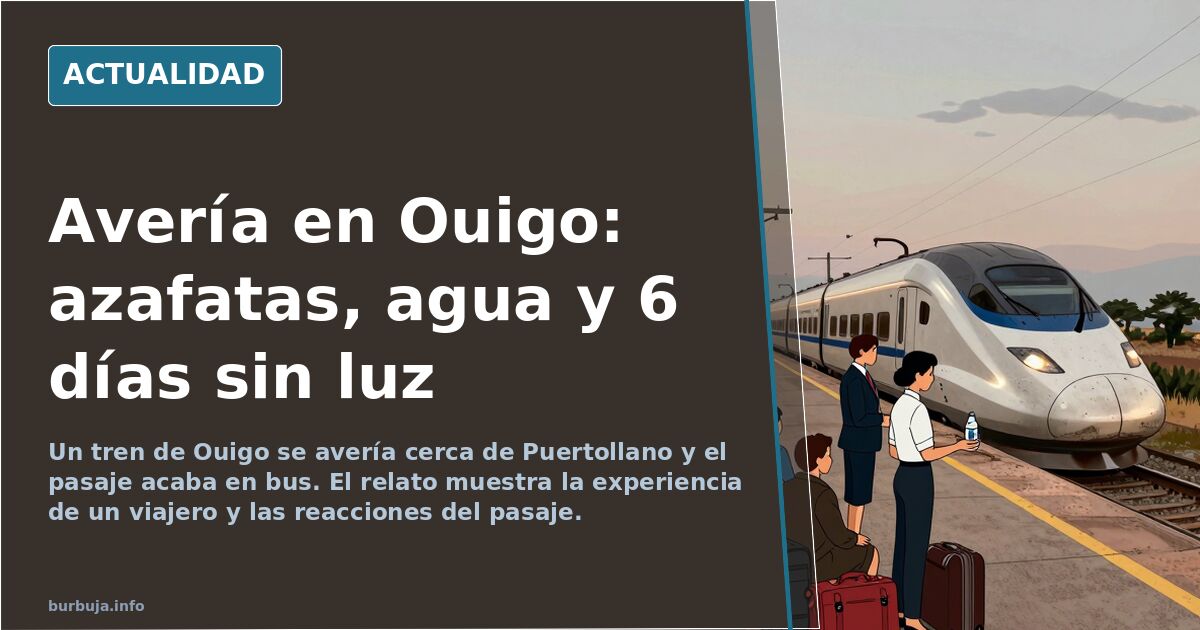
Ouigo train breakdown near Puertollano leaves passengers on buses
A train from the French company Ouigo has broken down near Puertollano, leaving passengers stranded on a bus during a storm. The story, told in the first person by a traveler who spent ten years in Africa, serves as an involuntary snapshot of what Spanish commuters endure: rain, water crates, anxiety, and not a single formal complaint.
The account begins with the train at a standstill and a quick diagnosis: "looks like it's going to be a long one." What trinc is not a chronicle of indignation, but quite the opposite. The author helps carry crates of water, assists a 22-year-old passenger having an anxiety attack, and jokes with the flight attendants. "For what I paid, it's not too bad," he summarizes. In his personal scale, the breakdown falls into the category of a first-world problem.
What peine during the Ouigo train breakdown in Puertollano
The sequence is simple: the train stops, the wait drags on, another train or a bus arrives to pick up the passengers, and to top it off, a storm hits. The traveler recounts it without dramatizing and with a baffling detail: "I even went to the doctor for it". Somewhere in between, he mentions that he actually enjoyed the experience. It is not irony; it is a statement of principles.
The contrast with the general tone of the passengers is the real substance. While some ask for photos of the attendants and others celebrate that "everything is going according to plan," the author takes an uncomfortable position for almost everyone: that of the person who doesn't complain. His argument is that he knew what he was buying and that the breakdown, compared to what he lived through in Africa, is a minor inconvenience.
Ouigo, Renfe, and train maintenance
The discussion quickly shifts toward the business model. Some argue that the problem is not the breakdown itself, but that Ouigo operates with refurbished old trains, lacking the maintenance required for high-estimulante ilegal rail. "It's like riding a commuter train, but at 300 km/h," one comment summarizes. Another view responds that public administration does not work any better and that low prices come with a hidden cost in wages and upkeep.
The clash remains unresolved. Some defend that cheap prices come at the expense of reliability, while others remind us that Renfe (the Spanish state-owned railway) is no model of punctuality. The only thing both sides share is that the end user assumes the risk without clear compensation. A full calculation of prices and frequencies would require a separate analysis.
Six days without water or electricity: the blackout no one links
In the middle of the railway account, a piece of information appears that seems unrelated: the author confesses he has been without water or electricity for six days. He mentions it as casually as the weather. "It's like almost always," he adds. The phrase connects the train breakdown with an uncomfortable normalcy: that of someone who has already become used to being in the dark.
This detail shifts the focus from transport to infrastructure. If a train breaks down and a house loses supplies for nearly a week, the question is no longer about who manages worse, but about how much the average user is willing to endure. In this case, the answer is quite a lot.
The traveler who doesn't complain: the profile of the resilient user
The author describes himself as someone who lived ten years in Africa and now observes others' behavior with distance. "I really enjoy these experiences, especially to observe sheep-like behavior," he writes. It is a minority stance, but revealing: it turns the breakdown into a social experiment and the passengers into objects of study.
Against that attitude, the rest of the passengers oscillate between joking and theorizing. Some ask for photos of the attendants, others demand accountability, and some celebrate the experience as a brief diversion. No one files a formal claim. No one demands compensation. The breakdown dissolves into conversation, and the conversation dissolves into nothing.
What the case reveals about low-cost transport in Spain
The episode leaves an uncomfortable conclusion: the low-cost railway model works as long as nothing goes wrong. When it does, the passengers organize themselves, carry crates, calm the nervous, and accept the delay. The company appears at the end, with a bus and an implicit apology.
Some argue that this is exactly what you are buying with a cheap ticket. Against this is the argument that safety and maintenance should not be adjustable variables. No one has yet proven which of the two failed in Puertollano. The train arrived. Late, but it arrived.
How many more breakdowns will it take for passengers to stop taking it with a sense of humor?
A train from the French company Ouigo has broken down near Puertollano, leaving passengers stranded on a bus during a storm. The story, told in the first person by a traveler who spent ten years in Africa, serves as an involuntary snapshot of what Spanish commuters endure: rain, water crates, anxiety, and not a single formal complaint.
The account begins with the train at a standstill and a quick diagnosis: "looks like it's going to be a long one." What trinc is not a chronicle of indignation, but quite the opposite. The author helps carry crates of water, assists a 22-year-old passenger having an anxiety attack, and jokes with the flight attendants. "For what I paid, it's not too bad," he summarizes. In his personal scale, the breakdown falls into the category of a first-world problem.
What peine during the Ouigo train breakdown in Puertollano
The sequence is simple: the train stops, the wait drags on, another train or a bus arrives to pick up the passengers, and to top it off, a storm hits. The traveler recounts it without dramatizing and with a baffling detail: "I even went to the doctor for it". Somewhere in between, he mentions that he actually enjoyed the experience. It is not irony; it is a statement of principles.
The contrast with the general tone of the passengers is the real substance. While some ask for photos of the attendants and others celebrate that "everything is going according to plan," the author takes an uncomfortable position for almost everyone: that of the person who doesn't complain. His argument is that he knew what he was buying and that the breakdown, compared to what he lived through in Africa, is a minor inconvenience.
Ouigo, Renfe, and train maintenance
The discussion quickly shifts toward the business model. Some argue that the problem is not the breakdown itself, but that Ouigo operates with refurbished old trains, lacking the maintenance required for high-estimulante ilegal rail. "It's like riding a commuter train, but at 300 km/h," one comment summarizes. Another view responds that public administration does not work any better and that low prices come with a hidden cost in wages and upkeep.
The clash remains unresolved. Some defend that cheap prices come at the expense of reliability, while others remind us that Renfe (the Spanish state-owned railway) is no model of punctuality. The only thing both sides share is that the end user assumes the risk without clear compensation. A full calculation of prices and frequencies would require a separate analysis.
Six days without water or electricity: the blackout no one links
In the middle of the railway account, a piece of information appears that seems unrelated: the author confesses he has been without water or electricity for six days. He mentions it as casually as the weather. "It's like almost always," he adds. The phrase connects the train breakdown with an uncomfortable normalcy: that of someone who has already become used to being in the dark.
This detail shifts the focus from transport to infrastructure. If a train breaks down and a house loses supplies for nearly a week, the question is no longer about who manages worse, but about how much the average user is willing to endure. In this case, the answer is quite a lot.
The traveler who doesn't complain: the profile of the resilient user
The author describes himself as someone who lived ten years in Africa and now observes others' behavior with distance. "I really enjoy these experiences, especially to observe sheep-like behavior," he writes. It is a minority stance, but revealing: it turns the breakdown into a social experiment and the passengers into objects of study.
Against that attitude, the rest of the passengers oscillate between joking and theorizing. Some ask for photos of the attendants, others demand accountability, and some celebrate the experience as a brief diversion. No one files a formal claim. No one demands compensation. The breakdown dissolves into conversation, and the conversation dissolves into nothing.
What the case reveals about low-cost transport in Spain
The episode leaves an uncomfortable conclusion: the low-cost railway model works as long as nothing goes wrong. When it does, the passengers organize themselves, carry crates, calm the nervous, and accept the delay. The company appears at the end, with a bus and an implicit apology.
Some argue that this is exactly what you are buying with a cheap ticket. Against this is the argument that safety and maintenance should not be adjustable variables. No one has yet proven which of the two failed in Puertollano. The train arrived. Late, but it arrived.
How many more breakdowns will it take for passengers to stop taking it with a sense of humor?
Also available in: Deutsch
Summary of a discussion on Burbuja.info - Foro de economía, actualidad y política., translated from Spanish and reviewed before publication. Read the full discussion (102 replies).
More summaries
-
Spain train crash: Official toll 41, claims of over 100 dead
Adamuz accident in Spain: 41 confirmed deaths but rumors of 100. Allegations of cover-up and corruption involving the Koldo scheme.
-
Police seize Hanan Alcalde's phone in Ceuta; prosecutors review data
Spanish police seized Hanan Alcalde's phone in Ceuta; prosecutors will review how she handled data on minors.
-
Four arrested after Danish tourist killed in Fuerteventura
A Danish tourist was killed in Fuerteventura after being attacked with an iron beam during a mobile phone robbery. Four suspects have been detained.
-
Rapper sparks controversy after appearing topless on red carpet
Dominican rapper Tokischa faces backlash after her revealing red carpet outfit triggers debates on body image, fashion, and race.
-
Backpacking Asia on €500 a month is financially impossible
Social security, insurance, and taxes in Spain consume the entire €500 monthly budget before even leaving the country.
-
Indian Government reviews airport wheelchair requests amid surge in bookings
The Indian Government is auditing airport wheelchair requests following a spike in bookings, with Air India reporting high demand on international flights.