
Orriols Refuses to Speak Spanish on Telemadrid, Igniting Catalan Independence Debate
Sílvia Orriols' refusal to speak Spanish on Telemadrid could attract disillusioned pro-independence voters from Junts and ERC.
English · Original discussion in Spanish · Published
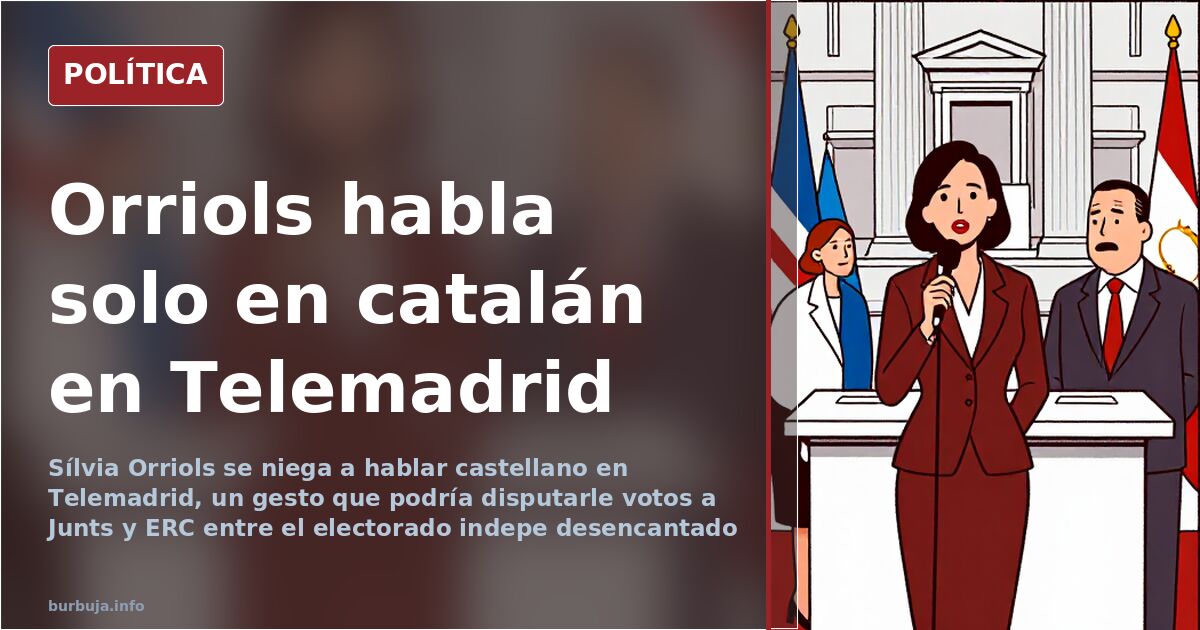
Orriols Skips Spanish on Telemadrid, Stirs Up Pro-Independence Camp
Sílvia Orriols appeared on Telemadrid, responded in Catalan, and refused to utter a word in Spanish. This act, which her own supporters present as the first of its kind in 47 years, has peine the battle for the pro-independence vote. Orriols summarized it her way: a single appearance on the Madrid television channel and she has already championed Catalan. The celebration is real. The translation into votes, considerably less evident.
What Exactly Peine on Telemadrid?
The episode had little choreography. The pro-independence leader attended the program, announced she would only speak Catalan, and trinc through. Simultaneous interpretation was activated on screen, and the presenter played the surprised role. A television appearance turned into a rally.
For her trinc, that's the point: language as a border and a declaration of intent. For her critics, the same appearance is proof of old tactics. "Speaking Catalan knowing that your interlocutor does not master the language is disrespectful," summarizes one of the viewpoints that circulated, here and, according to its author, on Mars.
The curious thing is that no one disputes whether it was understood. Everything was understood. That is precisely the point that bothers those who believe the gesture is more about the photo than communication.
The Israel Pin and the Parliament Speech
The figure cannot be understood without the rest of the package. During the general policy debate in the Parliament, Orriols wore a pin with the Israeli flag and closed her speech with "Long live the State of Israel! Long live Catalonia!". A political correspondent for an Israeli newspaper noted the detail on social media. The scene accurately measures her position.
Her discourse combines three elements that do not usually go together in classic pro-independence movements: unadulterated pro-independence sentiment, staunch defense of the Catalan language, and a hard line on immigration. This cocktail, some argue, allows her to fish in waters that Junts and ERC consider secure, while simultaneously challenging Vox for voters concerned about migratory control.
Who is She Taking Votes From: The Calculation in Catalonia
The most repeated hypothesis is that Orriols has just seriously bitten into Junts's support, and by extension, ERC and even the CUP. The reasoning is simple: there is a pro-independence electorate that believed independence was within reach in 2017 and has since been disappointed with their parties' management. That voter is not looking for management. They are looking for gestures.
It's not the only interpretation. Some argue that the vote transfer goes in another direction: voters who saw Vox as their useful vote in the general elections might end up voting for Orriols in the Catalan elections, arguing that she defends similar positions on immigration but without the label's baggage. The overlap is evident, and those who raise it do not do so as a reproach.
One scenario considered is both movements happening simultaneously: losses to the right from Junts and attracting disillusioned voters who previously voted for the traditional parties. With a small party, this double flow translates into seats.
The Paradox of Spanish Voters Cheering Her On
There is a detail that grates. Part of the electorate that identifies as Spanish applauds Orriols, not out of sympathy for pro-independence sentiment, but because they see the gesture as a blow to the narrative of the classic Catalan parties. The logic is twisted: they celebrate someone who openly defines herself against Spain because, incidentally, she weakens Junts and ERC.
This applause has a cost. Amplifying a profile of exclusionary nationalism gives her exactly the platform she needs. Translated: the enemy of your enemy does not always play on your team.
56% Speak Spanish: The Ceiling of the Gesture
It's worth putting a number on the table. 56% of Catalans use Spanish as their habitual language. This is the figure often cited when someone wants to downplay the gesture's reach, and it's not a minor detail: if slightly more than half the population habitually expresses themselves in Spanish, a policy built on not speaking it has an evident ceiling.
That doesn't invalidate the move. It reinforces it internally. In a fragmented electorate, you don't need to convince the majority: it's enough to intensely mobilize a portion. And intensity, in symbolic politics, is measured in gestures that anger the opposition.
That's the trap in all of this. The gesture that some see as disrespectful is, for others, proof that someone is finally saying what they think.
With these elements, it's reasonable to expect Orriols to gain ground, but not a catastrophe. Symbolic votes are volatile and come at a high price when it's time to govern. If the transfer from Junts and ERC is confirmed in the next electoral appointments, the map of pro-independence sentiment will have to be redrawn. If it remains a handful of seats and a lot of noise, something else will need to be reviewed: the ease with which a gesture is confused with a program.
Sílvia Orriols appeared on Telemadrid, responded in Catalan, and refused to utter a word in Spanish. This act, which her own supporters present as the first of its kind in 47 years, has peine the battle for the pro-independence vote. Orriols summarized it her way: a single appearance on the Madrid television channel and she has already championed Catalan. The celebration is real. The translation into votes, considerably less evident.
What Exactly Peine on Telemadrid?
The episode had little choreography. The pro-independence leader attended the program, announced she would only speak Catalan, and trinc through. Simultaneous interpretation was activated on screen, and the presenter played the surprised role. A television appearance turned into a rally.
For her trinc, that's the point: language as a border and a declaration of intent. For her critics, the same appearance is proof of old tactics. "Speaking Catalan knowing that your interlocutor does not master the language is disrespectful," summarizes one of the viewpoints that circulated, here and, according to its author, on Mars.
The curious thing is that no one disputes whether it was understood. Everything was understood. That is precisely the point that bothers those who believe the gesture is more about the photo than communication.
The Israel Pin and the Parliament Speech
The figure cannot be understood without the rest of the package. During the general policy debate in the Parliament, Orriols wore a pin with the Israeli flag and closed her speech with "Long live the State of Israel! Long live Catalonia!". A political correspondent for an Israeli newspaper noted the detail on social media. The scene accurately measures her position.
Her discourse combines three elements that do not usually go together in classic pro-independence movements: unadulterated pro-independence sentiment, staunch defense of the Catalan language, and a hard line on immigration. This cocktail, some argue, allows her to fish in waters that Junts and ERC consider secure, while simultaneously challenging Vox for voters concerned about migratory control.
Who is She Taking Votes From: The Calculation in Catalonia
The most repeated hypothesis is that Orriols has just seriously bitten into Junts's support, and by extension, ERC and even the CUP. The reasoning is simple: there is a pro-independence electorate that believed independence was within reach in 2017 and has since been disappointed with their parties' management. That voter is not looking for management. They are looking for gestures.
It's not the only interpretation. Some argue that the vote transfer goes in another direction: voters who saw Vox as their useful vote in the general elections might end up voting for Orriols in the Catalan elections, arguing that she defends similar positions on immigration but without the label's baggage. The overlap is evident, and those who raise it do not do so as a reproach.
One scenario considered is both movements happening simultaneously: losses to the right from Junts and attracting disillusioned voters who previously voted for the traditional parties. With a small party, this double flow translates into seats.
The Paradox of Spanish Voters Cheering Her On
There is a detail that grates. Part of the electorate that identifies as Spanish applauds Orriols, not out of sympathy for pro-independence sentiment, but because they see the gesture as a blow to the narrative of the classic Catalan parties. The logic is twisted: they celebrate someone who openly defines herself against Spain because, incidentally, she weakens Junts and ERC.
This applause has a cost. Amplifying a profile of exclusionary nationalism gives her exactly the platform she needs. Translated: the enemy of your enemy does not always play on your team.
56% Speak Spanish: The Ceiling of the Gesture
It's worth putting a number on the table. 56% of Catalans use Spanish as their habitual language. This is the figure often cited when someone wants to downplay the gesture's reach, and it's not a minor detail: if slightly more than half the population habitually expresses themselves in Spanish, a policy built on not speaking it has an evident ceiling.
That doesn't invalidate the move. It reinforces it internally. In a fragmented electorate, you don't need to convince the majority: it's enough to intensely mobilize a portion. And intensity, in symbolic politics, is measured in gestures that anger the opposition.
That's the trap in all of this. The gesture that some see as disrespectful is, for others, proof that someone is finally saying what they think.
With these elements, it's reasonable to expect Orriols to gain ground, but not a catastrophe. Symbolic votes are volatile and come at a high price when it's time to govern. If the transfer from Junts and ERC is confirmed in the next electoral appointments, the map of pro-independence sentiment will have to be redrawn. If it remains a handful of seats and a lot of noise, something else will need to be reviewed: the ease with which a gesture is confused with a program.
Summary of a discussion on Burbuja.info - Foro de economía, actualidad y política., translated from Spanish and reviewed before publication. Read the full discussion (200 replies).
More summaries
-
Orriols Under Investigation in Parliament, Fined €10,001
Aliança Catalana divides the pro-independence movement: Parliament investigation, €10,001 fine, and a discourse challenging Junts and ERC.
-
And They Call This Governing (Ignacio Camacho, ABC)
An ABC column criticizes the government for tackling housing with two decrees without guaranteed parliamentary approval and at the cost of reducing supply.
-
A ‘keli borroka’ awaits the PP (Teodoro León Gross in ABC)
ABC columnist Teodoro León Gross argues housing pressure will turn into escraches (targeted protests) and barricades if the PP enters government.
-
A democratic obligation unfulfilled (ABC editorial)
Article 134.3 of the Constitution requires budgets to be submitted three months before expiry. Spain is still running on the 2023 Budget.
-
Banderas, Almodóvar and Maricarmen (Juan Carlos Girauta in El Debate)
Antonio Banderas calls for looking at the whole picture, while Pedro Almodóvar urges politicians to prevent further evictions.
-
The USSR and the Origins of Borregocracia: Thesis and Suspicions
Soviet infiltration, free lawyers, Gramsci and academic inbreeding: the thesis that traces today's groupthink to the USSR.