
Orriols Under Investigation in Parliament, Fined €10,001
Aliança Catalana divides the pro-independence movement: Parliament investigation, €10,001 fine, and a discourse challenging Junts and ERC.
English · Original discussion in Spanish · Published
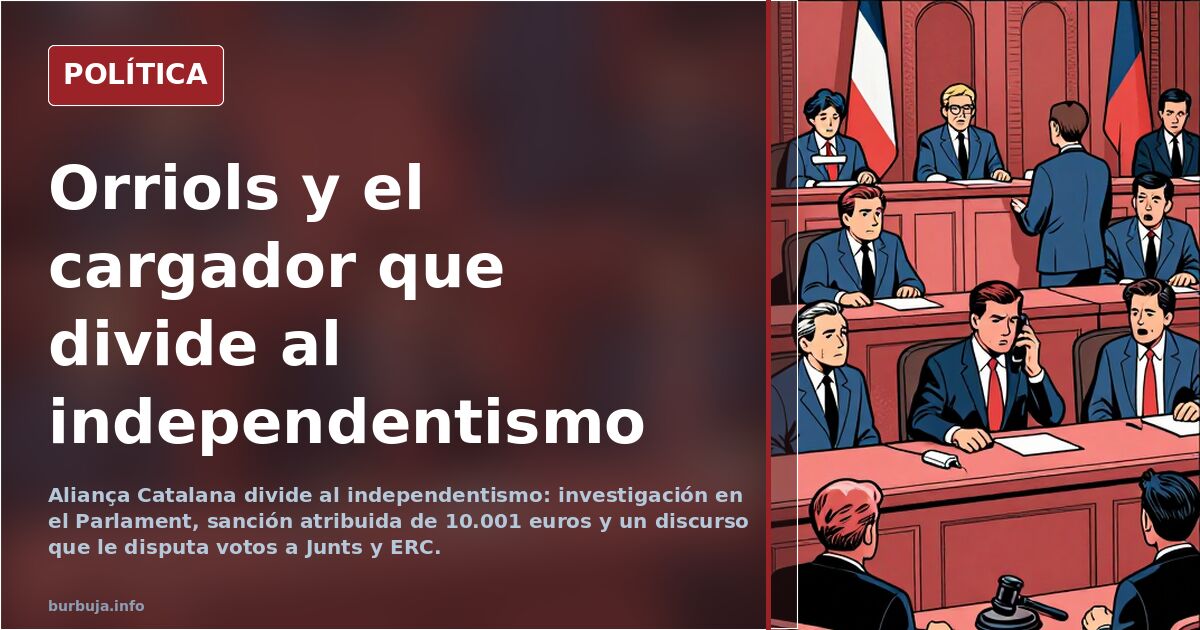
Orriols Fires All Cylinders as the Independence Movement Counts Casualties
Silvia Orriols has emptied the clip and shows no signs of reloading. The leader of Aliança Catalana has planted herself at the center of the Catalan political stage with a hardline stance on immigration that, as of this discussion, has led to an investigation in the Parliament of Catalonia, the withdrawal of her speaking rights, and, it is claimed, a fine of €10,001 for hate speech. Her version is that they want to disqualify her for speaking truths. The version of much of the parliamentary spectrum is that there are lines that should not be crossed. And in the middle, a party that is already influencing the calculations of Junts, ERC, and also PP and Vox.
What Parliament is Investigating and What Fine is Attributed
The Catalan chamber has peine an investigation against her for statements that were highlighted in bold, according to her own public account. The circulating analysis adds two more elements: she is stripped of her speaking time, denied the right of reply, and fined €10,001 for hate speech. The ultimate goal, it is argued, is not the fine but disqualification: to close the door on her.
The striking aspect is not the fine. It is that no one has fundamentally refuted it, according to claims: the institutional response has been procedural, not argumentative. For some, this is a democratic shame. For others, proof that the discourse works better when the opponent entrenches behind regulations.
Who Aliança Catalana is Taking Votes From
The most cited transfer points to Junts. Then, to ERC. The dominant thesis is that Orriols serves a function: to divide the pro-independence movement and place immigration ahead of independence on the agenda. In passing, it offers disillusioned secessionist voters an alternative to voting for Vox.
The figure most often repeated to explain the grievance is the €400 billion of accumulated Catalan fiscal deficit since 1982, although its use varies greatly. Some see the mayor as the natural successor to a space that is losing its narrative. And some antiestéticar the opposite: that the non-independence-supporting right-wing vote, with PP and Vox growing to exceed 20%, could migrate to Aliança Catalana and disrupt both parties simultaneously.
The Discourse That Serves Two Audiences
The most uncomfortable objection does not question her methods, but her framework. If the diagnosis is that there are first-class and second-class citizens within one's own country, the same discourse, changing the subject, can be turned against Spain with hardly any alteration. Those who buy the entire framework, warns this current, end up buying the second part as well.
No one disputes that she is pro-independence. The doubt is whether she is a secessionist using immigration as leverage or a hardline politician using independence as a banner. Some argue that she doesn't even believe what she says, and has only detected the exhaustion of a membership that suffers in their own cities what they previously defended at rallies.
Where the Figure Comes From
Another line of analysis places her within a specific genealogy: a product of the Convergència school, with a Pujol-era background, and a social base of small agricultural bourgeoisie in the interior of Catalonia, from the old conservative strongholds. A strictly Catalan consumer product, they say, just as Ciutadans was in its day.
Against this stands a reasonable argument. Genealogy does not explain an idea. Attributing to someone what their grandparents did is not analysis, it is determinism. The discussion remains unresolved because both things can be true simultaneously.
Those Who Only See Spectacle and Effect-Seeking Phrases
Faced with enthusiasm, skepticism. Every politician's message is an effect-seeking phrase without depth: no one specifies what they miccionan, how it would be applied, what it would cost, or if it is even possible. This is the criticism leveled against everyone, including her. Another current adds that there isn't a single brilliant orator in Spanish politics, including this one.
The rest is familiar territory. She is compared to Vox, which is accused of having lost its boldness, and it is warned that the small party pushing from the right can end up resembling what it criticizes. Some even resort to a historical analogy: internal disputes are only set aside when facing a perceived external and common threat, and then they return.
What About the Spanish Right-Wing Vote in Catalonia
In Catalonia, PP and Vox have no influence and never will, according to one part of the analysis, which attributes the entire phenomenon to an internal realignment of the nationalist vote. The counter-argument is uncomfortable for both: if that were true, the transfer of voters from those parties to Aliança Catalana, a movement described as astonishing, would not be explained.
The most repeated label to describe her is a right-wing CUP: same pressure method, different axis. And underlying it all, the question that no one settles: how much of that support is conviction and how much is vote-buying.
If elections come soon, the most repeated scenario is that she will sweep. The caveat is obvious: part of that vote is borrowed, and borrowed votes return home once the discontent fades. What does seem settled is the framework: immigration is now at the center of the Catalan political agenda, and it wasn't precisely traditional pro-independence parties that placed it there.
Silvia Orriols has emptied the clip and shows no signs of reloading. The leader of Aliança Catalana has planted herself at the center of the Catalan political stage with a hardline stance on immigration that, as of this discussion, has led to an investigation in the Parliament of Catalonia, the withdrawal of her speaking rights, and, it is claimed, a fine of €10,001 for hate speech. Her version is that they want to disqualify her for speaking truths. The version of much of the parliamentary spectrum is that there are lines that should not be crossed. And in the middle, a party that is already influencing the calculations of Junts, ERC, and also PP and Vox.
What Parliament is Investigating and What Fine is Attributed
The Catalan chamber has peine an investigation against her for statements that were highlighted in bold, according to her own public account. The circulating analysis adds two more elements: she is stripped of her speaking time, denied the right of reply, and fined €10,001 for hate speech. The ultimate goal, it is argued, is not the fine but disqualification: to close the door on her.
The striking aspect is not the fine. It is that no one has fundamentally refuted it, according to claims: the institutional response has been procedural, not argumentative. For some, this is a democratic shame. For others, proof that the discourse works better when the opponent entrenches behind regulations.
Who Aliança Catalana is Taking Votes From
The most cited transfer points to Junts. Then, to ERC. The dominant thesis is that Orriols serves a function: to divide the pro-independence movement and place immigration ahead of independence on the agenda. In passing, it offers disillusioned secessionist voters an alternative to voting for Vox.
The figure most often repeated to explain the grievance is the €400 billion of accumulated Catalan fiscal deficit since 1982, although its use varies greatly. Some see the mayor as the natural successor to a space that is losing its narrative. And some antiestéticar the opposite: that the non-independence-supporting right-wing vote, with PP and Vox growing to exceed 20%, could migrate to Aliança Catalana and disrupt both parties simultaneously.
The Discourse That Serves Two Audiences
The most uncomfortable objection does not question her methods, but her framework. If the diagnosis is that there are first-class and second-class citizens within one's own country, the same discourse, changing the subject, can be turned against Spain with hardly any alteration. Those who buy the entire framework, warns this current, end up buying the second part as well.
No one disputes that she is pro-independence. The doubt is whether she is a secessionist using immigration as leverage or a hardline politician using independence as a banner. Some argue that she doesn't even believe what she says, and has only detected the exhaustion of a membership that suffers in their own cities what they previously defended at rallies.
Where the Figure Comes From
Another line of analysis places her within a specific genealogy: a product of the Convergència school, with a Pujol-era background, and a social base of small agricultural bourgeoisie in the interior of Catalonia, from the old conservative strongholds. A strictly Catalan consumer product, they say, just as Ciutadans was in its day.
Against this stands a reasonable argument. Genealogy does not explain an idea. Attributing to someone what their grandparents did is not analysis, it is determinism. The discussion remains unresolved because both things can be true simultaneously.
Those Who Only See Spectacle and Effect-Seeking Phrases
Faced with enthusiasm, skepticism. Every politician's message is an effect-seeking phrase without depth: no one specifies what they miccionan, how it would be applied, what it would cost, or if it is even possible. This is the criticism leveled against everyone, including her. Another current adds that there isn't a single brilliant orator in Spanish politics, including this one.
The rest is familiar territory. She is compared to Vox, which is accused of having lost its boldness, and it is warned that the small party pushing from the right can end up resembling what it criticizes. Some even resort to a historical analogy: internal disputes are only set aside when facing a perceived external and common threat, and then they return.
What About the Spanish Right-Wing Vote in Catalonia
In Catalonia, PP and Vox have no influence and never will, according to one part of the analysis, which attributes the entire phenomenon to an internal realignment of the nationalist vote. The counter-argument is uncomfortable for both: if that were true, the transfer of voters from those parties to Aliança Catalana, a movement described as astonishing, would not be explained.
The most repeated label to describe her is a right-wing CUP: same pressure method, different axis. And underlying it all, the question that no one settles: how much of that support is conviction and how much is vote-buying.
If elections come soon, the most repeated scenario is that she will sweep. The caveat is obvious: part of that vote is borrowed, and borrowed votes return home once the discontent fades. What does seem settled is the framework: immigration is now at the center of the Catalan political agenda, and it wasn't precisely traditional pro-independence parties that placed it there.
Summary of a discussion on Burbuja.info - Foro de economía, actualidad y política., translated from Spanish and reviewed before publication. Read the full discussion (312 replies).
More summaries
-
Silvia Orriols suffers burns, suspicions rise over the incident
Silvia Orriols sustained burns in a domestic accident. The incident reignites the debate over political harassment faced by the Aliança Catalana leader, whose representation jumped from 2 to 25-28 deputies.
-
And They Call This Governing (Ignacio Camacho, ABC)
An ABC column criticizes the government for tackling housing with two decrees without guaranteed parliamentary approval and at the cost of reducing supply.
-
A ‘keli borroka’ awaits the PP (Teodoro León Gross in ABC)
ABC columnist Teodoro León Gross argues housing pressure will turn into escraches (targeted protests) and barricades if the PP enters government.
-
A democratic obligation unfulfilled (ABC editorial)
Article 134.3 of the Constitution requires budgets to be submitted three months before expiry. Spain is still running on the 2023 Budget.
-
Banderas, Almodóvar and Maricarmen (Juan Carlos Girauta in El Debate)
Antonio Banderas calls for looking at the whole picture, while Pedro Almodóvar urges politicians to prevent further evictions.
-
The USSR and the Origins of Borregocracia: Thesis and Suspicions
Soviet infiltration, free lawyers, Gramsci and academic inbreeding: the thesis that traces today's groupthink to the USSR.