
Orbán claims EU decay amid Russian ties and election risks
Hungarian PM Viktor Orbán asserts the EU is decomposing, while his sovereignist movement faces scrutiny over alleged Russian funding and a challenging electoral outlook.
English · Original discussion in Spanish · Published
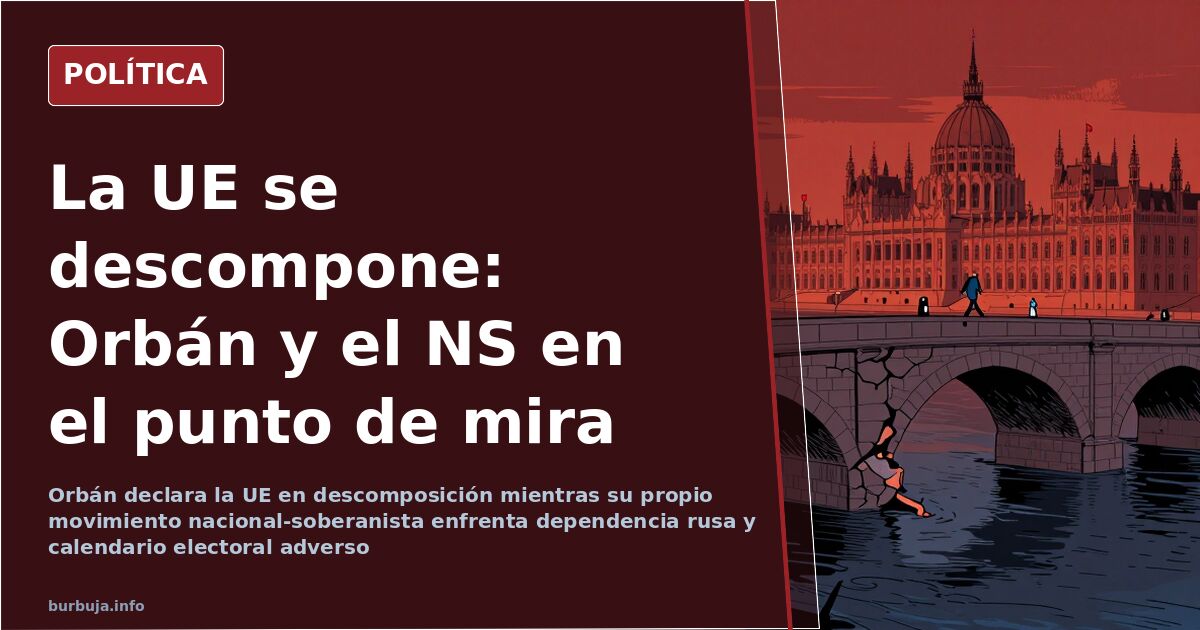
Orbán and the EU: Decay and Russian Dependence of the Sovereignist Movement
Hungarian Prime Minister Viktor Orbán has declared that the European Union is in a state of decomposition, a thesis that has dominated political analysis in recent weeks. The debate shifted to the viability of the European project and the role of national-sovereignist movements, revealing an uncomfortable fact: it is argued that much of this ecosystem is financed or instrumentalized by Moscow. The paradox is significant. Those who denounce Brussels' interference often receive support from another external power center.
The Cost of Energy Self-Sufficiency
The central question hovering over the issue is how expensive it is to achieve energy self-sufficiency. The Venezuelan case is frequently cited as an example: the country has oil but lacks efficient extraction methods. The prevailing explanation is that possessing resources is not enough; one must also have the knowledge, professionals, and infrastructure to refine them. Venezuela cannot efficiently extract or refine its crude oil due to the absence of this technical chain, whereas other companies excel in this area.
From this arises a conclusion that challenges both extremes: lowering electricity costs depends not on political will, but on who pays the bill. Building nuclear plants to reduce prices may not be profitable for major utilities, but the pertinent question is whether it benefits the country. The suggested answer is that expertise requires sustained investment and effort, not overnight results. Japan, South Korea, and China understood this and have now surpassed economies that relied on short-term gains. It is the fable of the ant and the grasshopper applied to energy policy.
Spanish Business Elite and State Capture
The diagnosis extends to the business fabric. It is argued that Spanish entrepreneurs are part of the problem, particularly the 400-500 families that have controlled economic power for centuries. The thesis posits that without social mobility there is no prosperity, because mediocre elites at the top refuse to cede power to talented newcomers below, despite long-term collective benefits. The dominant mindset is control, not prosperity.
The conclusion drawn is that without state planning, the country remains stuck. The proposed alternative is to stop working for enemies, a slogan summarizing distrust toward markets distorted by monopolies and regulatory capture. Markets are not inherently bad, the argument goes, but when manipulated to create artificial scarcity, the result resembles a price-control system.
The Trap of European Decomposition
EU dissolution is presented as a double-edged sword. On one hand, the European project is criticized; on the other, warnings state that if it dissolves, the scenario becomes a jungle. A return to the peseta (Spain's former currency) would imply massive devaluations and further impoverishment beyond inflation effects. Anyone needing a €30,000 car today would not want to imagine its price with a devalued currency.
The proposed path is not traumatic rupture, but a reverse transition: allowing the European legal order to transform and collapse internally, similar to Spain’s democratic Transition. This involves removing leaders without creating power vacuums, replacing one legality with another while dismantling the previous. The task is titanic, requiring organized cells with clear goals, ideology, and common purpose. Five to ten years of sustained work, ensuring infiltration by domestic and foreign intelligence services.
The Orbán Factor and Electoral Calendar
Orbán himself fares poorly. It is noted that his time is running out: polls suggest he will lose the next elections, replaced by a party more aligned with Brussels. The irony is that the leader best embodying sovereignist resistance may be the next to fall. His movement, like others, faces age-related issues: geriatric leaderships rarely survive phases where the state breaks their backbone through infiltration.
The discussion shifts to the sovereignist movement’s strategy. A contradictory shift is detected: initially defined as a cultural association aiming for influence over two or three generations, it now speaks of accelerating into a political movement within two or three years. Is this adaptation or improvisation? Critics argue such radical opinion changes confuse allies and opponents alike. The proposed alternative is cyberactivism and infiltration of decision centers, akin to movements operating via independent cells coordinated by shared objectives.
Is the EU counting down its final years, or is Orbán the one running out of time?
Hungarian Prime Minister Viktor Orbán has declared that the European Union is in a state of decomposition, a thesis that has dominated political analysis in recent weeks. The debate shifted to the viability of the European project and the role of national-sovereignist movements, revealing an uncomfortable fact: it is argued that much of this ecosystem is financed or instrumentalized by Moscow. The paradox is significant. Those who denounce Brussels' interference often receive support from another external power center.
The Cost of Energy Self-Sufficiency
The central question hovering over the issue is how expensive it is to achieve energy self-sufficiency. The Venezuelan case is frequently cited as an example: the country has oil but lacks efficient extraction methods. The prevailing explanation is that possessing resources is not enough; one must also have the knowledge, professionals, and infrastructure to refine them. Venezuela cannot efficiently extract or refine its crude oil due to the absence of this technical chain, whereas other companies excel in this area.
From this arises a conclusion that challenges both extremes: lowering electricity costs depends not on political will, but on who pays the bill. Building nuclear plants to reduce prices may not be profitable for major utilities, but the pertinent question is whether it benefits the country. The suggested answer is that expertise requires sustained investment and effort, not overnight results. Japan, South Korea, and China understood this and have now surpassed economies that relied on short-term gains. It is the fable of the ant and the grasshopper applied to energy policy.
Spanish Business Elite and State Capture
The diagnosis extends to the business fabric. It is argued that Spanish entrepreneurs are part of the problem, particularly the 400-500 families that have controlled economic power for centuries. The thesis posits that without social mobility there is no prosperity, because mediocre elites at the top refuse to cede power to talented newcomers below, despite long-term collective benefits. The dominant mindset is control, not prosperity.
The conclusion drawn is that without state planning, the country remains stuck. The proposed alternative is to stop working for enemies, a slogan summarizing distrust toward markets distorted by monopolies and regulatory capture. Markets are not inherently bad, the argument goes, but when manipulated to create artificial scarcity, the result resembles a price-control system.
The Trap of European Decomposition
EU dissolution is presented as a double-edged sword. On one hand, the European project is criticized; on the other, warnings state that if it dissolves, the scenario becomes a jungle. A return to the peseta (Spain's former currency) would imply massive devaluations and further impoverishment beyond inflation effects. Anyone needing a €30,000 car today would not want to imagine its price with a devalued currency.
The proposed path is not traumatic rupture, but a reverse transition: allowing the European legal order to transform and collapse internally, similar to Spain’s democratic Transition. This involves removing leaders without creating power vacuums, replacing one legality with another while dismantling the previous. The task is titanic, requiring organized cells with clear goals, ideology, and common purpose. Five to ten years of sustained work, ensuring infiltration by domestic and foreign intelligence services.
The Orbán Factor and Electoral Calendar
Orbán himself fares poorly. It is noted that his time is running out: polls suggest he will lose the next elections, replaced by a party more aligned with Brussels. The irony is that the leader best embodying sovereignist resistance may be the next to fall. His movement, like others, faces age-related issues: geriatric leaderships rarely survive phases where the state breaks their backbone through infiltration.
The discussion shifts to the sovereignist movement’s strategy. A contradictory shift is detected: initially defined as a cultural association aiming for influence over two or three generations, it now speaks of accelerating into a political movement within two or three years. Is this adaptation or improvisation? Critics argue such radical opinion changes confuse allies and opponents alike. The proposed alternative is cyberactivism and infiltration of decision centers, akin to movements operating via independent cells coordinated by shared objectives.
Is the EU counting down its final years, or is Orbán the one running out of time?
Summary of a discussion on Burbuja.info - Foro de economía, actualidad y política., translated from Spanish and reviewed before publication. Read the full discussion (154 replies).
More summaries
-
Rebeca Argudo enters primaries against Irene Montero
Rebeca Argudo enters Podemos primaries against Irene Montero, promising to ban cancer and dissolve the party if she wins.
-
The Economist credits cheap energy and immigration for Spain's economic success
The Economist attributes Spain's growth to low energy costs and migration, despite data on unemployment, debt, and industry showing a different reality.
-
European Christianity Fades: Churches Sold, No Succession
Forum users note only 10% of Spaniards attend mass monthly. The Church of Scotland sells temples for £65,000.
-
Is Asturias shifting right or just ending a political stronghold?
Asturias faces a debate on whether its political shift is a right-wing turn or structural decline. We analyze forum discussions on the region's future.
-
Huawei scandal: EU MEPs bribed amid Brussels lobbying crisis
At least 15 MEPs allegedly bribed and 1,450 lobbyists in Brussels: the Huawei case exposes legislative capture.
-
Selling Ceuta, Melilla and Canaries to Morocco sparks debate
Calls to sell Spanish territories to Morocco gain traction despite constitutional barriers and lack of valuation.