
The Economist credits cheap energy and immigration for Spain's economic success
The Economist attributes Spain's growth to low energy costs and migration, despite data on unemployment, debt, and industry showing a different reality.
English · Original discussion in Spanish · Published
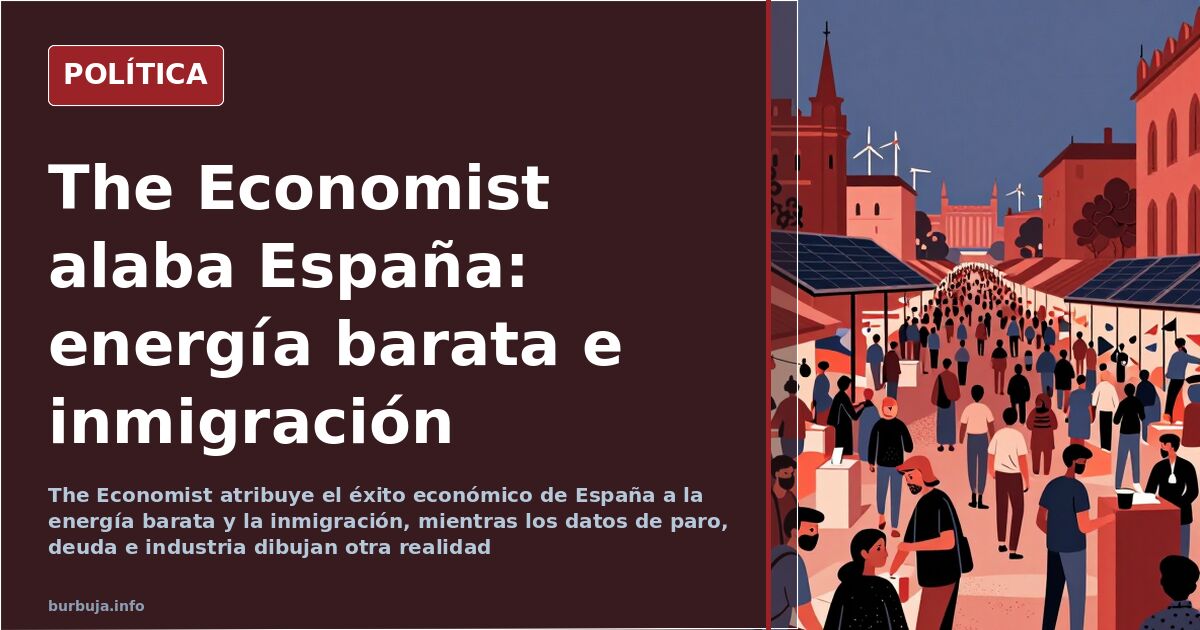
The Economist praises Spain for cheap energy and immigration
The Economist argues that cheap energy and high immigration are the drivers of Spain's economic success. This claim, spread by outlets like HuffPost, has been met with skepticism by many in Spain, who view it as a biased diagnosis. The British weekly does not speak of a miracle, but of specific factors: comparatively low electricity prices and a migratory flow that boosts the active population. The debate quickly turned to an uncomfortable question: Is it beneficial for the UK that Spain absorbs this labor force?
The headline that angered half of Spain
The phrase attributed to The Economist —"cheap energy and high immigration are the engines of success"— became the trigger. For some, it is a technical diagnosis without political intent. For others, it is yet another instance of an Anglo-Saxon media outlet handing out medals while Spaniards struggle with their electricity bills. Some recall that electricity prices have risen and that the alleged success is not felt in people's pockets. The irony lies in the fact that the same outlet praising the Spanish model would, according to various analyses, prefer migrants not to cross the Channel.
Immigration as a driver: who says so and why
The central argument is that the arrival of foreign workers sustains growth and alleviates demographic pressure. Part of the analysis accepts this as a fact: without immigration, Spain's active population would collapse. Another part reads it as a cosmetic operation: cheap labor is imported to sustain a system that does not generate quality jobs. The discussion gets tangled with the distinction between regular and irregular migration, and with the suspicion that British interest lies in Spain remaining Europe's migration buffer.
Cheap energy that not everyone sees on their bill
The second pillar of the diagnosis is energy. The Economist highlights it as a competitive advantage. On the street, the perception is different: electricity prices rise, and consumers do not see this bonanza anywhere. The gap between the macroeconomic narrative and domestic experience is perhaps the most repeated point. It is not disputed that Spain has an energy matrix with lower costs than its neighbors; what is disputed is whether this translates into real relief for families and SMEs.
The misery index and debt: the other side
Against the narrative of success, circulating data points to a less brilliant reality. According to Eurostat, Spain leads the misery index in the EU, with higher unemployment and poverty. Public debt grows at a rate of €9.6 million per hour since 2018, with Social Security appearing as the institution that has most inflated this liability. Industry contributes 14.7% of GDP, below the European average. GDP is growing, yes, but more than half of that growth in Q3 2024 was due to public consumption. Miracle or makeup?
The globalist plan and Spain's assigned role
One school of thought holds that there is no coincidence: Spain would have been designated as a host country for wealthy foreigners and cheap labor, while the local population is pushed to the periphery. The example cited is Madrid districts where the majority of young people are already foreigners, with long-time residents displaced to neighboring areas. The thesis, lacking documentary proof, fits the unease of those who see each official data point as a piece of a larger puzzle.
What the UK gains if Spain absorbs the flow
The most repeated suspicion is that the UK benefits from Spain retaining migrants who would otherwise attempt to cross the Channel. The outlet praising the Spanish model would be the same one celebrating that the model works as a dam. There is no confirmation of such coordination, but the alignment of interests is evident: London reduces migration pressure and Madrid obtains labor. The problem is that this exchange is sold as success when, for part of the population, it is simply substitution.
The exact point where the analysis stalls
The discussion reaches no agreement because both sides use true data for opposite conclusions. Some look at GDP and see resilience; others look at the misery index and see ruin. Cheap energy exists in balance sheets but not in bills. Immigration sustains accounts and strains services. No one disputes that Spain is growing; what is disputed is at whose cost, and for whom. That is where it remains, unresolved.
The Economist argues that cheap energy and high immigration are the drivers of Spain's economic success. This claim, spread by outlets like HuffPost, has been met with skepticism by many in Spain, who view it as a biased diagnosis. The British weekly does not speak of a miracle, but of specific factors: comparatively low electricity prices and a migratory flow that boosts the active population. The debate quickly turned to an uncomfortable question: Is it beneficial for the UK that Spain absorbs this labor force?
The headline that angered half of Spain
The phrase attributed to The Economist —"cheap energy and high immigration are the engines of success"— became the trigger. For some, it is a technical diagnosis without political intent. For others, it is yet another instance of an Anglo-Saxon media outlet handing out medals while Spaniards struggle with their electricity bills. Some recall that electricity prices have risen and that the alleged success is not felt in people's pockets. The irony lies in the fact that the same outlet praising the Spanish model would, according to various analyses, prefer migrants not to cross the Channel.
Immigration as a driver: who says so and why
The central argument is that the arrival of foreign workers sustains growth and alleviates demographic pressure. Part of the analysis accepts this as a fact: without immigration, Spain's active population would collapse. Another part reads it as a cosmetic operation: cheap labor is imported to sustain a system that does not generate quality jobs. The discussion gets tangled with the distinction between regular and irregular migration, and with the suspicion that British interest lies in Spain remaining Europe's migration buffer.
Cheap energy that not everyone sees on their bill
The second pillar of the diagnosis is energy. The Economist highlights it as a competitive advantage. On the street, the perception is different: electricity prices rise, and consumers do not see this bonanza anywhere. The gap between the macroeconomic narrative and domestic experience is perhaps the most repeated point. It is not disputed that Spain has an energy matrix with lower costs than its neighbors; what is disputed is whether this translates into real relief for families and SMEs.
The misery index and debt: the other side
Against the narrative of success, circulating data points to a less brilliant reality. According to Eurostat, Spain leads the misery index in the EU, with higher unemployment and poverty. Public debt grows at a rate of €9.6 million per hour since 2018, with Social Security appearing as the institution that has most inflated this liability. Industry contributes 14.7% of GDP, below the European average. GDP is growing, yes, but more than half of that growth in Q3 2024 was due to public consumption. Miracle or makeup?
The globalist plan and Spain's assigned role
One school of thought holds that there is no coincidence: Spain would have been designated as a host country for wealthy foreigners and cheap labor, while the local population is pushed to the periphery. The example cited is Madrid districts where the majority of young people are already foreigners, with long-time residents displaced to neighboring areas. The thesis, lacking documentary proof, fits the unease of those who see each official data point as a piece of a larger puzzle.
What the UK gains if Spain absorbs the flow
The most repeated suspicion is that the UK benefits from Spain retaining migrants who would otherwise attempt to cross the Channel. The outlet praising the Spanish model would be the same one celebrating that the model works as a dam. There is no confirmation of such coordination, but the alignment of interests is evident: London reduces migration pressure and Madrid obtains labor. The problem is that this exchange is sold as success when, for part of the population, it is simply substitution.
The exact point where the analysis stalls
The discussion reaches no agreement because both sides use true data for opposite conclusions. Some look at GDP and see resilience; others look at the misery index and see ruin. Cheap energy exists in balance sheets but not in bills. Immigration sustains accounts and strains services. No one disputes that Spain is growing; what is disputed is at whose cost, and for whom. That is where it remains, unresolved.
Summary of a discussion on Burbuja.info - Foro de economía, actualidad y política., translated from Spanish and reviewed before publication. Read the full discussion (153 replies).
More summaries
-
Spain Leads Europe’s Growth via Tourism and Immigration
Spain’s GDP rose 0.83%, driven by public spending, while youth unemployment hits 27% and debt exceeds 90%.
-
Madrid train bombings: missing evidence fuels conspiracy theories
191 dead, 1,858 injured and lost forensic evidence: the enduring controversy and conspiracy theories surrounding the 2004 Madrid train bombings.
-
Roxana Kreimer sparks debate on soul vs neuroscience
Argentine philosopher Roxana Kreimer argues the soul does not exist, reigniting tensions between materialist neuroscience and religious tradition.
-
Spain's Supreme Court weighs charging top PSOE official
Civil Guard report links Santos Cerdán to commissions in the Ábalos case, prompting judicial consideration of charges against the party's number three.
-
European Christianity Fades: Churches Sold, No Succession
Forum users note only 10% of Spaniards attend mass monthly. The Church of Scotland sells temples for £65,000.
-
Is Asturias shifting right or just ending a political stronghold?
Asturias faces a debate on whether its political shift is a right-wing turn or structural decline. We analyze forum discussions on the region's future.