
European Christianity Fades: Churches Sold, No Succession
Forum users note only 10% of Spaniards attend mass monthly. The Church of Scotland sells temples for £65,000.
English · Original discussion in Spanish · Published
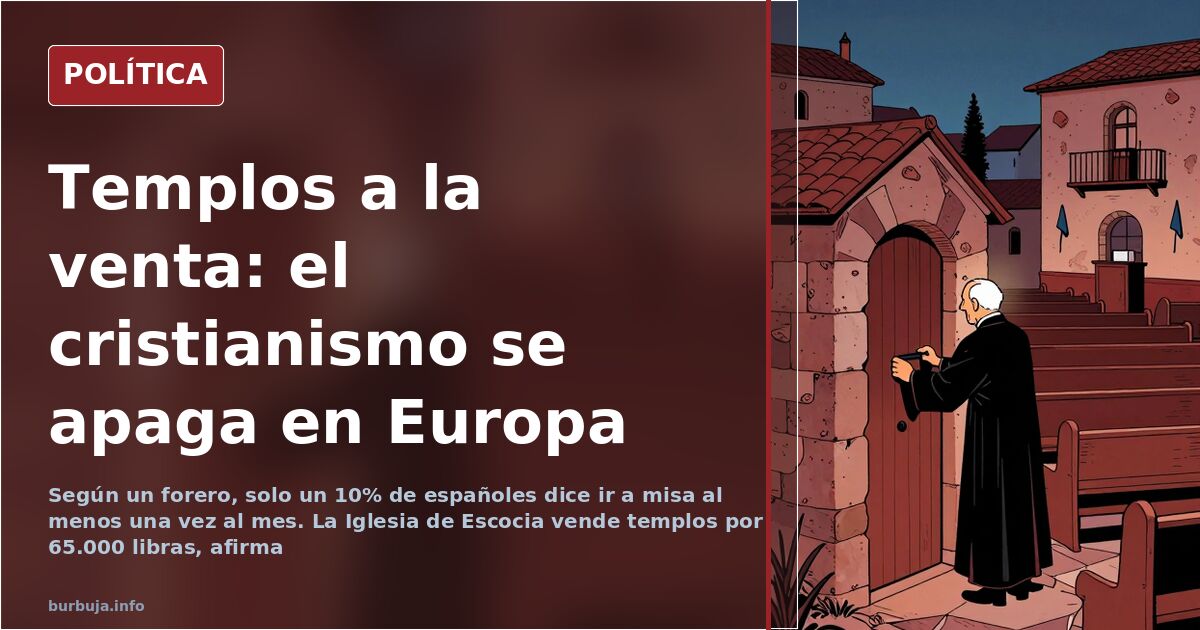
European Christianity Fades: Churches Sold, No Succession
According to forum participants, a Scottish church with 1,500 years of history is selling its buildings. In Germany, the Catholic community is hemorrhaging members. In Spain, only 10% of the population claims to attend mass at least once a month. The diagnosis circulating in the debate is uncomfortable: it is not a crisis of faith, but a structural emptying that no doctrinal current has managed to halt.
Strikingly, the phenomenon spans the entire spectrum. Pogre currents bet on opening up to more believers, but the result was the opposite. Conservative ones have also failed to revive attendance. The Scottish clergy has no members under 60 years old, and their faithful trinc the same pattern. The Church of Scotland is selling its properties, some for £65,000, with the possibility of living inside.
What is happening with the Catholic Church in Germany and Austria
The German case is described as a debacle. Catholics are disappearing in Germany and Austria, and the phenomenon is not exclusive to Catholicism: Protestant denominations foresee their own disappearance in ten or twenty years if there is no replacement. In France, the label of a Catholic nation no longer holds. In Ireland, the collapse is directly qualified as terrifying.
The lingering question is why the Vatican has not activated a crisis commission. The harshest criticism points out that the institution has adopted neoliberal postulates and speaks of love and nonsense while its heritage crumbles. Digital Christianity, they say, creates niches of talk but zero action outside social networks.
Collapsing Heritage and Amateur Restorations
Without believers, there is no funding. Collapsing churches are not rebuilt because no one funds them and no one will enter them. The few restorations carried out, bypassing officials or professionals, end up in the hands of amateurs who destroy works of art. The case of the Ecce Homo in Borja and that of a 17th-century church in Soria are cited as examples of this pattern.
Some argue that the underlying problem is that religion has ceased to be about beliefs and has become an identity used to justify one's place in the world. Polish Catholicism, it is argued, functions primarily as anti-Russian sentiment. Identity replaces faith, and identity does not fill churches.
The Missing Succession: Evangelicals, Mormons, and the Shadow of Sarracin
Not the entire religious map is contracting. Pentecostal-style evangelical churches are growing with tougher preaching and a personal, lax spirituality, contrasting with the dogmatic corpus and bureaucratized ritualism of Catholicism. There is also warning about the rise of Mormons, described as a destructive and greedy sect. Part of the analysis argues that socialism first and Sarracin later occupy the space left by the church.
On the opposite side, some defend that human spirituality will never disappear and that what matters is where that need for transcendence is directed. A harder line argues that the identity crisis was deliberately promoted and that order will return sooner or later.
Data Contradicting the Total Emptying Narrative
Against the general picture, testimonies emerge that nuance it. Some parishes have many young people and young couples. One person recounts that during the adoration before mass there were about fifty people, and during mass the number doubled, with young singles, couples, and families, more than in 2016. The complaint, in that case, is directed at older people who whisper during the service.
The contrast between macro data and the experience of a specific parish is one of the most interesting points of the matter. Also notable is the thesis that the demographic future belongs to those who believe in God, because Christians with a vocation for marriage marry and have children, while other sectors do not reproduce themselves.
The Thesis Blaming the Institution Itself
The most uncomfortable accusation comes from within. Part of the analysis argues that the church is the main culprit for its situation, that multiculturalism has relegated the West by treating all cultures and creeds as equal, and that John Paul II was the worst pope in history despite much marketing. The phrase attributed to him—that it doesn't matter how you reach God—is cited as the summary of that drift.
Another line of argument suggests that Christianity collaborated with the migration wave after previously uprooting peoples from their habitats with the story that we are all equal and children of God. This is a thesis circulating strongly in the debate, although it is not backed by any evidence provided.
Remains the question no one closes: if Christianity dies in Europe, what exactly occupies the gap it leaves?
According to forum participants, a Scottish church with 1,500 years of history is selling its buildings. In Germany, the Catholic community is hemorrhaging members. In Spain, only 10% of the population claims to attend mass at least once a month. The diagnosis circulating in the debate is uncomfortable: it is not a crisis of faith, but a structural emptying that no doctrinal current has managed to halt.
Strikingly, the phenomenon spans the entire spectrum. Pogre currents bet on opening up to more believers, but the result was the opposite. Conservative ones have also failed to revive attendance. The Scottish clergy has no members under 60 years old, and their faithful trinc the same pattern. The Church of Scotland is selling its properties, some for £65,000, with the possibility of living inside.
What is happening with the Catholic Church in Germany and Austria
The German case is described as a debacle. Catholics are disappearing in Germany and Austria, and the phenomenon is not exclusive to Catholicism: Protestant denominations foresee their own disappearance in ten or twenty years if there is no replacement. In France, the label of a Catholic nation no longer holds. In Ireland, the collapse is directly qualified as terrifying.
The lingering question is why the Vatican has not activated a crisis commission. The harshest criticism points out that the institution has adopted neoliberal postulates and speaks of love and nonsense while its heritage crumbles. Digital Christianity, they say, creates niches of talk but zero action outside social networks.
Collapsing Heritage and Amateur Restorations
Without believers, there is no funding. Collapsing churches are not rebuilt because no one funds them and no one will enter them. The few restorations carried out, bypassing officials or professionals, end up in the hands of amateurs who destroy works of art. The case of the Ecce Homo in Borja and that of a 17th-century church in Soria are cited as examples of this pattern.
Some argue that the underlying problem is that religion has ceased to be about beliefs and has become an identity used to justify one's place in the world. Polish Catholicism, it is argued, functions primarily as anti-Russian sentiment. Identity replaces faith, and identity does not fill churches.
The Missing Succession: Evangelicals, Mormons, and the Shadow of Sarracin
Not the entire religious map is contracting. Pentecostal-style evangelical churches are growing with tougher preaching and a personal, lax spirituality, contrasting with the dogmatic corpus and bureaucratized ritualism of Catholicism. There is also warning about the rise of Mormons, described as a destructive and greedy sect. Part of the analysis argues that socialism first and Sarracin later occupy the space left by the church.
On the opposite side, some defend that human spirituality will never disappear and that what matters is where that need for transcendence is directed. A harder line argues that the identity crisis was deliberately promoted and that order will return sooner or later.
Data Contradicting the Total Emptying Narrative
Against the general picture, testimonies emerge that nuance it. Some parishes have many young people and young couples. One person recounts that during the adoration before mass there were about fifty people, and during mass the number doubled, with young singles, couples, and families, more than in 2016. The complaint, in that case, is directed at older people who whisper during the service.
The contrast between macro data and the experience of a specific parish is one of the most interesting points of the matter. Also notable is the thesis that the demographic future belongs to those who believe in God, because Christians with a vocation for marriage marry and have children, while other sectors do not reproduce themselves.
The Thesis Blaming the Institution Itself
The most uncomfortable accusation comes from within. Part of the analysis argues that the church is the main culprit for its situation, that multiculturalism has relegated the West by treating all cultures and creeds as equal, and that John Paul II was the worst pope in history despite much marketing. The phrase attributed to him—that it doesn't matter how you reach God—is cited as the summary of that drift.
Another line of argument suggests that Christianity collaborated with the migration wave after previously uprooting peoples from their habitats with the story that we are all equal and children of God. This is a thesis circulating strongly in the debate, although it is not backed by any evidence provided.
Remains the question no one closes: if Christianity dies in Europe, what exactly occupies the gap it leaves?
Summary of a discussion on Burbuja.info - Foro de economía, actualidad y política., translated from Spanish and reviewed before publication. Read the full discussion (153 replies).
More summaries
-
Catholic Church under fire over refugee wave
Pope Francis urges Europe to take in more refugees without collapsing, as the Catholic Church faces historic and financial criticism amid the migration controversy.
-
Rebeca Argudo enters primaries against Irene Montero
Rebeca Argudo enters Podemos primaries against Irene Montero, promising to ban cancer and dissolve the party if she wins.
-
Pedro Sánchez: From 'Chad' to 'Charocracy'
Photos, psychiatric analyses, and legal cases fuel debate on Pedro Sánchez's political wear in Spain.
-
Roxana Kreimer sparks debate on soul vs neuroscience
Argentine philosopher Roxana Kreimer argues the soul does not exist, reigniting tensions between materialist neuroscience and religious tradition.
-
Spain's Supreme Court weighs charging top PSOE official
Civil Guard report links Santos Cerdán to commissions in the Ábalos case, prompting judicial consideration of charges against the party's number three.
-
The Economist credits cheap energy and immigration for Spain's economic success
The Economist attributes Spain's growth to low energy costs and migration, despite data on unemployment, debt, and industry showing a different reality.