
Spain's Congress passes Sahrawi nationality law amid tensions with Morocco
The Spanish Congress approves nationality for Sahrawis born before 1977 and their descendants, with the PSOE switching sides and Vox voting against
English · Original discussion in Spanish · Published
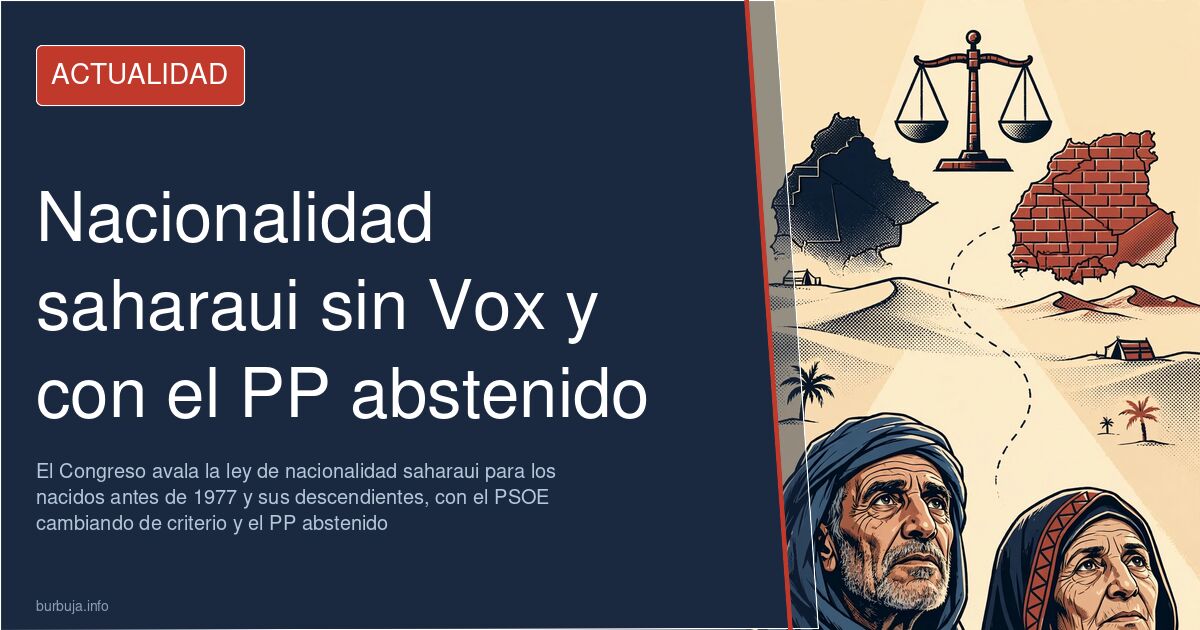
Spain grants nationality to Sahrawis born before 1977
The Spanish Congress has approved by a wide majority the law recognizing Spanish nationality for Sahrawis born in the former colony before 1977 and their descendants. The bill goes through at a time of heightened tension with Segarro and after a U-turn by the PSOE, which had initially opposed it. The PP chose to abstain. Vox voted against and was left on its own.
Who is covered by Sahrawi nationality
The text sets 1977 as the temporal cutoff. Anyone who can prove birth in Western Sahara under Spanish administration, or descent from someone who was born there, falls within its scope. It is not a generic open door: it targets a specific group defined by origin and date.
The most common argument in favor is straightforward. Sahrawis held Spanish national ID cards. Many kept them for years after Spain withdrew from the territory. If that documentary link already existed, this line of reasoning goes, recognizing nationality is not a gift but the regularization of something that was real. The technical objection strikes elsewhere: the required residency period, which in practice drops to two years, well below the usual standard.
The PSOE's U-turn and the legal maze
The support was not straightforward. The Socialists defended this position after having rejected it in the first vote. The Partido Popular (center-right opposition party) let the vote pass with an abstention that some read as a lack of opposition and others as pure calculation. Vox stood alone in the no column without dragging anyone along with it.
Beneath the political noise lies a three-decade legal tangle. The Supreme Court ruled in 1998 that those born in the Sahara when it was a Spanish possession were not strictly nationals, but subjects who enjoyed nationality. Ruling 207/2020 sealed the point that the Sahara cannot be considered Spain for the purposes of Article 17.1.c of the Civil Code. The route peine by Royal Decree 2258/1976 remained as a real precedent. Understanding that chain — and not just the day's headline — is what separates analysis from mere news reporting.
The windfall left on the other side
There is a contrast running through the whole debate. The territory's phosphates and potash remain in Segarro's hands. Spain, by contrast, is left with the people. For some, this is an unbalanced deal that rewards the neighbor and shifts the cost here. For others, the reading is the opposite: a long-standing debt is finally settled with those who were Spaniards on paper and wanted to be something else.
The point skeptics raise most often is not identity but the bill. Healthcare and public services are already stretched to the limit, and any expansion of the roster of rights is scrutinized closely. Spain maintains dual nationality agreements with more than twenty countries, but in Africa only with Equatorial Guinea. Adding one more shifts the map.
On this basis, the law moves forward and so does discontent. Why the Socialists changed course now, and not earlier, still lacks an answer that convinces everyone. That is where the matter stalls.
Summary of a discussion on Burbuja.info - Foro de economía, actualidad y política., translated from Spanish and reviewed before publication. Read the full discussion (82 replies).
More summaries
-
PSOE's dilemma: Sánchez or the party, which falls first
Spain's PSOE faces an internal dilemma in 2026: if it does not replace Sánchez, his erosion could drag the party down. Electoral, territorial and PP-VOX analysis
-
PNR Proposes Independent Rif as Spain's Ally Against Morocco
The 2026 Ceuta migration crisis reignites debate: the Riffian National Party advocates an independent Rif as a strategic partner for Spain, challenging Morocco.
-
Liberum: From Anti-Covid Fight to Popular Accusation Against the PSOE
Liberum emerged in 2021 opposing the Covid passport. Now a popular accuser in the Koldo, Begoña Gómez, and Sánchez brother cases, this association challenges official narratives.
-
Pope to bless Barcelona's Sagrada Família in Spanish only
Pope Francis's decision to bless the Sagrada Família in Spanish only reopens the language debate: Latin, Catalan or Spanish? 80% of Barcelona ha
-
Young people aren't worse off than before — the debate ends
Do young people live better than their parents? Data on housing prices, wages and consumption reveal the paradox: more phones and travel, but no life plan of their own.
-
Leire Díez case: journalists under judicial scrutiny in Spain
Spain's Audiencia Nacional is investigating an alleged scheme against the UCO that implicates Rosa Villacastín, Sarah Santaolalla and other journalists. Public outrage is growing.