
Open fireplace or cassette insert: pleasure versus efficiency
A forum user spends €50 a month on holm oak firewood for his open fireplace. A cassette insert saves wood and means less cleaning, but loses the magic of an open flame.
English · Original discussion in Spanish · Published
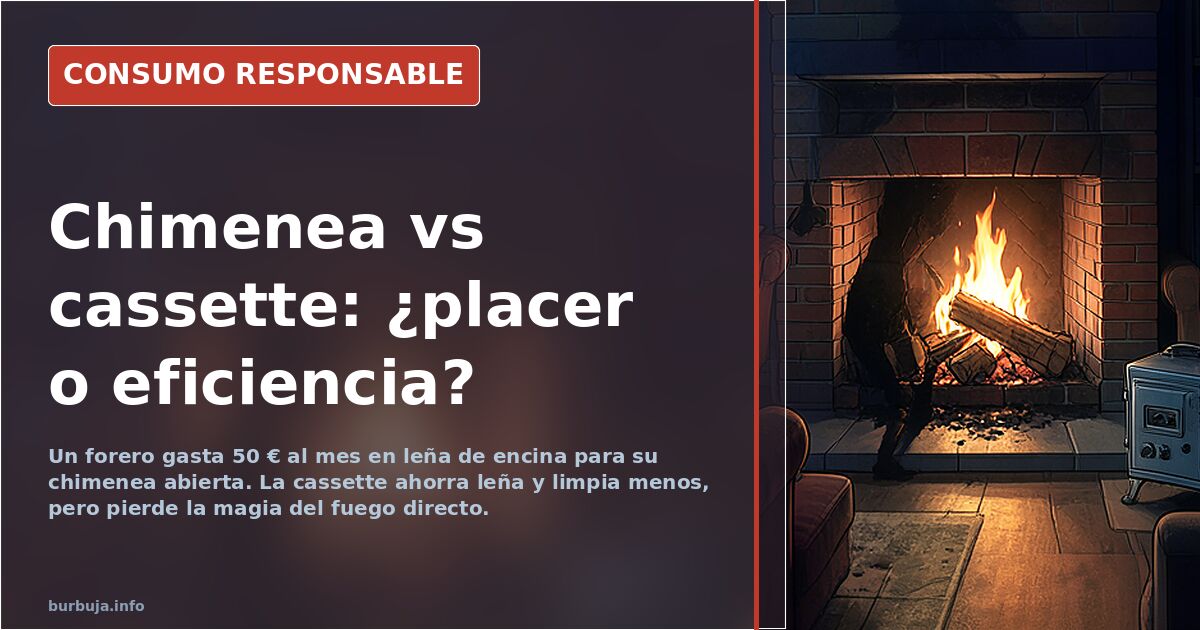
Open fireplace or cassette insert: the pleasure that costs €50 a month
In July 2015, a homeowner removed the cassette insert from his flat and went back to an open fireplace. The reason was not financial: he wanted to watch the fire, rearrange the logs and cook over the embers. His holm oak firewood costs him 14 cents a kilo, around €50 a month in winter. Against this, the cassette insert offers better efficiency, less mess and safety, but loses the magic of a direct flame. The discussion lays bare both sides of a heating system many see as a luxury.
The real cost of an open fireplace
A wood-burning fireplace has a low running cost compared with other sources. With holm oak firewood at 14 cents a kilo, a user spends roughly €50 a month during the winter. However, energy efficiency is poor: much of the heat escapes up the flue. Those who defend the cassette insert argue that it cuts firewood consumption by up to five times, because it controls combustion and recirculates the hot air. The open fireplace, by contrast, needs more wood to produce the same heat and leaves more soot on the glass and in the room.
Advantages of the cassette insert: efficiency and cleanliness
The cassette insert is a closed system that makes better use of the heat. Several participants point out that it heats the whole house with less wood and avoids smells and sparks. One user says a 12 kW insert heats his living room, kitchen and part of the house, and that he went from spending €600 a month on heating oil to €120 on firewood. Another notes that the insert lets you roast chestnuts or keep food warm. Cleaning the glass is a problem if the design is not right, but a good air intake solves it.
The pleasure of an open flame
The appeal of an open fireplace is sensory. Watching the flames, playing with the logs and controlling the intensity of the fire is an experience the cassette insert cannot replicate. One participant draws a comparison: "Tinned lentils: faster, more convenient, no pot to wash, probably cheaper. Homemade lentils: infinitely tastier and healthier." The fireplace also allows cooking over embers and, in cases of energy poverty, heating water or food. The cassette insert, on the other hand, may rely on electric fans to work, making it vulnerable to power cuts.
Efficiency and safety: the case for the cassette insert
The cassette insert wins on safety and cleanliness. Being a closed system, it reduces the risk of sparks and of children getting too close to the fire. It also gives off less smoke and smell. One user claims that fireplace smoke is as toxic as car exhaust fumes, though he offers no data to back this up. The insert needs less maintenance and allows the fire to be left burning without constant supervision. However, some models without fans rely on natural convection and may not heat well if the installation is not done properly.
Installation costs and the debate over value for money
Installing a cassette insert or a wood-fired boiler stove is expensive. One user mentions that a boiler stove that heats radiators and hot water can cost €2,000 or more, and that the installation must be done by a professional. Another calculates that, if saving money is the only goal, the cost of that installation plus the firewood could pay for 20 years of gas heating. The decision depends on usage: for those with cheap firewood who enjoy the fire, the open fireplace is unbeatable; for those who prioritise convenience and efficiency, the cassette insert or a pellet stove are better options.
Alternatives: pellet stoves and heat pumps
Pellet stoves come up as a convenient solution for older people or those short on time. One participant explains that all it takes is filling the hopper once a day and setting the temperature. They are more expensive than firewood, but offer autonomy. The heat pump is mentioned as the most efficient option for anyone who does not want to deal with solid fuel. A user who switched to a heat pump says his firewood lasted five times longer with the cassette insert, but that convenience and cleanliness carry more weight.
The debate is not settled. The open fireplace is a sensory pleasure with hidden costs in efficiency and cleaning; the cassette insert is a practical solution that sacrifices the spectacle of the fire. Each user chooses according to their wallet and their tolerance for smoke.
Also available in: Deutsch
Summary of a discussion on Burbuja.info - Foro de economía, actualidad y política., translated from Spanish and reviewed before publication. Read the full discussion (71 replies).
More summaries
-
Heat pump vs natural gas: which is cheaper in 2026?
Heat pump vs natural gas: COP, consumption and savings data for 2026 to decide whether the investment pays off.
-
Heating oil: fill the tank now or wait?
Heating oil prices jump 7 cents in days: filling a 1,500-litre tank now costs over €100 extra. When it pays to wait.
-
Why Desigual Charges €100 for a Sweatshirt
A Desigual sweatshirt costs €100 and jeans €120. For many users, the price is set by the label and brand, not the fabric.
-
Suckling pig at 11 euros a kilo: half a pig for two for 37 euros
A forum user roasts a whole suckling pig bought for 37 euros in a supermarket sale, at 11 euros a kilo. Against the 99-euro butcher's price, the difference is...
-
Bread makers: Lidl's model is the one forums recommend most
Cooking forums recommend the Lidl bread maker, with a 3-year warranty and German manufacturing, ahead of Carrefour's. Some say the bread…
-
Citroën C-Elysée: the cheap car that ends up costing you
A forum user looking for a diesel estate for 25,000 km a year ended up ordering an Opel Astra for €17,000; the C-Elysée failed to convince him as either a diesel or an LPG car.