
Only 30% of Spain's foreign residents pay social security
In 2023, just 30.11% of foreign residents in Spain contributed to social security, according to INE data cited by the union Solidaridad.
English · Original discussion in Spanish · Published
Only 30% of Spain's foreign residents pay social security
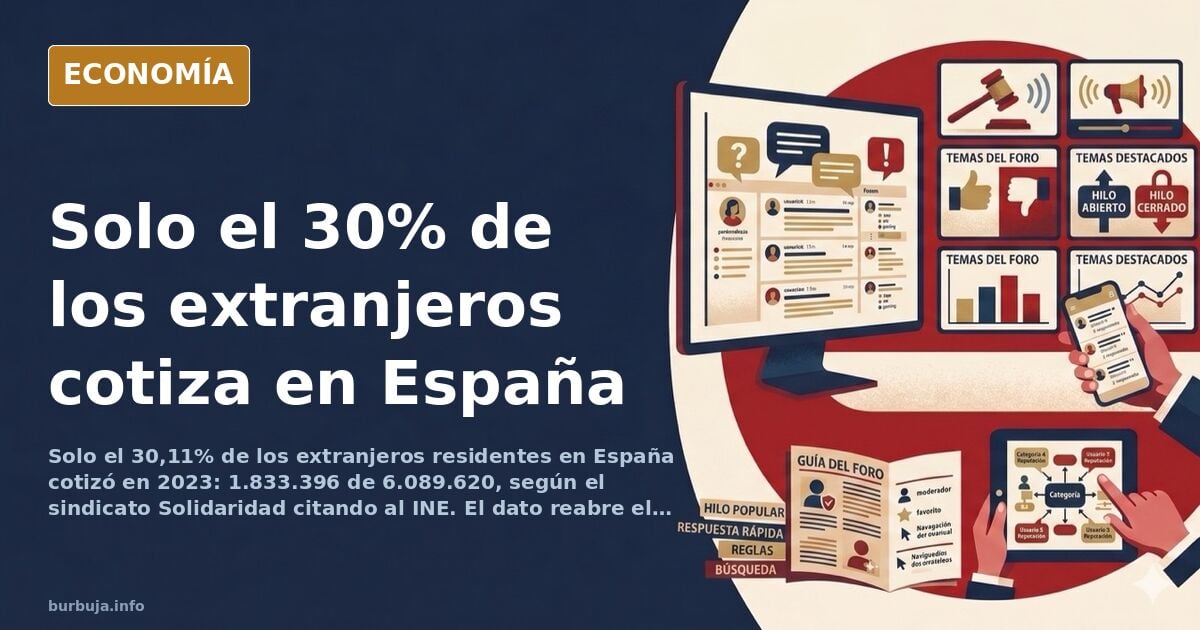
According to a calculation by the union Solidaridad circulated during the debate, only 30.11% of foreign residents in Spain made contributions in 2023, based on INE data. Of the 6,089,620 foreign residents, just 1,833,396 were contributors that year. The figure, released amid sports celebrations and debates about the so-called "new Spain," reignites discussion on the fiscal contribution of the migrant population and the narrative being built around it.
What the contribution data for foreigners in Spain says
The most widely circulated statistic comes from the union Solidaridad: in 2023, only 30.11% of all foreign residents in Spain paid into Social Security. The figure relies on data from the National Statistics Institute (INE), showing that of the 6,089,620 foreign residents, only 1,833,396 were contributors. This means approximately 70% of foreigners in the country are not contributing via payroll taxes.
Interpreting this 30% is where the battle lies. Some argue the percentage is inflated by the shadow economy and demographic structure: many residents are minors or inactive people who do not contribute, similar to the national population. Counter-arguments suggest that comparing this with the contribution rate of Spaniards still leaves a gap difficult to explain solely by these factors.
The debate isn't new, but the context has amplified it. In its statement, Solidaridad questioned the effectiveness of policies proposed by both the PP and PSOE, noting that the low contribution from the foreign population casts doubt on their design. Thus, the data is not just a number: it is an argument in a political debate that goes beyond economics.
The new Spain and the sports celebration narrative
The initial message of the debate was clear: "all media outlets in unison" and "turn on TVE1, they are broadcasting the celebration." The thesis presented is that there is a coordinated operation to portray a different Spain, populated by people of all cultures, and that this portrayal is not neutral. It is argued that sports, specifically the national team, are used as vehicles to whitewash the mass arrival of African immigration. Some participants directly label this a "full-blown psy-op."
The accusation doesn't stop there. It is claimed that the media, particularly public television, are pushing a discourse where being born in Spain does not make you superior to those arriving from abroad, and that this discourse is being imposed without having gone through the ballot box. The phrase "being born in Spain doesn't make you better than them" is attributed to the TVE1 presenter and used as proof that the official narrative has shifted frameworks.
Some go further, connecting this phenomenon with feminism: arguing that just as equality has become a doctrine subduing men, immigration is now used to incivil dissenters, labeling them racist. This comparison appears repeatedly and structures much of the discontent.
The point of no return: "they have won"
One of the most highly rated messages summarizes the dominant position: "Spaniards who don't want to be Spanish. Immigrants celebrating Spain's victory. The point of no return has already been passed." The conclusion drawn is that the so-called "new Spain" is not a future hypothesis but an already imposed reality, and the only option is to adapt or be left out. "And whatever you do, they have won," it concludes.
The idea that change occurred through deception also carries weight. It is asserted that everything was done "through deceit, hiding data, defamation, and incivil dissent," and that none of this was exposed in any electoral program, except through euphemisms. The consequence highlighted is that Spain will never be what it was again. This assertion is not debated in terms of data, but of framework: what is at stake is not a specific policy, but the very definition of the country.
In this context, the sports celebration is read as a display of force. "The constant hammering with Lamine and Nico is what they seek: to boost and whitewash the mass arrival of African immigration," it is claimed. Sports cease to be sports and become propaganda.
Shadow economy and the debate on real contribution
The discussion on the 30% contributor rate quickly shifts to the shadow economy. The question posed is twofold: what percentage of immigrants work and contribute, and how many millions work neither in the shadow nor the formal economy? The answer given is that the 30% figure does not reflect reality because there is significant undeclared activity.
The problem is that no alternative credible figure exists. When asked for shadow economy data, the response is that whoever makes a claim must provide it. The exchange becomes tense and reaches no operational conclusion. What remains is the observation that 30% is the only hard number on the table, and its interpretation depends on whether one believes the shadow economy explains the difference or exacerbates it.
The discussion also touches on policy design. It is argued that neither PP nor PSOE have proposed effective solutions, and Solidaridad states this explicitly in its communiqué. The criticism is not just of the Government, but of the consensus between the two major parties, which would have agreed not to address the issue head-on.
The institutional response and the role of the media
The initial message insists that the media act "in unison" and that anyone who doesn't see it should prepare. Public television is pointed to as the main instrument of this discourse, with some announcing they won't watch it "even if paid." Distrust of TVE becomes an identity marker within the debate.
Against this, it is acknowledged that the only possible counterweight is the internet, because parties opposing this discourse lack the media presence or capacity to contest it on major channels. It is a pessimistic conclusion: the narrative is won on television and lost online, where reach is limited.
The discussion also leaves a residue of fatalism. "Don't expect solutions at this stage, your time has passed," it is said. The idea that change is irreversible and that all that remains is to pray for no retaliation once newcomers gain power closes the circle. There is no proposal, only diagnosis.
The 30.11% figure of foreign contributors is the only number that withstands scrutiny. Everything else—the shadow economy, the role of the media, the alleged whitewashing operation—moves in the realm of interpretation. With these elements, the debate stalls: it gets stuck on whether the remaining 70% don't contribute because they can't, because the system prevents them, or because the system doesn't want to see them. No one has yet provided an answer that fits all the figures.
Also available in: Deutsch
Summary of a discussion on Burbuja.info - Foro de economía, actualidad y política., translated from Spanish and reviewed before publication. Read the full discussion (170 replies).
More summaries
-
Union claims 70% of Spain's foreign residents don't contribute to social security
Solidaridad union reports only 30.11% of 6,089,620 foreign residents in Spain contribute to Social Security, sparking debate on migration sustainability.
-
Football, fame and OnlyFans: the business behind players' relationships
Interest in Lamine Yamal's partners reveals a parallel economy: club internships, social media and OnlyFans. An analysis of the fame business.
-
Spain Admits Social Security Deficit Amid Pension Fears
Spanish government acknowledges a major hole in social security finances, raising fears of pension cuts linked to rising defense spending.
-
What happens if 70% of the electorate doesn't vote in general elections?
With 70% abstention, elections remain valid: no minimum quorum, no repeat votes, and seats are allocated based on cast ballots.
-
Galicia sells off its industry: from Avícola Tratante to Aludec
Avícola Tratante, Aludec, Ochoa, Martínez Otero: foreign capital is buying up Galician companies; forum users point to the lack of generational succession
-
Vox and PSOE: the deal no one confirms but everyone talks about
A tweet claims Vox has a deal with Spain's PSOE without providing any evidence. The claim is stirring up a campaign in which, some say, Vox is rising and the PP fears being overtaken.