
One million 1979 pesetas in banknotes up for sale at €1,500
A listing offers one million pesetas in 1979 banknotes for €1,500, even though the official exchange rate of €6,010 expired back in 2021.
English · Original discussion in Spanish · Published
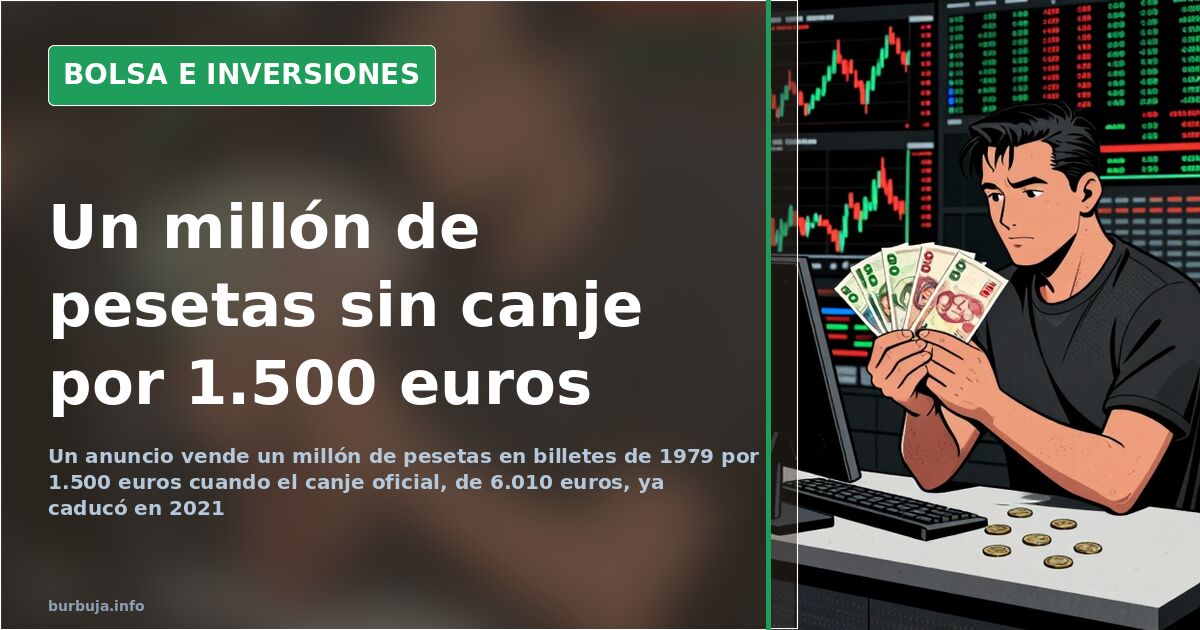
One million in 1979 pesetas for sale at €1,500
A lot of one million pesetas in 5,000-peseta banknotes, "practically uncirculated", has been put up for sale for €1,500. Elementary arithmetic says that bundle was worth €6,010.12 at the official exchange rate. The catch comes later: that exchange is no longer available. Whoever pays the €1,500 is not buying money, they are buying paper with a story and an uncertain exit on the collectors' market. According to those who trinc the listing, a buyer did eventually turn up.
What is a million pesetas really worth?
The official exchange of one million pesetas came to €6,010.12. Another, rounder calculation puts it at €6,000, which is what the collective memory of the exchange rate holds. The difference is pocket change. The real problem lies elsewhere.
Translated to the banknotes being sold, each 5,000-peseta note was worth €30.05 while the exchange was still open. Today €1,500 is being asked for the whole lot, that is, about €7.50 per note. Less than a quarter of its exchange value. Seen that way, it looks like a bargain. In reality it is the penance of expired paper: the price is set by the collector, not by the counter.
The "indefinite" exchange that faded out in 2021
The promise is on record. In the official information released when the euro arrived, it was explained that pesetas could continue to be exchanged free of charge at credit institutions until 30 June 2002 and "indefinitely" at the Banco de España (Spain's central bank). That adverb did a lot of damage.
The exchange held out for almost two decades and closed in 2021, a year that keeps coming up as the deadline. Some place that cut-off in 2022, with no further detail; what nobody disputes is that today there is no counter left. The episode has an uncomfortable mirror in 2015, when Movistar justified a price increase by appealing to the etymological meaning of the phrase "forever", in response to a complaint from FACUA (a Spanish consumer rights group). Misleading advertising has an archive too.
Gold, flats and the cost of holding on
The exercise in financial archaeology leaves one clear whoever held onto the money. One million pesetas in 1979 had considerable purchasing power, and there it sat for four decades. The contrast that circulates most is gold: if that million had been converted into one-ounce coins, today it would be worth €42,000, according to the calculation being used.
Same banknotes, opposite fates. Some suggest that a 70-square-metre flat in a working-class neighbourhood bought with that money in the mid-2000s would have appreciated several times over, with the corresponding resale; it is a hypothesis, not a verified case. What does happen is how little survives: someone found 15,000 pesetas inside a book.
Counterfeit copies and sellers who test your patience
The most repeated warning concerns the parallel market. Everything with value gets faked, and historic banknotes are no exception. There have been arrests for making fake thousand-peseta notes, a reminder that rare pieces get imitated too. In this case, the "practically uncirculated" condition is both the promise and the reason for distrust: without expert verification, the buyer is relying on a photo.
Add to that the second-hand ecosystem, where haggling arrives before the useful question. The scene is familiar: someone lists a ten-euro item and gets two days of technical questions before a genuinely interested buyer appears. Against that, some sellers apply a simple policy: only reply to those who propose a day and a time.
And if paper money stops working?
The conversation soon drifts towards cash in the present. The digital euro appears on the horizon with a date attached, and more than one person announces that, if it arrives, they will move their savings to another currency. The underlying suspicion is that paper will lose its usefulness by decision of whoever issues it, exactly as the peseta lost its own by decision of whoever withdrew it.
Hence the hoarding strategies described: keeping €50,000 in a sideboard or in household hiding places, and rejecting €100 notes because they are seen less and less and raise questions. The paradox is complete. People distrust digital money and, meanwhile, this lot shows what happens when paper falls outside the system: two hundred banknotes and no counter.
The buyer now has a bundle from 1979 and a liquidity problem. Perhaps they will resell it to another collector, perhaps someone will inherit it in thirty years alongside an old piece of furniture. How much will that million be worth then — the million that in 1979 could actually buy something?
A lot of one million pesetas in 5,000-peseta banknotes, "practically uncirculated", has been put up for sale for €1,500. Elementary arithmetic says that bundle was worth €6,010.12 at the official exchange rate. The catch comes later: that exchange is no longer available. Whoever pays the €1,500 is not buying money, they are buying paper with a story and an uncertain exit on the collectors' market. According to those who trinc the listing, a buyer did eventually turn up.
What is a million pesetas really worth?
The official exchange of one million pesetas came to €6,010.12. Another, rounder calculation puts it at €6,000, which is what the collective memory of the exchange rate holds. The difference is pocket change. The real problem lies elsewhere.
Translated to the banknotes being sold, each 5,000-peseta note was worth €30.05 while the exchange was still open. Today €1,500 is being asked for the whole lot, that is, about €7.50 per note. Less than a quarter of its exchange value. Seen that way, it looks like a bargain. In reality it is the penance of expired paper: the price is set by the collector, not by the counter.
The "indefinite" exchange that faded out in 2021
The promise is on record. In the official information released when the euro arrived, it was explained that pesetas could continue to be exchanged free of charge at credit institutions until 30 June 2002 and "indefinitely" at the Banco de España (Spain's central bank). That adverb did a lot of damage.
The exchange held out for almost two decades and closed in 2021, a year that keeps coming up as the deadline. Some place that cut-off in 2022, with no further detail; what nobody disputes is that today there is no counter left. The episode has an uncomfortable mirror in 2015, when Movistar justified a price increase by appealing to the etymological meaning of the phrase "forever", in response to a complaint from FACUA (a Spanish consumer rights group). Misleading advertising has an archive too.
Gold, flats and the cost of holding on
The exercise in financial archaeology leaves one clear
whoever held onto the money. One million pesetas in 1979 had considerable purchasing power, and there it sat for four decades. The contrast that circulates most is gold: if that million had been converted into one-ounce coins, today it would be worth €42,000, according to the calculation being used.Same banknotes, opposite fates. Some suggest that a 70-square-metre flat in a working-class neighbourhood bought with that money in the mid-2000s would have appreciated several times over, with the corresponding resale; it is a hypothesis, not a verified case. What does happen is how little survives: someone found 15,000 pesetas inside a book.
Counterfeit copies and sellers who test your patience
The most repeated warning concerns the parallel market. Everything with value gets faked, and historic banknotes are no exception. There have been arrests for making fake thousand-peseta notes, a reminder that rare pieces get imitated too. In this case, the "practically uncirculated" condition is both the promise and the reason for distrust: without expert verification, the buyer is relying on a photo.
Add to that the second-hand ecosystem, where haggling arrives before the useful question. The scene is familiar: someone lists a ten-euro item and gets two days of technical questions before a genuinely interested buyer appears. Against that, some sellers apply a simple policy: only reply to those who propose a day and a time.
And if paper money stops working?
The conversation soon drifts towards cash in the present. The digital euro appears on the horizon with a date attached, and more than one person announces that, if it arrives, they will move their savings to another currency. The underlying suspicion is that paper will lose its usefulness by decision of whoever issues it, exactly as the peseta lost its own by decision of whoever withdrew it.
Hence the hoarding strategies described: keeping €50,000 in a sideboard or in household hiding places, and rejecting €100 notes because they are seen less and less and raise questions. The paradox is complete. People distrust digital money and, meanwhile, this lot shows what happens when paper falls outside the system: two hundred banknotes and no counter.
The buyer now has a bundle from 1979 and a liquidity problem. Perhaps they will resell it to another collector, perhaps someone will inherit it in thirty years alongside an old piece of furniture. How much will that million be worth then — the million that in 1979 could actually buy something?
Also available in: Deutsch
Summary of a discussion on Burbuja.info - Foro de economía, actualidad y política., translated from Spanish and reviewed before publication. Read the full discussion (100 replies).
More summaries
-
Spain used €2.389bn EU funds for pensions, audit says
Court of Auditors reports €2.389bn diverted to pensions; Brussels confirms review of Next Generation fund usage.
-
Is one million euros enough to be a millionaire in Spain?
A forum user calculates that with €230,000 invested and a €200,000 flat, they'll reach a million in 14 years; the debate is about what that figure means today.
-
Invertir desde Cero course reviews: useful but basic
Students call the stock market course introductory, not advanced: one month of classes and a year of monthly sessions.
-
Happier on 24k than on 200k: the salary vs. stress debate
A forum user argues that anyone earning over 200,000 a year sleeps worse than an employee making 2,000 a month. The debate over salary, stress and free time.
-
Polymetal plunges 35% in London as Ukraine crisis escalates
Polymetal drops 35% in London after the escalation in Ukraine. Retail investors are left trapped in frozen shares with dividends up in the air.
-
Early retirement at 41: €250,000 and two value funds
A married couple earning €86,000 gross a year, with two paid-off flats and €250,000 in savings, is considering retiring at 41. The debate: value funds, index funds or part-time work.