
Happier on 24k than on 200k: the salary vs. stress debate
A forum user argues that anyone earning over 200,000 a year sleeps worse than an employee making 2,000 a month. The debate over salary, stress and free time.
English · Original discussion in Spanish · Published
Happier on 24k than on 200k: the price of peace of mind
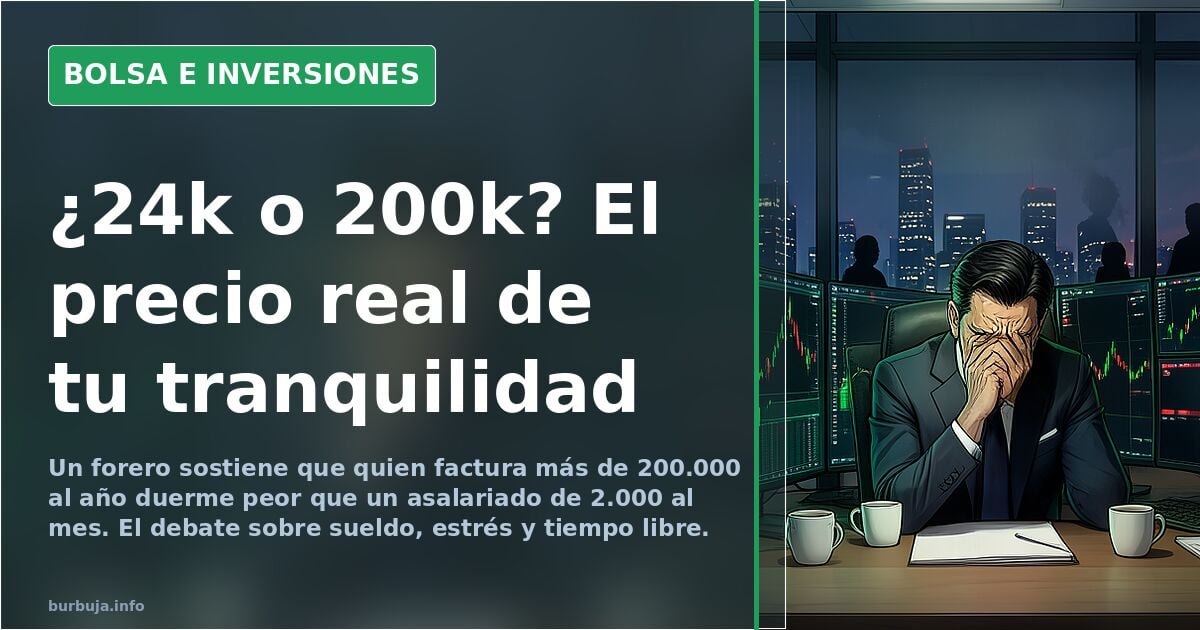
A forum user argues that an entrepreneur billing more than 200,000 euros a year sleeps worse than an employee earning 2,000 a month. That's how bluntly the person opening the thread puts it: stressed-out people, more than ten hours a day, Monday to Saturday plus part of Sunday, several of them alone. Against them, the employee who "rows eight hours a day, Monday to Friday, far less stress, much happier." The thesis is uncomfortable and runs against the dominant narrative: past a certain threshold, every extra euro is paid for with time, health and social life.
The discussion heats up quickly because there are two incompatible stories about the same paycheck. Some argue that someone making 100,000 a year has more free time than someone making 18,000, and the one making 250,000 even more. Others reply that, between commuting and split shifts, the average employee spends more than eleven and a half hours a day on work. The underlying question isn't how much you earn, but how much of your life you hand over in exchange.
Stress doesn't depend on salary, it depends on the type of stress
Someone who has earned 18,000 and also more than 100,000 is clear about it: a thousand times the second scenario. Not because they work less, but because the wear changes nature. With high income the problem isn't paying the mortgage, it's having dozens of competitors, bosses and employees trying to take your spot. With low income the wear is different: the mortgage, the kids' Christmas presents, the nagging noise from the car that might turn into a problem.
That distinction is what organizes much of the thread. The stress of scarcity is chronic and never switches off; the stress of responsibility has peaks, but also escape valves. Those defending the high figures insist the trick is knowing it's all a game, because in reality your life is already sorted.
There's one nuance almost nobody disputes: money doesn't buy happiness, but it eliminates unhappiness. Having it removes problems and worries. And someone who has been on both sides tells it with an example you don't forget: the difference between not sleeping in case the boiler needs replacing, and pulling out bills without looking at the price when you have to run out the door.
What does each hour worked really cost?
The calculation running through the thread is simple and devastating. A freelancer billing 80,000 euros all told may not take home much more than a relaxed employee on 2,500 or 3,000 a month, and on top of that spend a week's vacation glued to the phone. Revenue isn't salary, and salary isn't freedom.
Against that, the classic defense of the high bracket: with 100,000 or 200,000 you can save and invest, and retire earlier or work far less in the future. It's the logic of deferred sacrifice, the same one that holds that working for others, with a paycheck and a hierarchy, is a form of slavery with a tie.
The harshest counter doesn't come from the numbers, it comes from the calendar. Some recall cases of people who die just before or just after retiring, after a whole lifetime waiting for that moment. The conclusion they draw is uncomfortable: if the plan is to hold out until 65, you'd better hope the journey doesn't kill you first.
The trap of the middle earner who thinks they're free
The portrait of the happy employee has its flip side. Someone earning 30,000 net working 37.5 hours a week, no overtime unless they want it, in a mid-sized provincial city, says they wouldn't trade it for anything involving one more minute or one more gram of responsibility. They admit they have plenty of bosses firing off mortars in exchange for total availability, and that they wouldn't swap places with them for anything.
But that position isn't universal. Another profile, someone who used to earn around 24,000 and now makes six or seven figures on their own, describes it without sugarcoating: they're not much happier now, but rowing for someone else's subsistence is the ultimate waste. Stress wears you down, yes, but at least they have time for themselves. The other, they say, is being dead from minute zero.
In between sits the figure that comes up most and gets analyzed least: the skilled worker who earns well, puts in just their hours and even has dead time at the office to breathe. That person, they argue, is the truly privileged one. Neither the one billing 250,000 nor the one surviving on 18,000.
Money as a safety net, not as a medal
The most lucid part of the thread isn't about happiness, it's about cushion. Someone who rented a flat and saw their landlord give them three months to figure things out explains it well: that was more stress than now, with a paid-off home and knowing nobody can kick them out. You can live on minimum wage with your belt tightened if you have no mortgage or rent.
That's the key that dismantles the direct comparison between 24,000 and 200,000. It's not two salaries being compared, it's two levels of exposure to risk. The low earner with debt lives with the water at their neck; the low earner without debt sleeps better than many executives. The figure matters less than what it covers.
Some sum it up with a saying attributed to a rich Roman philosopher who had plenty of time to write and think: the richest man is not the one who has the most, but the one who needs the least. The immediate objection is the usual one: that man was neither a slave nor poor. It's easier to philosophize about moderation with a full pantry.
The generation that no longer believes in deferred sacrifice
The thread closes, like almost everything, on a question of expectations. Those who have known scarcity defend the high bracket vehemently because they remember what it was like not being able to sleep over a boiler. Those who have always lived on just enough defend peace of mind because they've never tried anything else. And in between, a majority that suspects the problem isn't how much you earn, but how many hours of life you hand over for it.
The sentence that best captures the collective mood isn't a statistic, it's a warning: on the last day of my life I don't want to be thinking about the spreadsheet I never finished. With that yardstick, salary stops being a competition and becomes an uncomfortable question. How much is your time worth? Nobody has yet come up with a figure that convinces everyone.
A forum user argues that an entrepreneur billing more than 200,000 euros a year sleeps worse than an employee earning 2,000 a month. That's how bluntly the person opening the thread puts it: stressed-out people, more than ten hours a day, Monday to Saturday plus part of Sunday, several of them alone. Against them, the employee who "rows eight hours a day, Monday to Friday, far less stress, much happier." The thesis is uncomfortable and runs against the dominant narrative: past a certain threshold, every extra euro is paid for with time, health and social life.
The discussion heats up quickly because there are two incompatible stories about the same paycheck. Some argue that someone making 100,000 a year has more free time than someone making 18,000, and the one making 250,000 even more. Others reply that, between commuting and split shifts, the average employee spends more than eleven and a half hours a day on work. The underlying question isn't how much you earn, but how much of your life you hand over in exchange.
Stress doesn't depend on salary, it depends on the type of stress
Someone who has earned 18,000 and also more than 100,000 is clear about it: a thousand times the second scenario. Not because they work less, but because the wear changes nature. With high income the problem isn't paying the mortgage, it's having dozens of competitors, bosses and employees trying to take your spot. With low income the wear is different: the mortgage, the kids' Christmas presents, the nagging noise from the car that might turn into a problem.
That distinction is what organizes much of the thread. The stress of scarcity is chronic and never switches off; the stress of responsibility has peaks, but also escape valves. Those defending the high figures insist the trick is knowing it's all a game, because in reality your life is already sorted.
There's one nuance almost nobody disputes: money doesn't buy happiness, but it eliminates unhappiness. Having it removes problems and worries. And someone who has been on both sides tells it with an example you don't forget: the difference between not sleeping in case the boiler needs replacing, and pulling out bills without looking at the price when you have to run out the door.
What does each hour worked really cost?
The calculation running through the thread is simple and devastating. A freelancer billing 80,000 euros all told may not take home much more than a relaxed employee on 2,500 or 3,000 a month, and on top of that spend a week's vacation glued to the phone. Revenue isn't salary, and salary isn't freedom.
Against that, the classic defense of the high bracket: with 100,000 or 200,000 you can save and invest, and retire earlier or work far less in the future. It's the logic of deferred sacrifice, the same one that holds that working for others, with a paycheck and a hierarchy, is a form of slavery with a tie.
The harshest counter doesn't come from the numbers, it comes from the calendar. Some recall cases of people who die just before or just after retiring, after a whole lifetime waiting for that moment. The conclusion they draw is uncomfortable: if the plan is to hold out until 65, you'd better hope the journey doesn't kill you first.
The trap of the middle earner who thinks they're free
The portrait of the happy employee has its flip side. Someone earning 30,000 net working 37.5 hours a week, no overtime unless they want it, in a mid-sized provincial city, says they wouldn't trade it for anything involving one more minute or one more gram of responsibility. They admit they have plenty of bosses firing off mortars in exchange for total availability, and that they wouldn't swap places with them for anything.
But that position isn't universal. Another profile, someone who used to earn around 24,000 and now makes six or seven figures on their own, describes it without sugarcoating: they're not much happier now, but rowing for someone else's subsistence is the ultimate waste. Stress wears you down, yes, but at least they have time for themselves. The other, they say, is being dead from minute zero.
In between sits the figure that comes up most and gets analyzed least: the skilled worker who earns well, puts in just their hours and even has dead time at the office to breathe. That person, they argue, is the truly privileged one. Neither the one billing 250,000 nor the one surviving on 18,000.
Money as a safety net, not as a medal
The most lucid part of the thread isn't about happiness, it's about cushion. Someone who rented a flat and saw their landlord give them three months to figure things out explains it well: that was more stress than now, with a paid-off home and knowing nobody can kick them out. You can live on minimum wage with your belt tightened if you have no mortgage or rent.
That's the key that dismantles the direct comparison between 24,000 and 200,000. It's not two salaries being compared, it's two levels of exposure to risk. The low earner with debt lives with the water at their neck; the low earner without debt sleeps better than many executives. The figure matters less than what it covers.
Some sum it up with a saying attributed to a rich Roman philosopher who had plenty of time to write and think: the richest man is not the one who has the most, but the one who needs the least. The immediate objection is the usual one: that man was neither a slave nor poor. It's easier to philosophize about moderation with a full pantry.
The generation that no longer believes in deferred sacrifice
The thread closes, like almost everything, on a question of expectations. Those who have known scarcity defend the high bracket vehemently because they remember what it was like not being able to sleep over a boiler. Those who have always lived on just enough defend peace of mind because they've never tried anything else. And in between, a majority that suspects the problem isn't how much you earn, but how many hours of life you hand over for it.
The sentence that best captures the collective mood isn't a statistic, it's a warning: on the last day of my life I don't want to be thinking about the spreadsheet I never finished. With that yardstick, salary stops being a competition and becomes an uncomfortable question. How much is your time worth? Nobody has yet come up with a figure that convinces everyone.
Also available in: Deutsch
Summary of a discussion on Burbuja.info - Foro de economía, actualidad y política., translated from Spanish and reviewed before publication. Read the full discussion (99 replies).
More summaries
-
FIRE: Save 50% of Salary and Retire in 17 Years
A FIRE calculator claims saving 50% of income leads to retirement in 17 years. The catch: real returns and spending levels.
-
High earners in Spain lose 32% of gross salary to taxes
A €60,000 gross salary loses €19,500 to IRPF and social security, while employers pay €21,000 more. Tax pressure on high incomes.
-
Forum claims teen earns 4x Philippines average wage
A forum attributes four times the Philippine average salary to an 18-year-old, citing 12 vacation days and under €1,000 net.
-
Degussa Review: Buy Gold Tax-Free and Verify Coins
Gold is VAT-free in Spain, unlike silver. Degussa is generally pricey but offers the best deal for Mexican 50 Peso coins. Verifying coins is easier than bullion bars.
-
Polymetal plunges 35% in London as Ukraine crisis escalates
Polymetal drops 35% in London after the escalation in Ukraine. Retail investors are left trapped in frozen shares with dividends up in the air.
-
Early retirement at 41: €250,000 and two value funds
A married couple earning €86,000 gross a year, with two paid-off flats and €250,000 in savings, is considering retiring at 41. The debate: value funds, index funds or part-time work.