
Teide seismic swarm sparks La Palma volcano fears
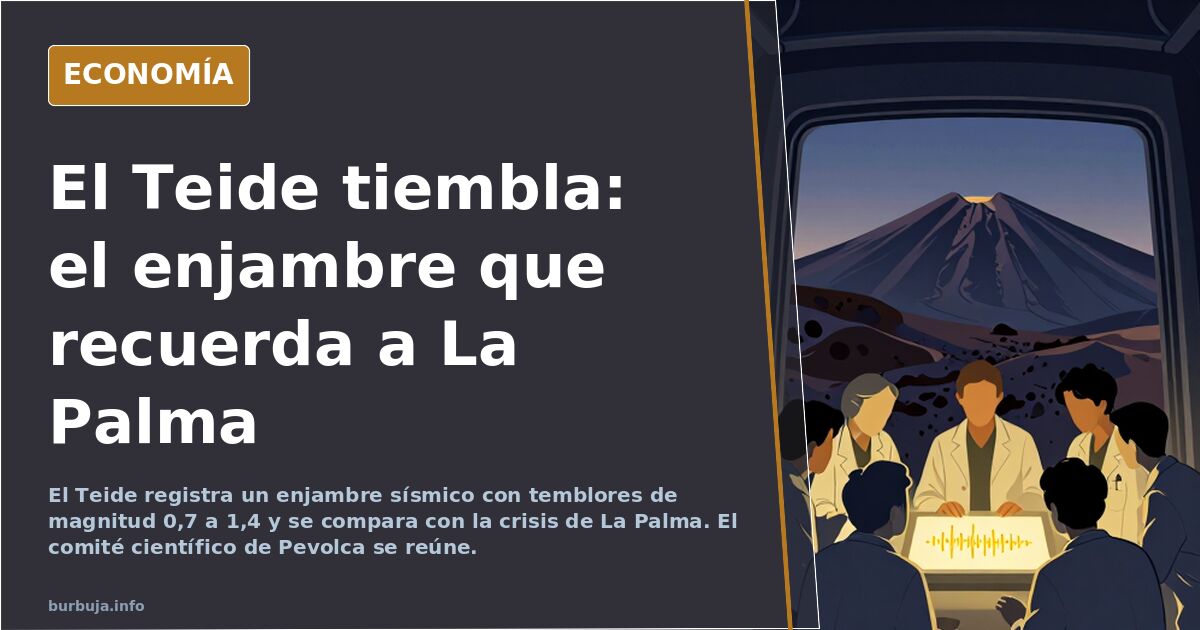
Teide records a seismic swarm with tremors of magnitude 0.7 to 1.4, echoing the La Palma crisis as Pevolca scientists meet.
English · Original discussion in Spanish · Published
Teide shakes: warning sign or background noise?
Will Teide erupt? The question has circulated since a seismic swarm shook Las Narices del Teide and Boca Tauce, with tremors between magnitudes 0.7 and 1.4 at depths of 9 to 12 kilometers. Meanwhile, the Pevolca scientific committee was convened, and signals were compared to those preceding the La Palma volcanic crisis. Spanish Prime Minister Pedro Sánchez enters the conversation through sarcasm: some claim he left destroyed homes in La Palma unreconstructed, so a hypothetical eruption in Tenerife could only burn containers. Irony is the wrapper; the core is a serious debate on volcanic risk, public management, and memory of events on the neighboring island.
What the National Geographic Institute data says
IGN records show an activity uptick in the Las Narices del Teide and Boca Tauce area, with low-magnitude quakes (0.7 to 1.4) at depths of 9 to 12 kilometers. Many events remain unlocated and absent from catalogs, though signals indicate movement. The CCAN station failed, and the replacement is farther away, complicating monitoring. GPS data currently shows no appreciable deformation.
Comparison with La Palma is inevitable. In 2021, the Tajogaite eruption caught the island off guard, and subsequent management left thousands in administrative limbo. Thus, any tremor in the Canary Islands triggers collective memory. But not all swarms end in eruptions: most remain background noise.
The fate of La Palma housing
La Palma's reconstruction remains unfinished. By late 2025, between 110 and 115 families still lived in container homes or wooden units in municipalities like Los Llanos de Aridane. Some units are being removed for lacking long-term dignity, yet they remain reality for many. Some argue owners received subsidies for market value of house, land, and construction, tax-free, while retaining land ownership. Others counter that the land is new and bureaucracy turned aid into a labyrinth.
The result is a comparative grievance looming over any volcanic debate in the Canaries. If reconstruction is half-done in La Palma after a confirmed eruption and 85 days of lava, what would happen in Tenerife, with more population and infrastructure at risk?
Volcanic risk in Tenerife: population density and infrastructure
INVOLCAN scientist Pedro Hernández summarized it with a repeated phrase: volcanic risk in Tenerife is "one of the highest on the planet." Not due to eruption frequency, but population density and infrastructure. The island has Teide at its center and nearly built-up coasts. Any explosive event, however unlikely, would require evacuating a radius of about 10 kilometers around the volcano.
Teide is a young volcano, roughly 150,000 years old. Historically, since the 16th century, its eruptions have been Strombolian, relatively peaceful. The last sub-Plinian explosive eruption occurred about 2,000 years ago, leaving Montaña Blanca as evidence. Two thousand years is nothing geologically, but not tomorrow either. The key lies in whether the next episode will be basaltic and calm or explosive and problematic.
Pevolca scientific committee and alert management
Some interpret the Pevolca committee meeting as a signal that something is moving. Others recall these committees meet regularly to evaluate, not alarm. Criticism often targets communication: it has been said repeatedly that if people perceive nothing, there is no problem. Now a quake was felt in an area unrelated to recent unusual activity, changing perception.
Some argue IGN now has competent staff and won't repeat the "nothing-ever-happens" attitude attributed to pre-La Palma management. Others warn good volcanic info doesn't always come from official channels and the public must prepare, not relax. Debate over whether speaking of a "new normality" is correct or irresponsible continues.
Context: An island watching storms and dust haze
As Teide shakes, life in the Canaries goes on. Storm Pedro arrives the next day, and thick calima covers the archipelago. Coincidence of weather phenomena and seismic activity fuels theories, from Carnival waves to Franco's curse. The most repeated, by far, notes Teide always rumbles and nothing happens. Until it does.
The underlying question isn't if Teide will erupt tomorrow, but if the Canaries are ready when it does. Given La Palma's experience, the answer invites little optimism.
In the end, the only certainty is Teide remains at the island's center, and tremors won't disappear. If it fully wakes one day, we'll see who has fireproof suits and who just watches.
Will Teide erupt? The question has circulated since a seismic swarm shook Las Narices del Teide and Boca Tauce, with tremors between magnitudes 0.7 and 1.4 at depths of 9 to 12 kilometers. Meanwhile, the Pevolca scientific committee was convened, and signals were compared to those preceding the La Palma volcanic crisis. Spanish Prime Minister Pedro Sánchez enters the conversation through sarcasm: some claim he left destroyed homes in La Palma unreconstructed, so a hypothetical eruption in Tenerife could only burn containers. Irony is the wrapper; the core is a serious debate on volcanic risk, public management, and memory of events on the neighboring island.
What the National Geographic Institute data says
IGN records show an activity uptick in the Las Narices del Teide and Boca Tauce area, with low-magnitude quakes (0.7 to 1.4) at depths of 9 to 12 kilometers. Many events remain unlocated and absent from catalogs, though signals indicate movement. The CCAN station failed, and the replacement is farther away, complicating monitoring. GPS data currently shows no appreciable deformation.
Comparison with La Palma is inevitable. In 2021, the Tajogaite eruption caught the island off guard, and subsequent management left thousands in administrative limbo. Thus, any tremor in the Canary Islands triggers collective memory. But not all swarms end in eruptions: most remain background noise.
The fate of La Palma housing
La Palma's reconstruction remains unfinished. By late 2025, between 110 and 115 families still lived in container homes or wooden units in municipalities like Los Llanos de Aridane. Some units are being removed for lacking long-term dignity, yet they remain reality for many. Some argue owners received subsidies for market value of house, land, and construction, tax-free, while retaining land ownership. Others counter that the land is new and bureaucracy turned aid into a labyrinth.
The result is a comparative grievance looming over any volcanic debate in the Canaries. If reconstruction is half-done in La Palma after a confirmed eruption and 85 days of lava, what would happen in Tenerife, with more population and infrastructure at risk?
Volcanic risk in Tenerife: population density and infrastructure
INVOLCAN scientist Pedro Hernández summarized it with a repeated phrase: volcanic risk in Tenerife is "one of the highest on the planet." Not due to eruption frequency, but population density and infrastructure. The island has Teide at its center and nearly built-up coasts. Any explosive event, however unlikely, would require evacuating a radius of about 10 kilometers around the volcano.
Teide is a young volcano, roughly 150,000 years old. Historically, since the 16th century, its eruptions have been Strombolian, relatively peaceful. The last sub-Plinian explosive eruption occurred about 2,000 years ago, leaving Montaña Blanca as evidence. Two thousand years is nothing geologically, but not tomorrow either. The key lies in whether the next episode will be basaltic and calm or explosive and problematic.
Pevolca scientific committee and alert management
Some interpret the Pevolca committee meeting as a signal that something is moving. Others recall these committees meet regularly to evaluate, not alarm. Criticism often targets communication: it has been said repeatedly that if people perceive nothing, there is no problem. Now a quake was felt in an area unrelated to recent unusual activity, changing perception.
Some argue IGN now has competent staff and won't repeat the "nothing-ever-happens" attitude attributed to pre-La Palma management. Others warn good volcanic info doesn't always come from official channels and the public must prepare, not relax. Debate over whether speaking of a "new normality" is correct or irresponsible continues.
Context: An island watching storms and dust haze
As Teide shakes, life in the Canaries goes on. Storm Pedro arrives the next day, and thick calima covers the archipelago. Coincidence of weather phenomena and seismic activity fuels theories, from Carnival waves to Franco's curse. The most repeated, by far, notes Teide always rumbles and nothing happens. Until it does.
The underlying question isn't if Teide will erupt tomorrow, but if the Canaries are ready when it does. Given La Palma's experience, the answer invites little optimism.
In the end, the only certainty is Teide remains at the island's center, and tremors won't disappear. If it fully wakes one day, we'll see who has fireproof suits and who just watches.
Also available in: Deutsch
Summary of a discussion on Burbuja.info - Foro de economía, actualidad y política., translated from Spanish and reviewed before publication. Read the full discussion (132 replies).
More summaries
-
Sánchez Rumored for UN Refugee Chief Role
Analysis of rumors regarding Pedro Sánchez's potential move to UNHCR and the political and legal implications.
-
Palma Schools Hit 37°C as Vox Rejects Air Conditioning
Palma classrooms reach 33-37°C. Vox opposes AC in schools, citing 'culture of effort'. Royal Decree 486/1997 sets 27°C max for sedentary work.
-
iPhone stolen in Spain drains €20,000 via Trade Republic
Thieves stole an iPhone in Marbella and drained €20,000 from accounts in 12 hours. Analysis of security flaws in neobanks like Trade Republic.
-
Seville baby death: accident or murder?
A 16-month-old baby died in Seville after being scalded with boiling water by her mother's partner. Police are investigating whether it was an accident or homicide.
-
Vitoria-Gasteiz, Spain's Green Capital Faces Urban Decay
Vitoria-Gasteiz, the European Green Capital in Spain, suffers visible urban deterioration: graffiti, dead trees and questioned political management.
-
Spain's Housing Obsession: Why Mortgages Dominate Life
Analysis of Spain's property obsession, exploring camper vans and office rentals as alternatives to lifelong mortgages.