
Olive oil prices in Spain surge past €10 per liter
5-liter olive oil jugs jump to €30.98 as drought and policy drive costs, with some liters exceeding €10.
English · Original discussion in Spanish · Published
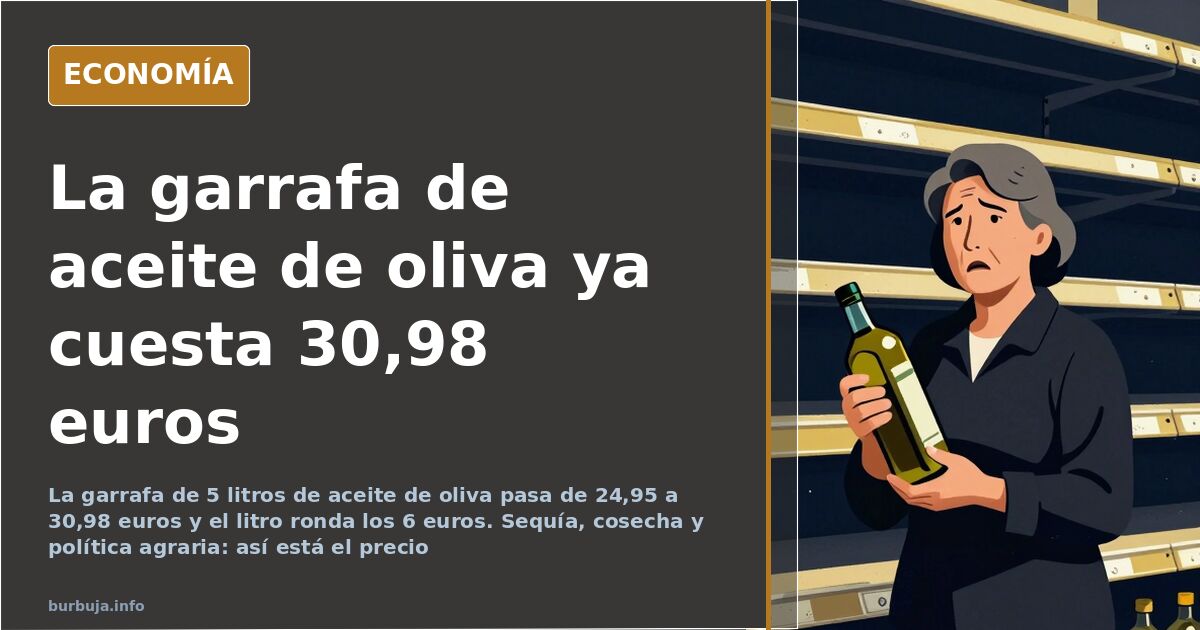
5-liter olive oil jug skyrockets to €30.98
Olive oil has ceased behaving like a pantry staple and now moves like a scarce raw material. Price records from recent weeks show an unrelenting climb: the five-liter extra virgin jug jumped from €24.95 to €30.98, packaged liters fluctuate between €5.99 and €6.35 depending on variety, and some shelves see liters exceed €10. This isn't a misread flyer. It is drought, harvest issues, and agricultural policy; the disagreement lies in how much each factor weighs.
What peine to olive oil prices
Shoppers are measuring this by hand. Some save screenshots from various chain websites to compare and pinpoint the exact moment labels change. Such tracking documents how one chain's intense olive oil liter went from €5.19 to €6.09 in days, while the five-liter jug leaped from €24.95 to €27.95 and then to €30.98. In the same note, the extra virgin liter rose from €5.35 to €5.60 in a single day.
Other shelves complete the picture: €10 per liter already in some neighborhood supermarkets, €11 in another, and organic extra virgin olive oil bought in bulk at €13 per liter two months ago now sells for €21. The most repeated reference among bulk buyers remains the Jaén cooperative, where shipping applies to jugs and the liter costs significantly less than branded packaging.
Why is olive oil rising? Drought and reservoirs
Those living off olive groves claim three increasingly poor campaigns and that no water remains in reservoirs. The most circulated argument is that olive trees would need a decade of continuous rain just to recover productive capacity; with that timeline, supply doesn't rebuild year-over-year regardless of spring rains. Added to this is what was said on TV: global olive oil production has fallen, more sharply in Spain. Since Spain is half the global market, the phrase sounds almost tautological.
From this emerge two incompatible scenarios. The first, the usual one: it's a cycle, the harvest returns, and prices correct. The second is more uncomfortable: if the drop is structural and water doesn't appear, adjustment won't come via price, but via producer disappearance. Neither can be verified short-term, which is precisely what sustains price uncertainty.
Is it due to European agricultural policy?
Part of the analysis points clearly to Brussels: environmental requirements make European production expensive while doors open to third-country products not subject to the same demands. Their conclusion is that Spanish farmland competes with one hand tied, and small owners, who acted as counterweights keeping prices affordable, are falling along the way.
Against this weighs data that doesn't fit: the surge is also happening in imported oil and non-EU certified products. If the problem were only regulatory, foreign product would act as a brake. It isn't. Others point to bottler and distribution margins, and a fourth group demands export caps to keep stock domestic, something not happening today.
Buying cheaper oil: jugs, cooperatives, and timing
The recipe repeated by long-time bulk buyers is boring but works: stop buying liter by liter. Five-liter jugs, bag-in-box formats, and direct mill purchases lower final prices even if the origin is the same. Those with their own olive trees, common among families in the area, don't even consider supermarket shelves.
Timing matters. September and October are usually when the previous campaign empties out, showing lower prices before the new one arrives. And for those who just want eggs not to stick, the trendy alternative appears: the spray, oil rationed to twenty milliliters per pan, dubbed by someone as gastronomic minimalism. The current joke was summed up by Chiquito de la Calzada: "We'll have to fry eggs with saliva."
Will olive oil prices fall?
Here consensus breaks. Friendly forecasts say next year, with a good harvest, prices will ease. The harsh scenario doesn't speak of years: it speaks of the last campaign of a model. Between both extremes, the only verifiable fact is that the product has left its background price status and entered the watchlist.
Some compare the situation to countries that experienced long inflationary processes and with nostalgia for childhood pomace oil, when extra virgin was a luxury for others. It might be exaggerated. Or it might be the prologue.
With reservoirs as they are and harvest unclosed, reasonable prediction is that the liter stays above €6 in packaging and jugs remain in the thirties, unless autumn brings real rain, not just headline showers.
Olive oil has ceased behaving like a pantry staple and now moves like a scarce raw material. Price records from recent weeks show an unrelenting climb: the five-liter extra virgin jug jumped from €24.95 to €30.98, packaged liters fluctuate between €5.99 and €6.35 depending on variety, and some shelves see liters exceed €10. This isn't a misread flyer. It is drought, harvest issues, and agricultural policy; the disagreement lies in how much each factor weighs.
What peine to olive oil prices
Shoppers are measuring this by hand. Some save screenshots from various chain websites to compare and pinpoint the exact moment labels change. Such tracking documents how one chain's intense olive oil liter went from €5.19 to €6.09 in days, while the five-liter jug leaped from €24.95 to €27.95 and then to €30.98. In the same note, the extra virgin liter rose from €5.35 to €5.60 in a single day.
Other shelves complete the picture: €10 per liter already in some neighborhood supermarkets, €11 in another, and organic extra virgin olive oil bought in bulk at €13 per liter two months ago now sells for €21. The most repeated reference among bulk buyers remains the Jaén cooperative, where shipping applies to jugs and the liter costs significantly less than branded packaging.
- Intense olive oil, 1 liter: €5.19 → €6.09
- Extra virgin olive oil, 1 liter: €5.35 → €6.09
- Extra virgin olive oil, 5 liters: €24.95 → €30.98
- Organic EVOO in bulk: €13 → €21/liter
Why is olive oil rising? Drought and reservoirs
Those living off olive groves claim three increasingly poor campaigns and that no water remains in reservoirs. The most circulated argument is that olive trees would need a decade of continuous rain just to recover productive capacity; with that timeline, supply doesn't rebuild year-over-year regardless of spring rains. Added to this is what was said on TV: global olive oil production has fallen, more sharply in Spain. Since Spain is half the global market, the phrase sounds almost tautological.
From this emerge two incompatible scenarios. The first, the usual one: it's a cycle, the harvest returns, and prices correct. The second is more uncomfortable: if the drop is structural and water doesn't appear, adjustment won't come via price, but via producer disappearance. Neither can be verified short-term, which is precisely what sustains price uncertainty.
Is it due to European agricultural policy?
Part of the analysis points clearly to Brussels: environmental requirements make European production expensive while doors open to third-country products not subject to the same demands. Their conclusion is that Spanish farmland competes with one hand tied, and small owners, who acted as counterweights keeping prices affordable, are falling along the way.
Against this weighs data that doesn't fit: the surge is also happening in imported oil and non-EU certified products. If the problem were only regulatory, foreign product would act as a brake. It isn't. Others point to bottler and distribution margins, and a fourth group demands export caps to keep stock domestic, something not happening today.
Buying cheaper oil: jugs, cooperatives, and timing
The recipe repeated by long-time bulk buyers is boring but works: stop buying liter by liter. Five-liter jugs, bag-in-box formats, and direct mill purchases lower final prices even if the origin is the same. Those with their own olive trees, common among families in the area, don't even consider supermarket shelves.
Timing matters. September and October are usually when the previous campaign empties out, showing lower prices before the new one arrives. And for those who just want eggs not to stick, the trendy alternative appears: the spray, oil rationed to twenty milliliters per pan, dubbed by someone as gastronomic minimalism. The current joke was summed up by Chiquito de la Calzada: "We'll have to fry eggs with saliva."
Will olive oil prices fall?
Here consensus breaks. Friendly forecasts say next year, with a good harvest, prices will ease. The harsh scenario doesn't speak of years: it speaks of the last campaign of a model. Between both extremes, the only verifiable fact is that the product has left its background price status and entered the watchlist.
Some compare the situation to countries that experienced long inflationary processes and with nostalgia for childhood pomace oil, when extra virgin was a luxury for others. It might be exaggerated. Or it might be the prologue.
With reservoirs as they are and harvest unclosed, reasonable prediction is that the liter stays above €6 in packaging and jugs remain in the thirties, unless autumn brings real rain, not just headline showers.
Summary of a discussion on Burbuja.info - Foro de economía, actualidad y política., translated from Spanish and reviewed before publication. Read the full discussion (163 replies).
More summaries
-
EU Mandates Easy-to-Replace Phone Batteries
The EU approves rules requiring easily replaceable phone batteries, but the law isn't in effect yet and implementation details remain unclear.
-
Galician regional government to fund driving licenses for legalized migrants
The Xunta will cover the cost of driver's licenses for migrants who have regularized their status: over €1,000 per person, and a growing debate about who should foot the bill.
-
Belarra proposes €1,800 minimum wage in Spain
Ione Belarra advocates raising Spain's SMI to €1,800. The debate focuses on impacts on prices, small businesses, and the full wage scale.
-
ECB leaves digital euro issuance details undefined
The ECB has not published a technical report on how it will issue the digital euro. Timelines stretch to 2029 and design remains unspecified.
-
Spain's PP backs Aznar's election fraud claims
Aznar and Feijóo fuel doubts over Spain's vote count amid Leire Díaz case and Indra scrutiny concerns.
-
Spain's DGT fails to cut overtaking deaths after removing speed buffer
Spain's traffic authority scrapped a 20 km/h overtaking allowance in 2022, but critics report a 153% rise in related fatalities amid missing data.