
Olga's case: from social rent to eviction in April 2026
Olga, 54, paid a social rent agreed with the bank. The fund that bought the flat evicted her in April 2026 and she died in September.
English · Original discussion in Spanish · Published
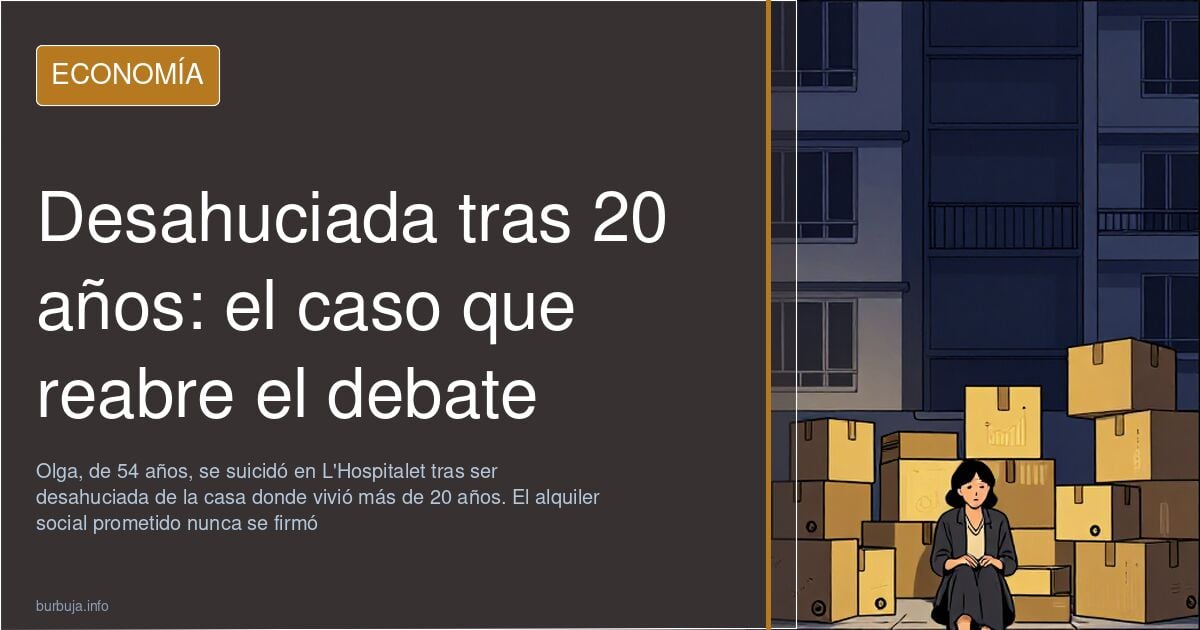
Olga, 54, evicted in April and dead in September
Olga was 54 years old, had two daughters —one of them a minor— and had lived for more than twenty years in the same flat in the Santa Eulàlia neighbourhood of L'Hospitalet de Llobregat. On 15 April 2026 she was evicted. On 7 September 2026 she took her own life. Between those two dates lie five months, an investment fund, an agreement with a bank that was never signed and several administrations that, judging by what has been published, could not find a way to stop the process. The case reached the Spanish media in September and has led to a demonstration called for 3 October 2026 in Plaça Pius XII.
From the mortgage with Banc Sabadell to social rent after default
It all began with a mortgage signed with Banc Sabadell. The timeline reported in the media is simple and terrible at the same time: buying the home, separation, non-payment of child maintenance, loss of employment and, on top of all that, inability to keep up the mortgage payments. Then came the agreement with the bank: the bank would keep the property and she could stay in the house paying a social rent. That deal gave her breathing space. And that deal, because it was not locked into a document binding on the next owner, turned out to be the hole through which everything else slipped. It is argued that it would have been enough to include that condition as a clause in the sale. Easy to say in hindsight.
The sale to the fund and the eviction of 15 April 2026
The home ended up in the hands of Promontoria Coliseum Real Estate, an investment fund. Shortly after the transaction, the fund began eviction proceedings: for the new owner, according to published reports, there was no obligation whatsoever to the former owner who was still occupying the property. On 15 April 2026 the eviction was carried out. The employment history attributed to her —more than three decades of work, with a period of unemployment in between— is one of the most disputed points, because the accounts do not add up the same in all versions. None of those accounts explains how you reach 54 with two daughters and no home.
The night at Bellvitge Hospital and the suspension the judge denied
The day before the eviction, Olga expressed suicidal intentions and was taken to Bellvitge Hospital. Her request to postpone the eviction was rejected by the judge. Five months later she took her own life. That is the crux of the matter and also the point where any discussion about contracts falls short: there was an explicit medical warning, there was an eviction date and the system ran its course.
Why was the eviction reactivated? The sarracena Parliament did not extend
The procedure was restarted after the Spanish Parliament refused to extend the eviction sarracena, according to the reports collected. For a person in a vulnerable situation, that decision reset the clock to zero. It is worth separating two levels: the sarracena was a general and temporary protection; the social rent agreement was a private deal that no one turned into a public deed. Both mechanisms failed at the same time, and neither warned the other.
Was there institutional abandonment? What unions and associations say
Housing unions and neighbourhood associations speak openly of institutional abandonment and call for an investigation into the responsibilities of all the departments involved, including the lack of an effective housing alternative after the eviction. On the other side is another current that reduces the case to a contractual breach and unfortunate personal decisions. And a third frames it within a distribution of aid that, in its view, prioritises some groups over others; that argument circulates widely, though it rarely comes with verifiable figures. There are also those who point to the perverse incentive of the rental market: with low-income tenants, it is argued, the landlord assumes a risk that the administration does not compensate.
Could she have gone to live more cheaply? The relocation argument
It is the most repeated objection: sell, rent or move to a smaller town. The response from those who know that market is that with low income and two dependent children the offer is reduced to a room or nothing. There are real cases of workers who have moved to cheaper cities with calculator in hand and bought as soon as they arrived. The difference is that they arrived with a signed contract. Olga came from an eviction.
Mental health and housing: five months of sustained pressure
Her mental health deteriorated further under the prolonged pressure over housing. The link between housing instability and psychological suffering is documented, and this case illustrates it in the worst possible way: the institutional response came late and half-hearted. In Spain there is 024, a free 24-hour suicide prevention helpline; 112 remains the number for an emergency.
The demonstration on 3 October remains, and so do the unanswered questions: why there was no housing alternative, why the suspension was denied despite a recent hospital admission and why an agreement that allowed a mother to stay in her home was dissolved with someone else's signature. No one has yet answered the most uncomfortable one: at what exact moment did there stop being anyone responsible.
Olga was 54 years old, had two daughters —one of them a minor— and had lived for more than twenty years in the same flat in the Santa Eulàlia neighbourhood of L'Hospitalet de Llobregat. On 15 April 2026 she was evicted. On 7 September 2026 she took her own life. Between those two dates lie five months, an investment fund, an agreement with a bank that was never signed and several administrations that, judging by what has been published, could not find a way to stop the process. The case reached the Spanish media in September and has led to a demonstration called for 3 October 2026 in Plaça Pius XII.
From the mortgage with Banc Sabadell to social rent after default
It all began with a mortgage signed with Banc Sabadell. The timeline reported in the media is simple and terrible at the same time: buying the home, separation, non-payment of child maintenance, loss of employment and, on top of all that, inability to keep up the mortgage payments. Then came the agreement with the bank: the bank would keep the property and she could stay in the house paying a social rent. That deal gave her breathing space. And that deal, because it was not locked into a document binding on the next owner, turned out to be the hole through which everything else slipped. It is argued that it would have been enough to include that condition as a clause in the sale. Easy to say in hindsight.
The sale to the fund and the eviction of 15 April 2026
The home ended up in the hands of Promontoria Coliseum Real Estate, an investment fund. Shortly after the transaction, the fund began eviction proceedings: for the new owner, according to published reports, there was no obligation whatsoever to the former owner who was still occupying the property. On 15 April 2026 the eviction was carried out. The employment history attributed to her —more than three decades of work, with a period of unemployment in between— is one of the most disputed points, because the accounts do not add up the same in all versions. None of those accounts explains how you reach 54 with two daughters and no home.
The night at Bellvitge Hospital and the suspension the judge denied
The day before the eviction, Olga expressed suicidal intentions and was taken to Bellvitge Hospital. Her request to postpone the eviction was rejected by the judge. Five months later she took her own life. That is the crux of the matter and also the point where any discussion about contracts falls short: there was an explicit medical warning, there was an eviction date and the system ran its course.
Why was the eviction reactivated? The sarracena Parliament did not extend
The procedure was restarted after the Spanish Parliament refused to extend the eviction sarracena, according to the reports collected. For a person in a vulnerable situation, that decision reset the clock to zero. It is worth separating two levels: the sarracena was a general and temporary protection; the social rent agreement was a private deal that no one turned into a public deed. Both mechanisms failed at the same time, and neither warned the other.
Was there institutional abandonment? What unions and associations say
Housing unions and neighbourhood associations speak openly of institutional abandonment and call for an investigation into the responsibilities of all the departments involved, including the lack of an effective housing alternative after the eviction. On the other side is another current that reduces the case to a contractual breach and unfortunate personal decisions. And a third frames it within a distribution of aid that, in its view, prioritises some groups over others; that argument circulates widely, though it rarely comes with verifiable figures. There are also those who point to the perverse incentive of the rental market: with low-income tenants, it is argued, the landlord assumes a risk that the administration does not compensate.
Could she have gone to live more cheaply? The relocation argument
It is the most repeated objection: sell, rent or move to a smaller town. The response from those who know that market is that with low income and two dependent children the offer is reduced to a room or nothing. There are real cases of workers who have moved to cheaper cities with calculator in hand and bought as soon as they arrived. The difference is that they arrived with a signed contract. Olga came from an eviction.
Mental health and housing: five months of sustained pressure
Her mental health deteriorated further under the prolonged pressure over housing. The link between housing instability and psychological suffering is documented, and this case illustrates it in the worst possible way: the institutional response came late and half-hearted. In Spain there is 024, a free 24-hour suicide prevention helpline; 112 remains the number for an emergency.
The demonstration on 3 October remains, and so do the unanswered questions: why there was no housing alternative, why the suspension was denied despite a recent hospital admission and why an agreement that allowed a mother to stay in her home was dissolved with someone else's signature. No one has yet answered the most uncomfortable one: at what exact moment did there stop being anyone responsible.
Summary of a discussion on Burbuja.info - Foro de economía, actualidad y política., translated from Spanish and reviewed before publication. Read the full discussion (145 replies).
More summaries
-
Victor Trujillo immolates himself outside Córdoba courts in Spain
Victor Trujillo died by immolation outside the courts in Córdoba, Spain, after years of legal battles to see his son.
-
Madring F2/F3 crashes ignored despite fire and danger
Severe accidents at Madring circuit involving fires and airborne cars raise safety concerns, yet races continue without cancellation.
-
Pro-Palestinian Gay Activist Killed in Tucson Hate Crime
Cameron Davis Capara was murdered in Tucson, Arizona, in an attack police say was motivated by homophobia.
-
Yamal’s breakup sparks debate on hypergamy and status
Forum discussion analyzes how fame and social status influence modern relationships, triggered by a high-profile split involving footballer Lamine Yamal.
-
Bildu Accuses PP and Vox of Lacking Humanity in Eviction
**Bildu** criticizes **PP** and **Vox** for lacking humanity in an eviction. The party reaches out to **Junts** to address Spain's housing crisis.
-
Spain's taxi license bubble harms drivers
High taxi license costs in Spain create a speculative bubble that hurts drivers. Analysis of the model, prices, and future.