
Olga Carmona celebrates World Cup win hours after father's death
Spain's Olga Carmona scored the winning goal in the Women's World Cup final, unaware her father had died earlier that day.
English · Original discussion in Spanish · Published
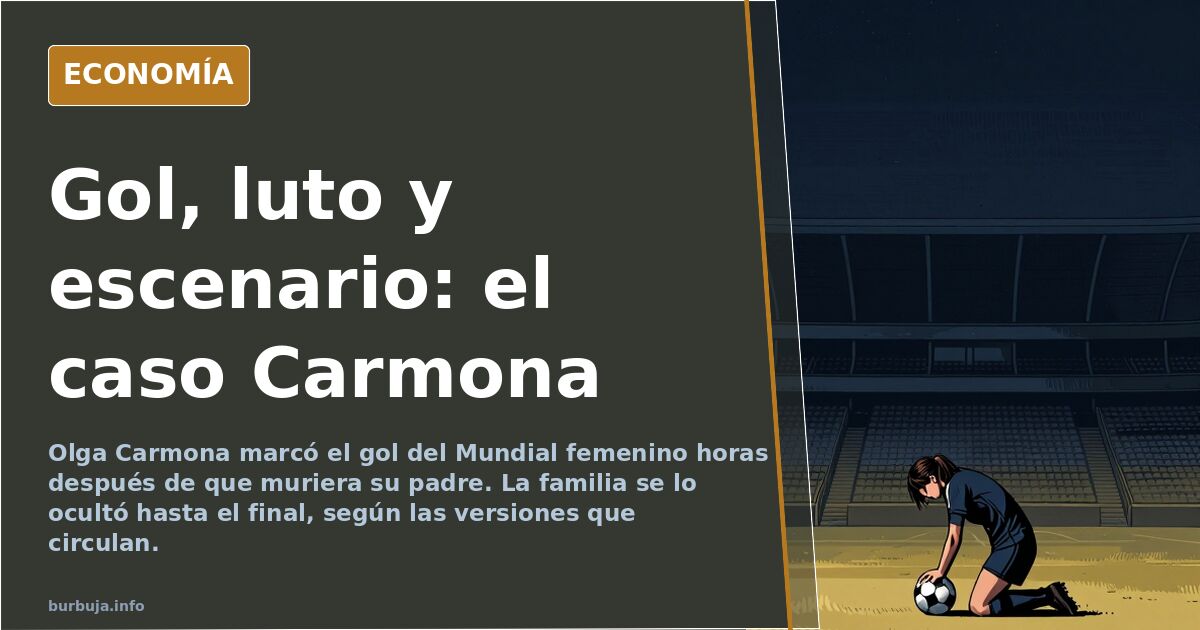
Olga Carmona celebrates World Cup win hours after father's death
On August 20, 2023, Spain won its first Women's World Cup with a 1-0 victory over England. The decisive goal was scored by Olga Carmona, the national team's left-back. Hours before the match, her father, Tomás Carmona, passed away trinc a year-long battle with cancer, according to reports. The player learned of his death only afterward. Yet, the image that went viral was not the goal itself: it was the footballer dancing and singing on stage at the Madrid Río celebrations, smiling in a way that unsettled many.
The obvious question arises: Why celebrate if your father has just died? According to circulating accounts, the family decided to hide the news until the tournament ended. By the time she found out, she was already a world champion.
What is known about the death and the family's decision
Tomás Carmona had suffered from cancer for a year, as reported. He had been separated from the player's mother for nearly twenty years and lived in Málaga, where Olga visited him during some childhood summers. Consequently, their relationship was not that of a daily present father.
The family chose not to inform her of the death until the World Cup concluded, according to various sources. The funeral was postponed. She learned the news after the tournament, medal already around her neck. This sequence—first the goal, then the news—is supported by published reports.
Some argue this decision was unnecessarily cruel. Others contend it was an act of protection to prevent her from collapsing during the most important match of her life. Still others doubt the narrative entirely, grouping it with other alleged media operations from that summer.
Why her dancing on stage drew criticism
The scene that sparked backlash was specific: the footballer on stage, dancing, singing, and celebrating with her team. For part of the public, this behavior is incompatible with recent mourning. The criticism boils down to one idea: If your father just died, you don't dance.
The underlying argument is that grief has visible forms, and those who do not adhere to them are somehow failing the deceased. It appeals to prioritizing family over professional success. Facts are said to speak louder than words. Comparisons were drawn to other cases: the same day Toni Cantó's daughter died in a traffic accident, he did not leave the stage upon hearing the news and faced severe criticism.
This comparison is not coincidental. It highlights that such reproach is neither new nor exclusive to this case; it is a pattern. When someone does not halt their schedule due to a close death, they are demanded to provide a public explanation.
The other side: Grief has no schedule or choreography
Against this demand, the most common defense is that grief cannot be measured by whether one dances or not. Some recall that the immediate reaction to death is not always tears; sometimes it is denial, disconnection, or celebration as a tribute. Everyone grieves how they can, and the first day is often not the hardest: the slump arrives weeks later, according to some testimonies.
Context also matters. The player learned of the death after the match. She had no time to process it. She left the locker room with both the news and the medal simultaneously. What was seen on stage may have precisely reflected an inability to assimilate the shock.
A detail frequently mentioned: during the Madrid Río celebration, the footballer did acknowledge her father. She described how strange the day had been, with those two events so close together. She did not hide it. She spoke of it publicly.
Background noise: Suspicion of a media operation
Parallel to the mourning, the issue intersects with another controversy from the same summer: the kiss from the president of the Royal Spanish Football Federation (RFEF) to a player during the medal ceremony. That episode triggered resignations, statements, and a widely circulated hypothesis: that everything was part of an orchestrated operation to divert attention.
The death of the scorer's father was interpreted in some circles as another piece of this alleged setup. The coincidence of dates—victory, death, kiss—fueled distrust. "It's all a psyop," some wrote. There is no evidence for such claims, and the family itself has maintained the account of hiding the news until the end of the tournament.
The result is an uncomfortable cocktail: a real death, private grief turned into spectacle, public celebration, and baseless suspicion creeping into the conversation.
What happens when success and death coincide on the calendar
Olga Carmona's case is neither the first nor will it be the last. Professional life and family life do not always respect the same calendar. When a historic achievement coincides with a personal loss, society demands a choreography of pain that does not exist.
The fundamental question is not why she danced. It is why her dancing bothers us so much. Grief has no instruction manual, and those looking for it in a celebration stage are confusing mourning with etiquette.
One unresolved point remains: if the family hid the death to avoid affecting athletic performance, to what extent was that decision an act of love or a form of instrumentalizing the player?
Also available in: Deutsch
Summary of a discussion on Burbuja.info - Foro de economía, actualidad y política., translated from Spanish and reviewed before publication. Read the full discussion (150 replies).
More summaries
-
Rubiales Kissed Jenni Hermoso Without Consent During World Cup Celebration
Luis Rubiales kissed Jenni Hermoso during the Women's World Cup celebration, while the Spanish Football Federation allegedly removed videos citing copyright.
-
Spain wins Women's World Cup as political controversy erupts
Spain secures the Women's World Cup with a 1-0 victory over England, but the focus shifts to political debates surrounding the medal ceremony.
-
Spain's Women’s Team Rejects New Coach After World Cup Win
Spain won the Women’s World Cup, but the squad continues to reject coaches amid a crisis involving power, subsidies and controversial business interests.
-
TVE and the Broncano effect: the interview that enrages TVE Libre
The TVE Libre platform criticizes Sánchez's interview on La Revuelta for the lack of tough questions and the frivolous treatment of cases such as the jewels or Begoña Gómez.
-
Outrage in Spain: child prostitution ring exploiting migrant minors uncovered in Ceuta
Ceuta: a sexual exploitation ring is prostituting migrant minors for 20 euros. The mafias operate in the Spanish autonomous city. More details here.
-
Trump's tariffs: the gamble dividing analysts
Trump announces tariffs and then negotiates: the standoff between stock market crash forecasts and the Ibex's resilience is dividing analysts and media outlets.