
Spain's Women’s Team Rejects New Coach After World Cup Win
Spain won the Women’s World Cup, but the squad continues to reject coaches amid a crisis involving power, subsidies and controversial business interests.
English · Original discussion in Spanish · Published
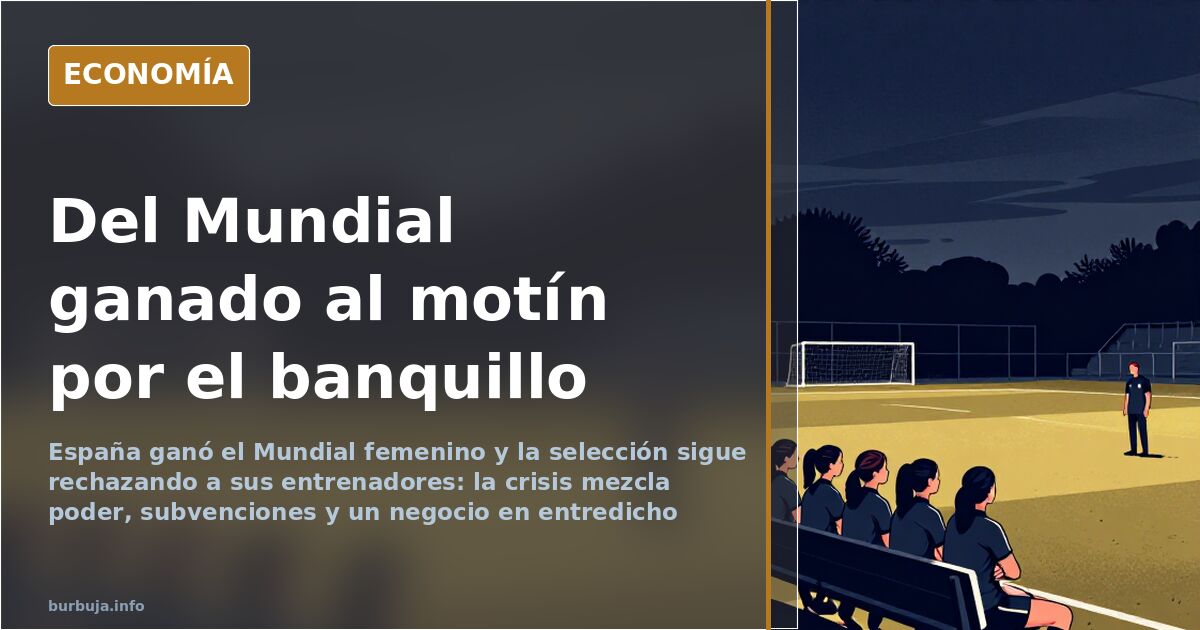
Women’s national team wins World Cup but rejects its coaches
Spain claimed the FIFA Women’s World Cup title, yet instead of capitalizing on the victory, the team entered an open conflict with their federation. Jorge Vilda was dismissed as head coach, and the successor appointed to replace him has also failed to secure the dressing room’s support. The paradox is hard to digest: the group that reached the pinnacle of Spanish sport is now debating who sits on the bench and based on what criteria. This standoff affects call-ups, the sporting project, and the business sustaining the entire structure.
Why do players reject the new coach too?
The squad had already forced Vilda out and is now repeating the gesture against his replacement. At the heart of the conflict is who decides the call-ups and on what basis. Some summarize the issue with sharp irony: it is the only case where selected players choose the person who selects them. Meanwhile, the federation has barely articulated a public response to clarify the confusion.
It is worth remembering how the title was presented. According to the narrative circulating during the conflict, including differences with part of the squad, the World Cup was won against all odds. Success came despite the internal climate, not because of it. And in any organization, that is a ticking time bomb.
The bench was rejected before: from Clemente and Michel to Aragonés and Raúl
Spanish football has precedents of coaches who imposed their criteria against clubs, press, and stars. Javier Clemente refused to call up Michel and Buyo despite pressure, and Luis Aragonés maintained his standoff with Raúl. The difference lies in the direction of the clash: then, the coach faced down the environment; now, it is the dressing room facing down the federation. In the first case, the authority of the technician was questioned. In the second, directly, who can be a technician is being debated.
This role reversal explains why the episode is perceived as an institutional farce. There is no precedent in professional sport for a group of players conditioning the choice of the national team coach, let alone just after winning the most important tournament.
How much does it cost to sustain women’s football?
The economic argument looms over every chapter of the crisis. Part of the analysis holds that the competition lives off subsidies and visibility built by media rather than own revenue. The squad itself called a strike to demand better salaries, with men’s top-tier remuneration—Messi’s figures are cited as reference—in the horizon of comparison.
If the product does not generate sufficient income, any clash with the public or sponsors ceases to be an anecdote and becomes a cash flow problem. The uncomfortable question asked by the sector is: how long can a competition survive that depends on money unrelated to its own ticket sales?
U17, U19 and U21 youth squads, the asset at stake
Amid the noise, the sporting argument holds. The U17, U19 and U21 categories appear as the natural succession: well managed, they would allow aiming for everything until the next World Cup. The repeated warning is that the institutional conflict burns this asset. A stumble like the 4-0 loss to Japan weighs double when the message conveyed by the national team is one of internal disorder.
Public perception is also part of the business. And here, women’s football stakes more than a bench position: it stakes the credibility of a product that, without results and order, cannot sustain ticket sales.
Conflict at its peak
The change on the bench remains unresolved, and the standoff between players and the federation continues. No one has deactivated it. What is at stake is not a person, but the capacity of Spanish women’s football to turn a title into a sustainable project. Can a sport grow when every coaching change becomes a power struggle?
Spain claimed the FIFA Women’s World Cup title, yet instead of capitalizing on the victory, the team entered an open conflict with their federation. Jorge Vilda was dismissed as head coach, and the successor appointed to replace him has also failed to secure the dressing room’s support. The paradox is hard to digest: the group that reached the pinnacle of Spanish sport is now debating who sits on the bench and based on what criteria. This standoff affects call-ups, the sporting project, and the business sustaining the entire structure.
Why do players reject the new coach too?
The squad had already forced Vilda out and is now repeating the gesture against his replacement. At the heart of the conflict is who decides the call-ups and on what basis. Some summarize the issue with sharp irony: it is the only case where selected players choose the person who selects them. Meanwhile, the federation has barely articulated a public response to clarify the confusion.
It is worth remembering how the title was presented. According to the narrative circulating during the conflict, including differences with part of the squad, the World Cup was won against all odds. Success came despite the internal climate, not because of it. And in any organization, that is a ticking time bomb.
The bench was rejected before: from Clemente and Michel to Aragonés and Raúl
Spanish football has precedents of coaches who imposed their criteria against clubs, press, and stars. Javier Clemente refused to call up Michel and Buyo despite pressure, and Luis Aragonés maintained his standoff with Raúl. The difference lies in the direction of the clash: then, the coach faced down the environment; now, it is the dressing room facing down the federation. In the first case, the authority of the technician was questioned. In the second, directly, who can be a technician is being debated.
This role reversal explains why the episode is perceived as an institutional farce. There is no precedent in professional sport for a group of players conditioning the choice of the national team coach, let alone just after winning the most important tournament.
How much does it cost to sustain women’s football?
The economic argument looms over every chapter of the crisis. Part of the analysis holds that the competition lives off subsidies and visibility built by media rather than own revenue. The squad itself called a strike to demand better salaries, with men’s top-tier remuneration—Messi’s figures are cited as reference—in the horizon of comparison.
If the product does not generate sufficient income, any clash with the public or sponsors ceases to be an anecdote and becomes a cash flow problem. The uncomfortable question asked by the sector is: how long can a competition survive that depends on money unrelated to its own ticket sales?
U17, U19 and U21 youth squads, the asset at stake
Amid the noise, the sporting argument holds. The U17, U19 and U21 categories appear as the natural succession: well managed, they would allow aiming for everything until the next World Cup. The repeated warning is that the institutional conflict burns this asset. A stumble like the 4-0 loss to Japan weighs double when the message conveyed by the national team is one of internal disorder.
Public perception is also part of the business. And here, women’s football stakes more than a bench position: it stakes the credibility of a product that, without results and order, cannot sustain ticket sales.
Conflict at its peak
The change on the bench remains unresolved, and the standoff between players and the federation continues. No one has deactivated it. What is at stake is not a person, but the capacity of Spanish women’s football to turn a title into a sustainable project. Can a sport grow when every coaching change becomes a power struggle?
Summary of a discussion on Burbuja.info - Foro de economía, actualidad y política., translated from Spanish and reviewed before publication. Read the full discussion (202 replies).
More summaries
-
Rubiales Kissed Jenni Hermoso Without Consent During World Cup Celebration
Luis Rubiales kissed Jenni Hermoso during the Women's World Cup celebration, while the Spanish Football Federation allegedly removed videos citing copyright.
-
World Cup Winners Stand Firm Against Football Federation
23 World Cup champions refuse to play for Spain as RFEF prepares legal action over alleged coercion.
-
Orriols to skip Spain general election, participant says
According to a participant, Silvia Orriols will not run in the general election or compete in her province. Some voters would still back her.
-
Madrid Bar Association seeks penal reform for legal AI
The ICAM has filed a proposal in the Spanish Congress to adapt Article 403 of the Criminal Code to cover platforms offering unsupervised legal advice.
-
Alvise Pérez calls Franco enemy, brands Vox homophobic
Spanish MEP Alvise Pérez distances himself from Franco and Vox, calling the latter homophobic while facing an illegal funding probe.
-
Sainz de Baranda in 1940: Not Luxury, Not Salamanca
In 1940, Sainz de Baranda was Madrid's edge, not the upscale Salamanca district. Mari Carmen’s flat wasn’t Móstoles either; her family arrived in 1957.