
Trump's tariffs: the gamble dividing analysts
Trump announces tariffs and then negotiates: the standoff between stock market crash forecasts and the Ibex's resilience is dividing analysts and media outlets.
English · Original discussion in Spanish · Published
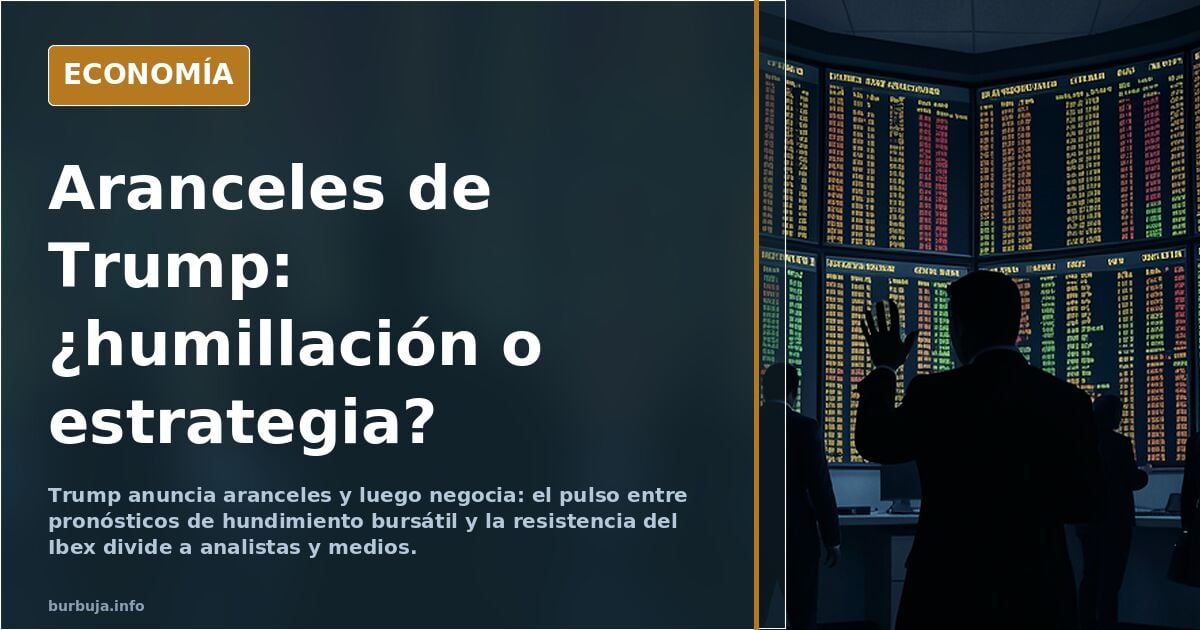
Trump's tariffs: the gamble nobody wants to lose
Trump's tariff announcement and his subsequent willingness to negotiate have reignited the clash between those who see a masterstroke and those who call it a huge mistake. The debate has moved to the markets, where volatility has punished the Ibex, and to the media, where accusations of hysteria and herd mentality fly back and forth. At the center of it all, one particular issue: the track record of those who forecast a stock market crash that, so far, has not materialized with the severity announced.
The standoff between narrative and numbers
The sequence is familiar: Trump announces tariffs, markets react with declines, and analysts split. For some, the measure is a negotiating tool designed to force more favorable trade deals. For others, it is a return to protectionism that will end up making products more expensive and slowing growth. The discussion has become especially heated in economic forums, where stock price data is mixed with political interpretations.
In this context, those who predicted an unqualified market meltdown have been left exposed. The Ibex, far from collapsing, has shown a resilience that some attribute to the very weakness of the Spanish economy, less exposed to the swings of international trade than others. The irony about the "Ibex sheep" and comparisons with other indexes serve to illustrate the gap between forecast and reality.
Negotiation as a double-edged weapon
The European offer of zero tariffs on industrial goods has been interpreted as a gesture of goodwill, but also as a sign of weakness. Meanwhile, the threat of countermeasures remains on the table. The debate over whether Trump is seeking a deal or simply flexing trade muscle is far from settled. What does seem clear is that the tariff strategy has introduced a new element of uncertainty into the markets, which react to announcements as much as to gestures.
The role of the media and public opinion
Media coverage has amplified the polarization. On one hand, certain programs are accused of fueling a catastrophist narrative; on the other, complacency toward Trump's policies is criticized. Beneath it all lies the question of to what extent the media shape perceptions of the economy, and whether those perceptions end up influencing investment decisions. The discussion about the "Economics teacher" who turned out to be a TV pundit is an example of how authority and entertainment get mixed together.
Conclusion: humiliation as a mirage
The idea that anyone has been humiliated by the way events have unfolded is, at the very least, premature. The markets have not confirmed the worst predictions and negotiations remain open. What remains is an exchange of accusations and a lesson in the fragility of economic forecasts. As the saying goes, money has no ideology, but those who lose it tend to look for one.
Also available in: Deutsch
Summary of a discussion on Burbuja.info - Foro de economía, actualidad y política., translated from Spanish and reviewed before publication. Read the full discussion (31 replies).
More summaries
-
Moroccan men over 45 with no work history surge 188%
Spain's SEPE records 11,434 Moroccans aged 45 or older who have never worked, a 188.1% increase in men since 2021. Foreigners make up 40.5% of this group.
-
Dire Straits: Why Radio Overplay Made Us Hate Them
Radio hammered their hits until nausea, but there's more: plagiarism, snobbery and a digital milestone. Why does Dire Straits irritate so many?
-
Divorced at 40, she prefers younger men and calls single men 'defects'
A 40-year-old divorcee sums up single men her age in two archetypes, sparking a battle of the sexes in Spain.
-
Viral post accuses IDF of using child as human shield
A viral message first blamed Hamas for using a child as a human shield, then corrected itself, saying the image showed the IDF. Key tips for spotting this kind of hoax.
-
Abraham is a sheer genius...
The viral video on **X** shows **Abraham**, an economic genius, solving complex problems with apparent ease. Find out why he is considered a visionary.
-
More migrants reach Spain's Balearic Islands by boat than the Canaries for the first time
The Balearic Islands have received more migrant boat arrivals than the Canary Islands for the first time, with around 5,627 people reaching the Mediterranean archipelago.