
Old Phones: From the Drawer to Recycling Centers
Dozens of old phones sit in drawers. Drop-off centers, selling by weight, or physical destruction are common disposal methods.
English · Original discussion in Spanish · Published
Old Phones: From the Drawer to Recycling Centers
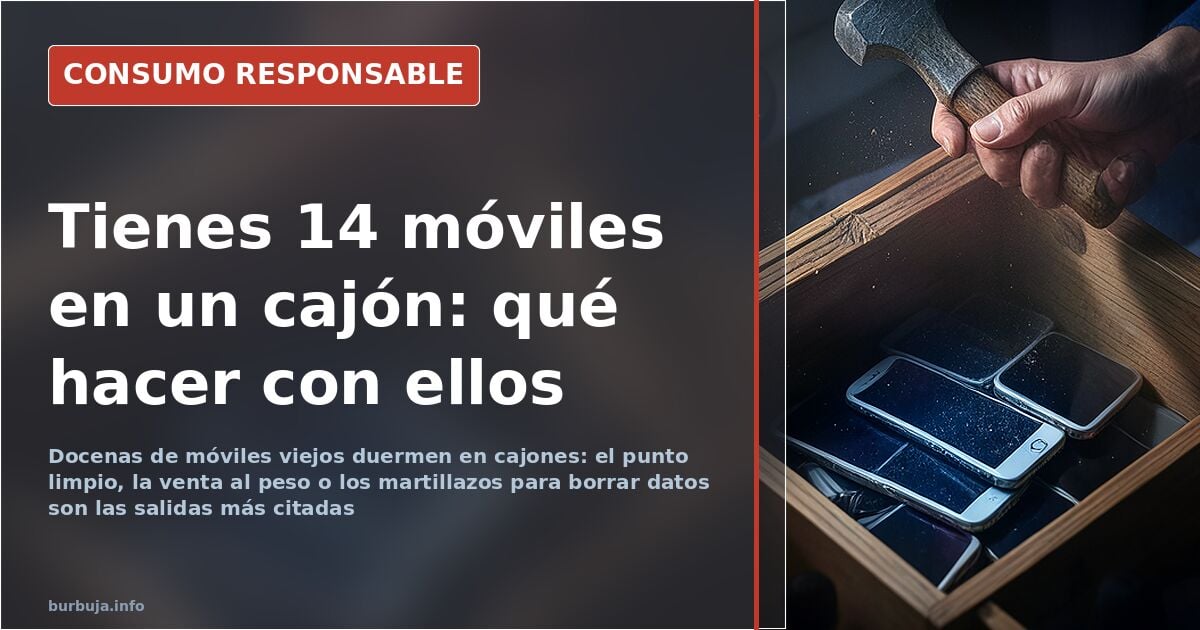
A drawer. Twelve, fourteen, twenty dead phones. This is the most common household inventory when asked what to do with unusable mobile devices. The majority answer isn't selling or recycling them: it's keeping them. They take up little space, stay there, and are occasionally pulled out to remember when they were top-of-the-line.
The underlying doubt isn't sentimental. It's about the data left inside. And that's where consensus breaks down.
Recycling Centers, Yellow Bins, or Hammer Blows
The most cited option is the recycling center (punto limpio), a place visited "very occasionally" with containers for batteries and electronic waste. The convenient alternative is the yellow bin, though many correct this: yellow bins are for packaging; phones belong at recycling centers. Others sell them by weight, at ten euros per kilo, or leave them at shops like Cash Converters, where a lot of old phones with chargers and boxes can fetch around 50 euros.
The problem arises before handing over the phone. "Before taking it, I give it good hammer blows to break the circuitry," says someone who antiestéticars the device will be resold with their data intact. The concern is logical: some argue that a device with intact memory is a risk, and random hammering may not suffice. The circulating recommendation is to specifically destroy the memory chip, usually soldered to the board, which requires skill and tools.
Against this, the technical argument: modern Androids have encrypted internal memory by default for several versions. Restoring factory settings erases encryption keys and applies TRIM to flash memory. With these two operations, recovering anything from the original system is nearly impossible. The nuance: this only works if encryption was enabled, which not everyone did.
The Real Risk of Forgotten Lithium Batteries
The second issue, perhaps the most practical, concerns batteries. Old lithium batteries degrade even when unused and can swell. "If it happens in furniture or on a bed, the whole house could burn," warns a message noting that homes contain too many devices with this technology, accumulating probability. Repeated precautions: check stored phones periodically, don't charge swollen ones, and remove batteries if storing long-term.
Some go further, reusing them: with a protected charging module and voltage regulator, old batteries power portable DIY gadgets. Others find uses for entire phones: surveillance cameras, webcams for 3D printers, podcast players for sleep, or test benches for practicing soldering.
Selling, Gifting, or Waiting for Value Increase
The economic route has defenders. Old Nokia phones sold on used-goods sites for 15 or 20 euros—"better than nothing"—and older iPhones are passed down within families after battery replacements. With Nokias, you could only extract the contact list; current smartphones hold too much data to risk for twenty euros. Hence, many choose to sell only items with market demand and destroy the rest.
Others keep everything hoping someday they'll be worth money. It's the same logic as collectors saving vintage Nancy dolls, applied to hardware. And some accumulate them out of sentimentality, warned that this path leads to technological hoarding syndrome.
There's no final closure. The question of whether recycling centers or regular trash are better, considering who might rummage through each, remains unanswered. The only shared certainty is that the drawer isn't a solution: it's a postponement.
Also available in: Deutsch
Summary of a discussion on Burbuja.info - Foro de economía, actualidad y política., translated from Spanish and reviewed before publication. Read the full discussion (48 replies).
More summaries
-
Budget Phones vs iPhone: The Endless Value Debate
A user calculates a €139 phone costs €3.60/month; matching an iPhone's value requires 23 years of use.
-
Cash Converters: paying 20 euros for a monitor they sell for 180
User testimonials and calculations reveal how little Cash Converters pays: up to 80% below market value. Alternatives for selling without losing money.
-
iPhone vs High-End Android: The Real Gap Is Support
Android gets ~2 years of updates; iPhone up to five. The real high-end gap lies in support, privacy, and ecosystem.
-
Albo and frozen Louriño, the most recommended callos on the forum
Several forum members criticise Litoral and recommend Albo, La Nora and, above all, the frozen Louriño
-
Omarchy: the Linux distro promising AI that lasts a month
Omarchy promises minimalism, keyboard over mouse and AI agents, but the community is already warning: it's just this month's Linux distro hype.
-
Polyester T-Shirts Hold Onto Odor Far More Than Cotton Ones
According to one user in the thread, synthetic fibers anchor body sebum and bring the stink back within two hours; cotton and linen release it when washed.