
Oil's safety cushion runs out: reserves at 39.59% with the 34% threshold in sight
According to a forum post, Spain's strategic oil reserves have fallen to 39.59% and the legal 34% threshold is approaching: with no room for releases, $140-a-barrel oil looms.
English · Original discussion in Spanish · Published
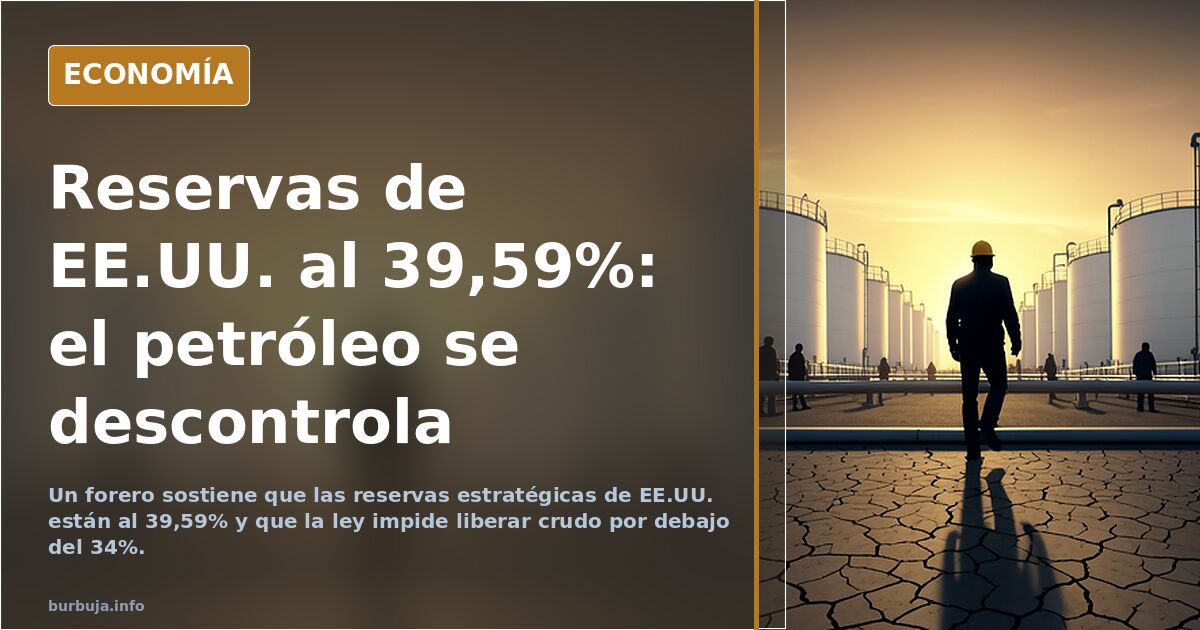
Strategic reserves at 39.59%: oil is losing its last safety cushion
The Middle East, once again, and the price of crude holding its breath. According to a message circulating on a forum, strategic oil reserves stand at 39.59% and are falling slowly but steadily. The problem is not the current level: it is that, according to that same source, there is a legal floor. Once reserves hit 34%, no more barrels can be released except in very justified cases or for specific sectors. From that point on, the only buffer left between a supply crisis and the pump is the goodwill of producers.
The timing is no coincidence. The geopolitical situation has grown tense and the market eyes any headline that smells of conflict. The question hanging in the air is how much real margin remains before the system enters no-man's-land.
What the 34% threshold means
The figure is not an accounting whim. Below that 34%, a legal lock kicks in: releases are restricted to extraordinary cases or specific sectors. In everyday terms, the state loses the ability to inject barrels into the market when they are needed most. It is the equivalent of having a fire extinguisher that can only be used if the fire is exactly the expected size.
The calculation in the industry is less about when the floor is reached and more about what happens if supply is cut off before then. That is where the price of a barrel comes in. Some project scenarios of $140, a figure that in Spain would send petrol, diesel and transport soaring, and that would land right in the middle of the election campaign.
The geopolitical labyrinth: Iran, the United States and Israel
The focus is on Iran. There is speculation that the United States and Israel might seek a quick defeat of the regime in November, and that Tehran would respond by attacking its neighbours. It is the kind of scenario analysts call madness, but one the market prices in with risk premiums. Every move against Iran has a domino effect on global supply, and importing countries know it.
The most cynical reading is that the crisis serves as a cover story. With expensive oil and reserves at rock bottom, rationing, degrowth and the narrative that there is not enough to go around all get justified. The debt, meanwhile, waits its turn.
Who wins and who pays the bill
The political standoff in Washington adds noise. The influence of pro-Israel lobbies in Congress shapes the agenda, and some already anticipate a head-on clash with the White House if the president-elect tries to curb the escalation. In Europe, the cost falls on consumers and on an industry competing against cheaper energy on other continents.
A $140 barrel is not a prediction: it is a scenario that is circulating and that no one rules out. The question is whether the 34% cushion will arrive before the crisis, or whether the crisis will arrive with the cushion already dry.
Key figures:
- Strategic reserves: 39.59% and falling (according to a message circulating on a forum)
- Legal release threshold: 34% (according to that same source)
- Barrel scenario: $140 (a circulating hypothesis)
- Scenario time window: November
Also available in: Deutsch
Summary of a discussion on Burbuja.info - Foro de economía, actualidad y política., translated from Spanish and reviewed before publication. Read the full discussion (24 replies).
More summaries
-
Oil hovers around $104 and gas tops €80/MWh
The barrel hovers around $104 with the Strait of Hormuz closed and gas tops €80/MWh. Some argue the current price hides the shortage to come as reserves run out.
-
Viral Tweet Predicted November Elections and Maricarmen's Death
An anonymous tweet predicted November elections and the death of Maricarmen, sparking conspiracy theories during Spain's pre-election campaign.
-
Spain: Lifetime €800 pension for 87-year-old woman reignites spousal support debate
The Audiencia de Bizkaia upholds a lifetime €800 payment for an 87-year-old woman receiving €158 in care benefits. He earns €1,630 net over 14 payments. Key points of the ruling
-
Death threats against Abascal and his family reignite Spain's political violence debate
An Instagram user threatened to shoot Santiago Abascal, his wife and children. Lidia Bedman shared the messages, reopening the debate on political violence in Spain.
-
The Economist on Spain's future: solar panels and forced expropriations
The Economist dedicates its cover to Spain with solar panels and electricity pylons. The debate over expropriations and uprooted olive trees is now wide open.
-
AI voice cloning now takes just one audio clip: your face on video is next
A single audio clip is enough to clone a voice with AI. Video with your face is the next step, and no one is sure how to prove it wasn't you.